




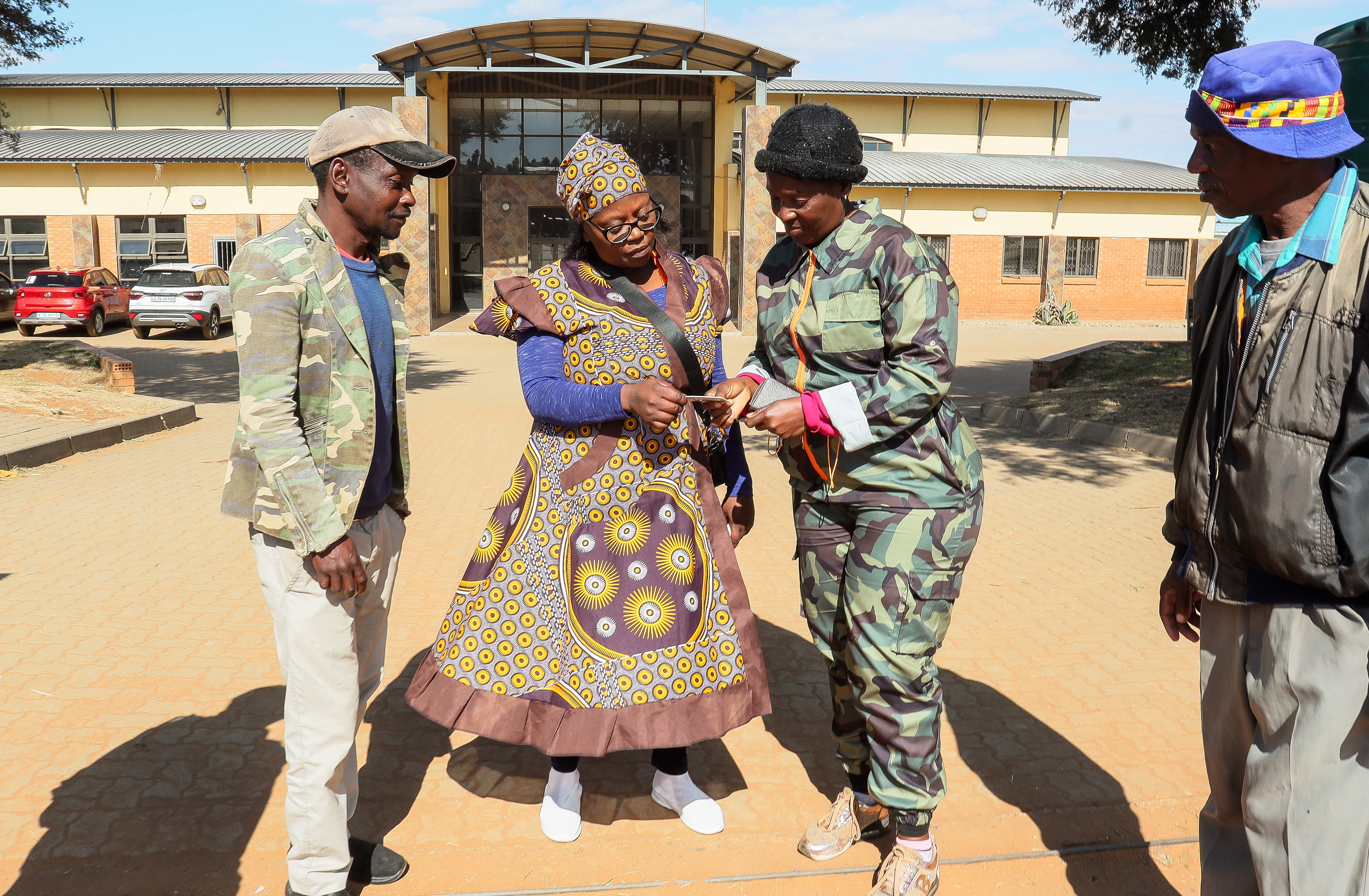
 Operation Dudula members outside Braamfischer Clinic checking the passports and IDs of migrant nationals on July 16, 2025 in Soweto, South Africa. It is alleged that Operation Dudula has been turning away foreign nationals from accessing health care services from public clinics. (Photo: Gallo Images/Fani Mahuntsi)
 The NGO Collective Voices for Health Access launched a civil society consensus statement on “Access to Healthcare for All in South Africa” and an educational booklet on “Your Right to HealthCare in South Africa” on 9 December.
This comes after foreign nationals were reportedly charged for chronic medication at Gauteng clinics, while some were denied medication.
At the launch, Marlise Richter, a member of Collective Voices for Health Access, played an audio of Flora (not her real name), who lives in Johannesburg and is struggling to access healthcare at her local clinic because she is a foreign national.
Flora has been in South Africa since 2013. In 2019, she tested HIV-positive and started taking ARV medication.
On 29 October, Flora went to her usual clinic to receive her medication, but was not assisted after Operation Dudula members asked her to produce a South African identity document, which she was unable to do.
In the second week of November, Flora returned to the clinic to try to get her medication, and the same Operation Dudula members barred her access.
She explained that she had been coming to the clinic since 2019, but they still refused to allow her in.
Flora said a staff member at the clinic offered to help.
“I asked her if I should go inside with her to the clinic, but [she] said no. I gave her my appointment card to check the records because I told her I was supposed to come on 29 of October.”
However, the clinic worker said she could only help Flora for R200.
“I had to buy my medication from her, and my main worry is that I cannot afford to buy ARVs every month, and R200 is expensive. I can’t afford it,” she said.
“My life is at risk, and I am very worried and so stressed.”
Mike Ndlovu from Kopanang Africa against Xenophobia (Kaax), said that despite recent court rulings, xenophobic groups were still barring patients’ access to clinics and that nurses and security guards were working hand in hand with these groups.
Ndlovu said Operation Dudula members were at a Rosettenville clinic this week and were chased away by the police. When the police left, they came back again.
Read more: Court orders authorities to act against anti-migrant harassment at hospitals and clinics
“I think it has become their side-hustle in terms of making money,” said Ndlovu.
Flora said that she hoped someone would come to her aid because she needed to collect another regimen of medication on 12 December.
Collective Voices
“Health is a human right for all,” said Richter.
She said the Collective Voices for Health Access coalition was formed in August 2022 — it was originally called Collective Voices Against Health Xenophobia — and consisted of more than 60 organisations and individuals.
The coalition challenged attempts to target and exclude foreign nationals from accessing healthcare as guaranteed under section 27 of the Constitution, and other practices defined as health xenophobia and discrimination.
It commissioned a research report to understand the history of civil society responses to xenophobia and to think strategically about what could work in the future.
The report highlighted the importance of collaboration and partnerships, saying that local organising and strong community networks were essential to counter xenophobia.
The consensus statement
The coalition’s consensus statement on access to healthcare points out the obligations of the state and the provisions within the Constitution of access to healthcare.
“This consensus statement makes it very clear that we believe it is unlawful and unethical to refuse care. This will be a living document, and we will encourage people to sign the statement to join in advocacy,” said Richter.
The coalition’s booklet, Your Right to Healthcare in South Africa, is a guide that explains what the Constitution guarantees in terms of healthcare and what services citizens are entitled to.
Coalition member Rebecca Walker said the booklet was a practical tool for the right to healthcare, and it applied to everybody: cross-border migrants, internal migrants, South African citizens and South Africans without documentation.
The booklet turns constitutional language into everyday instructions.
“We want to make it much harder for discrimination to hide behind policy confusion and claims by making the law visible and usable,” said Walker.
Solutions to combat medical xenophobia
Ndlovu said Kaax would work closely with the SA Human Rights Commission (SAHRC) to monitor clinics that were still facing issues, and would demand accountability.
“And we have launched monthly Zoom webinars to do a build-up for an upcoming march against xenophobia,” he said.
Constitutional obligation
Sandra Makoasha from the SAHRC said most complaints of medical xenophobia were from Gauteng and KwaZulu-Natal.
“Our work as the commission has to focus on holding the state accountable for its constitutional obligation to ensure unhindered access to health in facilities and addressing the unlawful conduct of vigilante groups,” said Makoasha.
The commission wrote to the minister of health, the Gauteng MEC of health, the national police commissioner and the Gauteng provincial commissioner on 25 July about medical xenophobia, and had still not received any response.
“If the MEC of health is not responding to the Chapter 9 institution, what about the organisations that are trying to ensure that we protect the rights of those who are vulnerable?”
Monwabisi Mabasa from the Treatment Action Campaign said that equitable access to healthcare was a fundamental human right.
Mabasa said the campaign has been delivering medicine to people’s homes and partnered with a directorate of the Gauteng Department of Health to facilitate this.
The campaign will also monitor hospitals in Gauteng to ensure they are complying with the recent court orders prohibiting xenophobic actions.
“We are committed to ensuring that nobody’s human rights are being violated regardless of who that person is,” said Mabasa. DM