




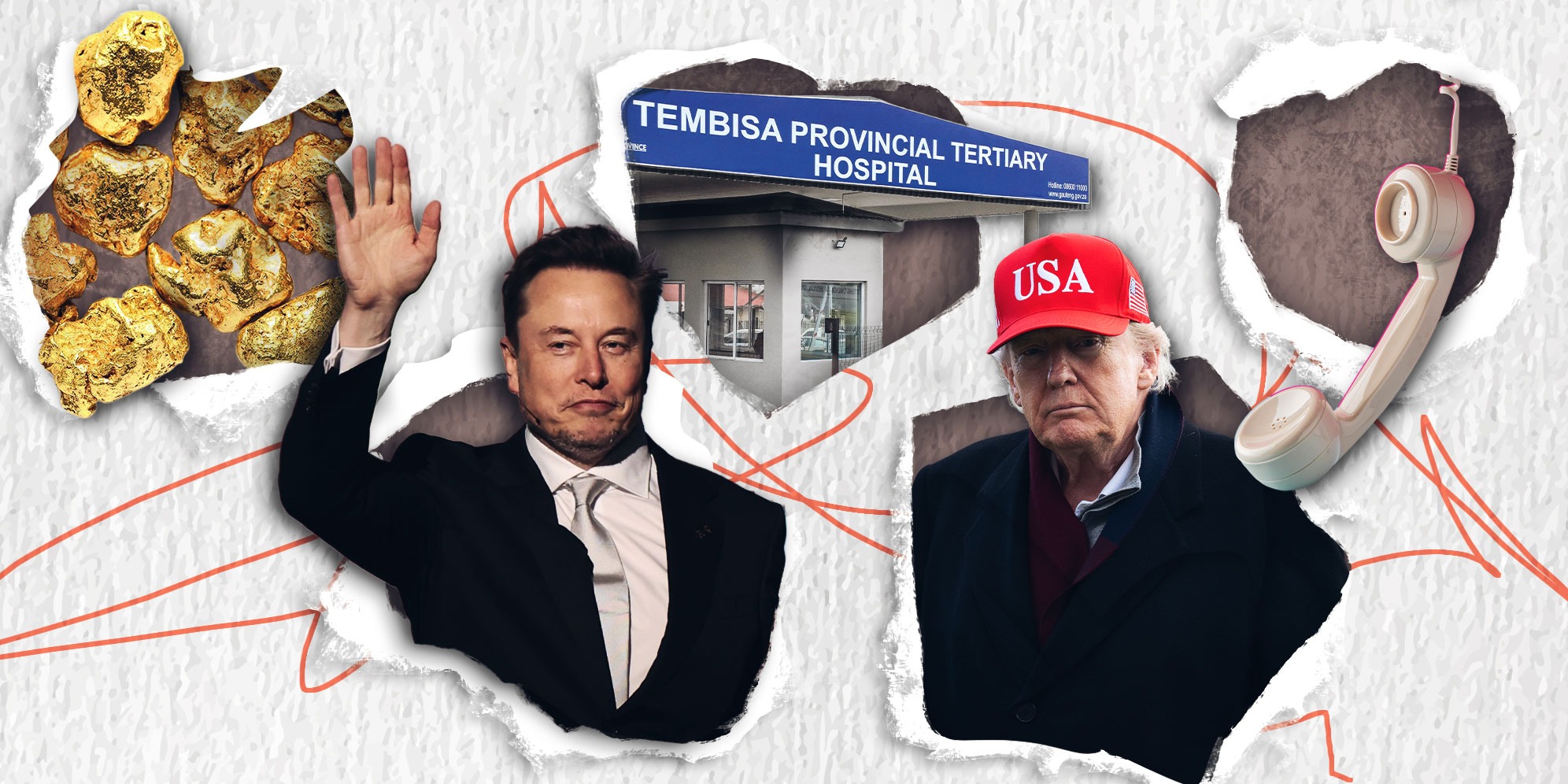
 Illustrative Image: Gold nuggets (Image: Freepik) | Tembisa Hospital. (Photo by Gallo Images/Papi Morake) | Phone. (Photo: Freepik) | SpaceX and xAI CEO Elon Musk. (EPA / ALI HAIDER) | US President Donald Trump. (Photo: Gallo Images / John McDonnell) | Paper texture (Image: Freepik) | (By Daniella Lee Ming Yesca)
 Over the last year, it has been my absolute pleasure and privilege to oversee the After the Bell columns written by two great journalism minds — the inimitable Tim Cohen and the legendary Stephen Grootes.
Some columns arrive like a polite email. Others kick down the door, borrow your kettle, and leave you staring at the ceiling at 2am (no, really, they did) thinking about tariffs, trust and the price of a single good idea.
This year’s best After the Bell pieces by Tim Cohen and Stephen Grootes did the latter. They weren’t just “takes”. They were little operating manuals for living in an economy where the rules keep changing, the referees are missing, and everyone’s pretending the scoreboard is optional.
Trying to single out some of the best offerings this year was difficult, to say the least.
/file/dailymaverick/wp-content/uploads/2025/05/ATB-tim-farewell.jpg "Tim Cohen. (Photo: Supplied)")
First up was Tim’s “Nǐ hǎo and some green tea please before the auto trade war” that hit our inboxes on 6 January.
Read more: After the Bell: Nǐ hǎo and some green tea please before the auto trade war
While Tim’s witty columns often made for good humour, there was a serious warning. The rise of Chinese carmakers was a story that could (and has) affected supply chains, politics, labour markets and South Africa’s own auto story.
It was less about cars and more about energy choices with headlights; geopolitics, you could finance over 72 months. Tim basically asked the question no one wants to hear: Are we preparing for the future, or merely importing it?
The following month, he shone a light on a tale of two assets in “Gold vs Bitcoin: a crucial arm-wrestling match still to be decided” (16 February).
Read more: Gold vs Bitcoin: a crucial arm-wrestling match still to be decided
Gold is the old god: heavy, inert, reassuring, while Bitcoin has increasingly emerged as what you could think of as the new religion: volatile, narrative-driven, powered by code and conviction. In a year of uncertainty, the column asked: What do you trust when trust is the scarce commodity?
/file/dailymaverick/wp-content/uploads/2025/08/Z63_3448.jpg "Stephen Grootes at the Daily Maverick's The Gathering 2025. (Photo: David Harrison)")
The affable (those being interviewed by him on radio might choose different adjectives) Stephen Grootes’ writing is somewhat different but no less entertaining or insightful.
If you’ve ever watched a company announce a firing and then instantly start speaking in PR (rainbows to cover up dung), then Stephen’s “The strange and difficult aftermath of sending a signal of a good sacking” (22 July) read like someone had finally opened a window.
Read more: The strange and difficult aftermath of sending a signal of a good sacking
He pointed out (and rightly so) that a “good sacking” can be a form of organisational communication. It’s not only punishment; it’s a signal to everyone still inside the building: about standards, power, fairness, and whether consequences are real or purely decorative. The sting is that firings are rarely clean. They are legally fraught, emotionally expensive (oh boy), and sometimes politically impossible. Yet without them, cultures rot.
A week later, he hit the philosophical jugular with “How much is a business idea worth?” (31 July).
Read more: How much is a business idea worth?
In South Africa, we love the mythology of the lone genius with a napkin sketch. We also love, in practice, the machinery that turns that genius into a court case. The Vodacom Please Call Me case ignited strong emotions over the last decade, with its inevitable framing as a David vs Goliath case. Stephen’s musings examined what happens when an idea becomes a product, and a product becomes billions, who gets what? How do you price the spark versus the furnace that made it scale?
He was sceptical of billion-rand windfalls that feel disconnected from the collaborative reality of building anything big. But he also brought up the counterpoint: if you don’t reward innovation, you stop getting it.
In “Musk to Makate: ‘please call me’” (10 November), Stephen
stitched together two ballooning bank accounts (Makate — the Please Call Me “inventor” — and Elon Musk) and raised questions about what wealth does to a person, and what it reveals about a system.
Read more: Musk to Makate: ‘please call me’
One (Musk) is the global archetype of unthinkable billions (trillions?) in success, while the other (Makate) is the local legend of an idea that became a long, bruising fight for recognition and compensation. Put them in the same frame, and you’re forced to confront how wildly different “getting paid” can look, depending on who you are, where you are and how the power lines are laid.
“The sad end of the road for ArcelorMittal SA” (1 September) hit us all in the gut. It was much more than a column about one company’s woes. It was about the consequences of losing industrial capacity in a country with too little work and too many people who need it.
Read more: The sad end of the road for ArcelorMittal SA
Steel is not glamorous, but it is foundational. When it fails, the blast radius hits towns, suppliers, skills, families and future investment decisions that never make headlines because they never happen. Just ask the survivors of Saldanha Steel on the West Coast that I call home.
The column was one of our most highly read in the year. It was not just a eulogy but an indictment: of policy drift, of execution failure, of the casual way we allow big systems to degrade until the only remaining option is grief.
Later that month, Stephen touched on the disaster that was Tembisa Hospital (this was the one that kept me up). I couldn’t sleep thinking about that one sentence: “Tembisa Hospital is something different: R2-billion is twice what we paid for the entirety of the Zondo Commission”
Read more: Tembisa Hospital and the shocking cost of corruption
Words fail me on that one. How is that scale of corruption still okay, and why (after the Zondo Commission) have we not done more to stop it?
Read together, these seven columns form a neat little constellation: machines, money, accountability, ideas and the heavy industry beneath everything else.
If there was a theme for the year, it’s this: reality always collects. Tariffs arrive. Fraud evolves. Cultures decay. Factories close. Ideas get priced, or stolen, or litigated into dust. And in between it all, there you sit, our reader, with your coffee (or something stronger on some days), trying to figure out what matters.
This year’s After the Bell columns did what the best business writing does. They made the invisible visible. They turned “the economy” back into people and decisions. Then they rang the bell again, like a reminder: tomorrow’s tape will print, whether we’re ready or not. DM