




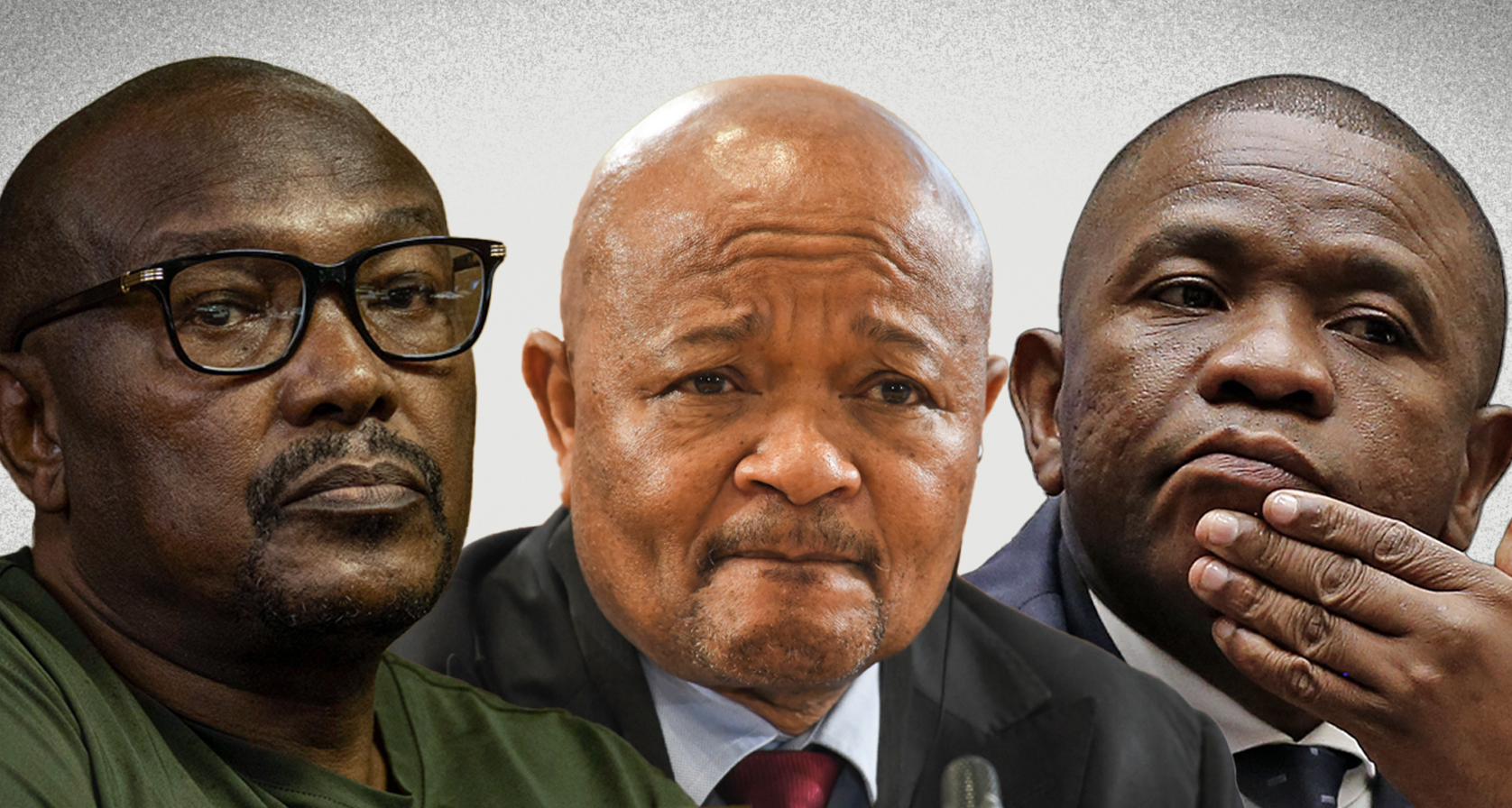
 Illustrative image | Katiso ‘KT’ Molefe. (Photo: Gallo Images / News24 / Rosetta Msimango) | Suspended Police Minister Senzo Mchunu. (Photo: Gallo Images / Frennie Shivambu) | Lieutenant General Nhlanhla Mkhwanazi. (Photo: Phando Jikelo / RSA Parliament)
 President Cyril Ramaphosa has reportedly praised Senzo Mchunu for taking special leave as police minister and then stepping aside from the ANC’s top structures following KwaZulu-Natal police commissioner Nhlanhla Mkhwanazi’s allegations before he faced any official charges.
The Madlanga Commission is due to deliver an interim report to Ramaphosa on 17 December.
Almost six months after Mkhwanazi unleashed a series of staggering accusations against Mchunu and fellow SAPS officers on 6 July 2025 – with the sidelined minister, Mkhwanazi and a list of other officials having testified at both the Madlanga Commission and Parliament’s ad hoc committee – how do the allegations stack up?
Parliament’s ad hoc committee is running parallel to the Madlanga Commission of Inquiry, which is investigating the same accusations of criminal infiltration into law enforcement. Both hearings are in response to Mkhwanazi’s claims.
Here are the allegations against Mchunu, the evidence led so far, and Mchunu’s defences.
Mchunu disbanded the Political Killings Task Team to shield criminals
/file/attachments/orphans/ED_589747_297436.jpg "Senzo Mchunu and his legal team at Madlanga Commission Of Inquiry at Brigitte Mabandla Judicial College on December 04, 2025 in Pretoria (Photo by Gallo Images/Lefty Shivambu)")
Mkhwanazi’s main accusations about Mchunu were that on 31 December 2024, he issued a directive to disband the Political Killings Task Team (PKTT), set up in 2018, to shield politically connected members of a criminal syndicate from prosecution.
He disbanded the team without consulting national police commissioner Fannie Masemola.
In December, Mchunu told the Madlanga Commission that as far back as 2019, a work study report had recommended integrating the PKTT into the SAPS Murder and Robbery Unit.
Mchunu stated that his 31 December 2024 directive to disband the unit was driven by his view that the unit had become “administratively untenable”. He claimed this assessment was reinforced by numerous complaints of human rights abuses submitted to him by civil society actors, whistleblowers, SAPS members, members of Parliament and members of the public.
Read more: Senzo Mchunu defends decision to disband National Political Killings Task Team as ‘inevitable'
He handed the commission an envelope containing the names of eight individuals who have made serious allegations against the PKTT – including claims of murder – stressing that their identities cannot be made public for safety and security reasons.
However, he was criticised for repeating these claims from whistleblower Patricia Morgan-Mashale and KwaZulu-Natal violence monitor Mary de Haas without verification.
/file/dailymaverick/wp-content/uploads/2025/11/ED_586295.jpg "Dr Mary de Haas testifies at the parliamentary ad hoc committee inquiry, 18 November 2025. (Photo: Gallo Images / Brenton Geach)")
Commissioner Sesi Baloyi SC tore into Mchunu’s reasoning, saying: “You reach a point where you decide that these complaints amount to evidence of administrative untenability – yet you never verify them with your own management. And on the strength of untested complaints, you conclude that the NPKTT (National Political Killings Task Team) can no longer exist.”
“How is that a sound or defensible thought process,” she pressed, “for arriving at such a far-reaching conclusion? You did not verify the truthfulness of allegations and yet you take them into account as they are facts to disband the NPKTT.”
Read more: Madlanga grills Mchunu on failure to consult SAPS leaders before disbanding NPKTT
Masemola told the Madlanga Commission that, at the time the contentious directive was issued, Mchunu had actually approved his festive-season annual leave.
Even more peculiar: on the very day Masemola went on leave – 31 December 2024 – Mchunu signed the controversial directive. Masemola told the commission: “It looks like it happened by design that I was on leave.”
The commission’s chairperson, Justice Mbuyiseli Madlanga, said he found it “very strange” that the minister of police, now on special leave, never mentioned the impending disbandment to Masemola when the two attended a funeral together.
“This lack of prior warning made the subsequent developments all the more unexpected and perplexing,” he said.
Read more: ‘False narrative and encroachment’ — Masemola on Mchunu’s sudden Political Killings Task Team disbandment
Further damning testimony about whether Mchunu overstepped his authority with his directive emerged from both Masemola and SAPS head of legal services, Major General Petronelle van Rooyen. Both indicated that it was inappropriate – and outside the minister’s powers – for him to order the disbandment.
Van Rooyen stated: “The minister unlawfully strayed into the constitutional competence of the national commissioner when he issued the letter for the disbandment of the PKTT.
“What would have been an appropriate path is for the minister to express that he no longer considers political killings to be a priority and direct the national commissioner to consider and take steps to align it with his directive.”
Mchunu has argued that he acted within his powers when he disbanded the team and wasn’t infringing on police operational matters.
Read more: Mchunu ‘unlawfully’ usurped Masemola’s power in political killings saga, Madlanga Commission hears
Furthermore the directive also came as a surprise to Deputy Police Minister Cassel Mathale who told the parliamentary ad hoc committee when he saw the news of the disbandment of the PKTT, he thought it was “fake”.
He went to tell the ad hoc committee: “I don’t know what was going through his mind when he wrote that letter.”
Read more: PKTT disbandment ‘surprised’ Deputy Police Minister Cassel Mathale
Also in the dark was the director of public prosecutions in KwaZulu-Natal, Elaine Harrison, who in her testimony at the Madlanga Commission said she also thought the news was fake, having come across the announcement of the disbandment via social media reports, rather than official documentation.
Mchunu also argued that extreme violence on the Cape Flats contributed to his decision to disband the unit. “If you keep on funding one unit somewhere in one corner of the country, even if they do well, they are not going to deal with criminality in the Cape Flats,” he told Parliament.
“Our consciences are going to be gouged on an hourly basis because, every time there is a death in the Cape Flats, you are asked: ‘What are you doing about it?’ You can’t say: ‘I have the Political Killings Task Team’ which is operating in one corner.”
Read more: Mchunu’s repeated reference to Cape Flats killings underscores the politics-gangsterism nexus
Another factor, according to Mchunu, that contributed to his disbandment order included the tight police budget. But chief police financial officer Puleng Dimpane told the ad hoc committee on Tuesday, 25 November 2025 that Mchunu had never discussed the PKTT and its budget with her.
A table that Dimpane referred to showed that since the PKTT’s inception in 2018, a total of R435-million had been spent on the PKTT. Compared with other policing operations, however, this figure did not seem exorbitant.
Mchunu and the alleged cartel
/file/dailymaverick/wp-content/uploads/2025/11/6I1A3072b.jpg "Brown Mogotsi testifies at the Madlanga Commission in Pretoria on 18 November 2025. He is accused of acting as a go-between for sidelined police minister Senzo Mchunu and alleged crime boss Vusimuzi ‘Cat‘ Matlala. (Photo: Felix Dlangamandla)")
The questions over Mchunu’s apparently sudden decision to disband the PKTT stem from his links to Brown Mogotsi and Vusimuzi “Cat” Matlala.
Mkhwanazi told the commission that someone had influenced Mchunu to disband the PKTT. According to his testimony, the chain of events leading to the task team’s dissolution began with the assassination of Vereeniging engineer Armand Swart on 17 April 2024.
At the centre of that corruption, Mkhwanazi said, was Lucky Molefe, a Transnet buyer now on the run. On 17 April 2024, Molefe was reportedly under mounting pressure from Transnet investigators to hand over doctored tender documents containing inflated prices.
Instead of complying, Molefe turned to his uncle, Katiso “KT” Molefe, who in turn approached the police officer Michael Tau, who allegedly moonlighted as a hitman – a chain of events that allegedly led to the murder of Swart.
/file/dailymaverick/wp-content/uploads/2025/09/ED_565542.jpg "Katiso ‘KT’ Molefe. (Photo: Gallo Images / News24 / Rosetta Msimango)")
The investigation into KT Molefe, the alleged crime kingpin and hitman, revealed multiple links to other assassinations, as well as an attempted hit on Tebogo Thobejane, Matlala’s former partner. The PKTT was making those links in late 2024.
Evidence heard at both the Madlanga and Parliament’s ad hoc committee suggests that Mchunu then faced pressure to act against the PKTT because it was closing in on Matlala.
These claims were further reinforced by explosive testimony from Witness C before the Madlanga Commission on Thursday, 30 October. He alleged that Matlala had paid R500,000 to help fund Mchunu’s bid for the ANC presidency.
Mchunu has denied any links to Matlala and claimed that Mogotsi is “just a comrade” from whom he never “requested or received” anything.
But evidence before the Madlanga Commission painted a very different picture. A bleak account emerged during the cross-examination of Mogotsi on Thursday, 20 November, when evidence leader Matthew Chaskalson SC meticulously mapped out, step by step, how messages between Mchunu and Mogotsi were allegedly relayed to Matlala.
Matlala, accused of being part of the Big Five members of a drug cartel, allegedly financially supported Mchunu’s political ambitions. Mchunu has also known ANC-aligned businessman Brown Mogotsi, a central figure in South Africa’s developing law enforcement scandal, for about eight years.
The commission and the ad hoc committee have heard that Matlala, who had irregularly scored a R360-million SAPS health services contract, paid between R250,000 and R500,000 in connection with activities surrounding the ANC’s birthday celebrations in January 2024.
The inference is that Matlala was supporting Mchunu’s ambitions to run for the ANC presidency in 2027 while trying to protect his tender and shield himself from investigations.
Mchunu testified: “I have never met Matlala… I have never seen him [with] my naked eye.”
As for Mogotsi, Mchunu insisted again that even though he has known the businessman since 2017, he viewed Mogotsi as a “comrade”. “I’ve never enquired about his personal life because we just occasionally talk about this and that.”
Read more: Mkhwanazi twisted what I said about comrade Brown Mogotsi, Mchunu tells Parliament
Commission evidence leader Matthew Chaskalson SC, however, pointed to a series of damning messages between Mchunu and Mogotsi, and Mogotsi and Matlala.
They suggested Mogotsi had advance knowledge from Mchunu of the PKTT’s disbandment and he duly informed Matlala that “the task team that came to your house and harassed you has been dissolved/disbanded”. Mogotsi, however, vehemently denied having prior knowledge.
Mchunu told Parliament he never told Mogotsi about disbanding the PKTT. He still has to answer to the claims at the commission.
Read more: Brown Mogotsi grilled on his alleged advance knowledge of the PKTT’s disbandment
/file/attachments/orphans/ED_588250_571722.jpg "Vusimuzi 'Cat' Matlala Testifies at the Parliamentary Ad Hoc Committee inquiry into alleged corruption and political interference in the criminal justice system at Kgosi Mampuru Correctional Facility on November 27, 2025 in Pretoria. (Photo: Gallo Images / Frennie Shivambu)")
Matlala testified during his appearance before Parliament’s ad hoc committee at Pretoria’s Kgosi Mampuru Prison that he had a relationship with several police officials, including former police minister Bheki Cele.
The revelations didn’t end there. He further claimed that Matlala also paid suspended Deputy National Commissioner of Crime Detection Shadrack Sibiya up to R1-million a month in bribes, including R2-million to buy a plot and 20 impalas, which have since died.
Matlala is said to have allegedly contributed R80,000 towards a party celebrating the promotion of Major General Richard Shibiri, head of the SAPS Organised Crime Unit.
He also implicated Major General Feroz Khan, head of counterintelligence at Crime Intelligence, whom the commission heard had demanded R2.5-million from Matlala, of which only R500,000 was allegedly paid.
Mchunu Defence Incomplete
/file/dailymaverick/wp-content/uploads/2025/02/Tembeka-Expropriation-expert1.jpg "Tembeka Ngcukaitobi .(Photo: Mlungisi Louw / Gallo Images)")
During his testimony at the Madlanga Commission in December, Mchunu’s legal representative, Tembeka Ngcukaitobi SC, tried to address the sidelined minister’s alleged improper motives in the saga, including his alleged links to Matlala and his R360-million contract.
Read more: Witness C details ‘Cat’ Matlala’s claims to have bribed minister, top cops
However, he was cut off due to limited time and told the commission he would deal with those issues in January, with evidence leader advocate Mohlapo Sello telling him:
“[Mchunu] has already set out his responses to these allegations in his statement, yet he has not been taken through them, nor confronted with any evidence that contradicts the position he asserts. This is putting the cart before the horse.”
Ngcukaitobi pushed back: “Mr Chairman, I will proceed as the commission directs, but it is impossible to separate the act of disbandment from the reasons behind it. The central allegation is that the disbandment was unlawful – that it was driven by an ulterior motive.”
He continued: “It is grossly unfair that the minister, appearing here for the first time, is not permitted to tell the commission and the nation that he is innocent of corruption.”
The commission and the ad hoc committee will resume in January. DM