




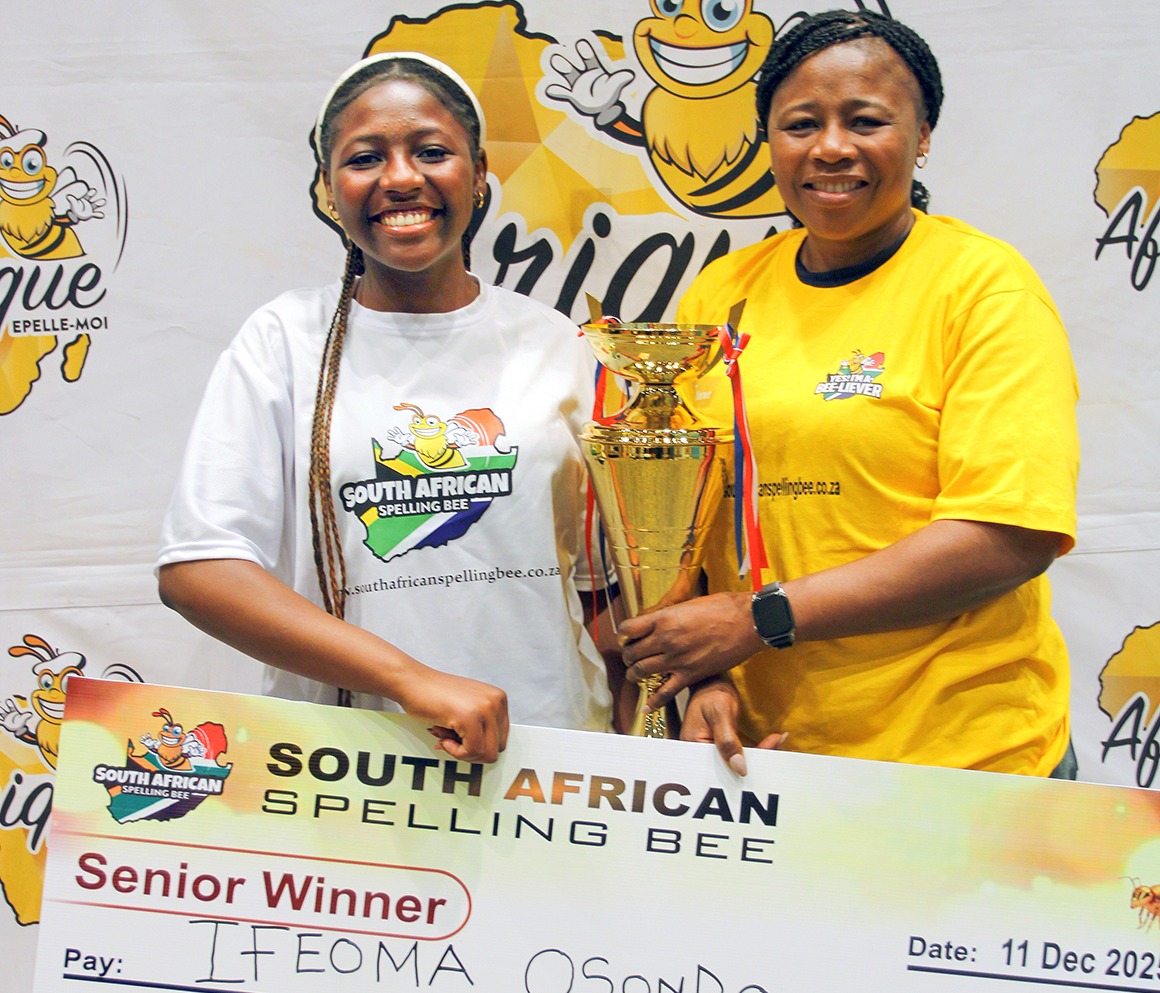
 Ifeoma Osondo (left) celebrates with her mother, after the Cape Town learner was crowned the senior champion in the National SA Spelling Bee finals in Sun City. (Photo: Ofentse Diale)
The stakes were high at the 2025 National Spelling Bee Finals, hosted at the Sun City resort in North West on 11 December 2025, where South Africa’s top junior and senior spellers, who made it through local, district and provincial competitions to book a place among South Africa’s elite word warriors, battled it out to become SA’s word champion.
This year’s event was a vibrant reflection of the country’s linguistic diversity. Spellers were challenged on words from all 12 official languages, including South African Sign Language, and an array of foreign languages such as Shona, Italian, Spanish and German.
The preliminary rounds kicked off on the evening of 10 December, just hours after the spellers’ arrival. An initial written test, which included Italian and Shona components from the official preparation materials, set a competitive tone, with the majority of young scholars scoring an impressive 7/10. Early signs showed this would be a year for the history books.
Main competition
In the main competition, junior spellers took to the stage for round 1, where they had to correctly spell as many of the 20 words as possible in 60 seconds. That was followed by round 2, where they also needed to spell in 60 seconds, featuring 10 more complex and challenging words. For many junior spellers such as Mbulelo Tolom, George van Wyngaard, Ashton Singh and Thandolwethu Sibiya, keeping focus and being calm was the recipe that booked their place in the top 16.
Tolom was crowned the winner of the junior spelling contest, Singh was runner-up and van Wyngaard coming in third.
For the seniors, it was a tougher battle that saw parents sitting on the edge of their seats. Returning spellers, such as Ryhle Adams, and new participants, like Xilombe Xivuri, put their best foot forward. All spellers were tested on words like “danke” (German), “grazie” (Italian), and “arigato” (Japanese). Xivuri and Adams booked a spot in the top seven. The last round, which would determine the two winners for junior and senior levels, saw the spellers for the first time spelling in sign language. After a long and fun competition, the winners were crowned.
Among the seniors, Ifeoma Osondo took the top spot winning a cash prize and a laptop from Cell C.
The joy of winning
After the winners were handed their trophies, some parents celebrated, while others comforted their tearful children who had not managed a winning place.
Daily Maverick spoke to junior winner Mbulelo, who attends Klerksdorp Primary School, North West, and his mother, Nokukhanya Tolom.
Mbulelo shared what it took for him to win. “It was tiring, but the outcome was worth it. Now I’m representing South Africa, going to Zimbabwe, and hopefully I can also come out in first place and represent my country,” he said.
His mother said: “This was a job well done for the initiative; it’s really helpful. I wish more people could be involved in doing what they are doing; so they must just keep it up and expand.”
The senior winner, Ifeoma, from Milnerton High in Cape Town, Western Cape, took part in the competition for the first time.
“I was shocked when they called out my number, so I am happy, but I’m shocked,” she said.
“To those who did not win, don’t give up and keep trying again. […] I am really grateful to have this; we don’t pay for anything. They come through for everyone and still make it a fun time for everyone.”
Improving literacy and growing the competition
The National Spelling Bee is a collaborative project established by A Better Africa Foundation, the Department of Basic Education (DBE) and key partners such as the National Education Collaboration Trust and Nal’ibali.
Chief executive officer of the SA National Spelling Bee, Roger Dickinson said: “We started in 2010; my wife made me watch the movie [Akeelah and the Bee], and we ran a literacy enrichment programme. The thinking initially was that the spelling bee would add to the enrichment programme.”
Speaking about the need to include language and foreign languages, he said: “People who can speak and hear properly, if you want to use that term, they hardly ever think about deaf people. What was so exciting today was how the kids took to it. We want to build a South African child that is empathetic, that thinks about other people, that is non-xenophobic and that’s non-discriminatory.”
Responding to the challenge of South African children in Grade 4 who cannot read for understanding and how competitions such as spelling bees help bridge this gap, he said: “It’s not true that South African children can’t read for meaning. It’s skewed socioeconomically for sure, and we do have a reading challenge, but what we have in the country are learners with gaps coming from multiple things.
Read more: New data points to solutions for SA’s child literacy woes
“There are teachers in the foundation and intermediate phases that are needing to fill those gaps, and they struggle there. And the struggle is not necessarily about capacity or competence. It’s systemic. That’s where, with the Department of Education, we’ve now formed this reading collective. The idea is, can you put teacher assistants like those young people in classrooms to support [others].”
Meanwhile, Nal’ibali’s programmes manager, Prudence Erens, highlighted to Daily Maverick the importance of the spelling bees. “It encourages children to read more, grow their vocabulary and feel confident using words, and that confidence is a big step towards better comprehension. It also pulls families and teachers into the process, which speaks directly to Nal’ibali’s belief that literacy is a shared responsibility between home, school, and community,” Erens said.
“Including more languages, especially South African Sign Language, sends a powerful message that every child belongs in the literacy space,” she said.
Musa Zulu: the DBE’s assistant director, said: “The programme significantly enhances linguistics, literacy and inclusivity. The inclusion of English, African languages and further languages spoken among South African communities allows the competition to focus on the different aspects that make each of these languages complex and different. It is an opportunity to deepen navigating multilingualism.”
The winners of this year’s competition will now carry the flag for South Africa at the continental African Spelling Bee Finals in Zimbabwe in March 2026. DM