




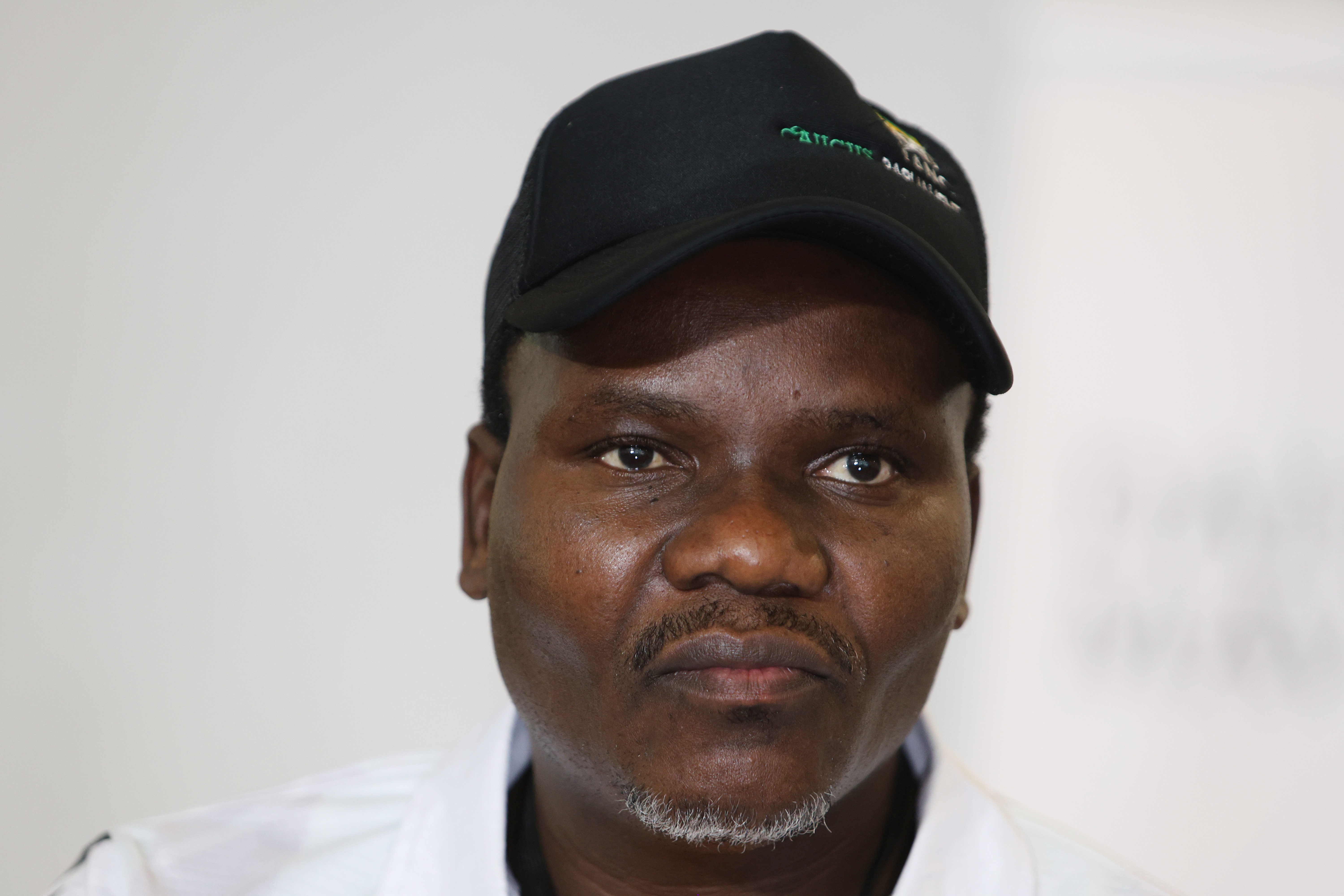
 ANC Chief Whip Mdumiseni Ntuli says the state the ANC 'is very worrying, even more worrying for me, because I’m the head of elections'. He spoke to Daily Maverick after the party’s 5th National General Council held in Boksburg in December 2025. (Photo: Felix Dlangamandla)
 The ANC’s midterm report at the National General Council (NGC) this week not only confirmed the party’s decline but also suggested it is increasingly becoming a rural organisation, with most of its functional branches now concentrated in Limpopo, Mpumalanga and the Northern Cape.
This, according to the ANC’s chief whip and head of elections, Mdumiseni Ntuli, is an indication that the party is nearing its death.
“If you become a purely rural party, it’s essentially a signal that you are coming to an end,” he said.
The report, presented by ANC secretary-general Fikile Mbalula, confirmed that the party’s decline was not sudden but a slow erosion over many years, starting in 2016. It also shows that ANC membership numbers have dropped by almost 30% since 2019, when they stood at 769,870.
By October 2025, there were 543,524 members in good standing, the report says.
Between 2019 and 2024, the former governing party’s voter support dropped by 17 percentage points nationally to 40%, leading to the formation of the Government of National Unity (GNU) with other parties, including the Democratic Alliance, Inkatha Freedom Party and the Patriotic Alliance. The party also failed to garner majorities in KwaZulu-Nata, Northern Cape and Gauteng.
Read more: ‘Time is not on our side’ — ANC reflects on GNU and declining voter support
/file/attachments/orphans/6I1A5542_567372.jpg "ANC Chief Whip Mdumiseni Ntuli says that if the party becomes purely rural, it’s a signal of its final demise. (Photo: Felix Dlangamandla)")
‘Sustaining our 40%’
The decline of the party is giving Ntuli a headache, especially as the country heads to the 2026 local government election. Many ANC heavyweights believe the party can recover lost ground and possibly return to its former glory. Ntuli, however, is not entirely optimistic. He is hoping that the party at least maintains what it has.
“The state of the ANC is very worrying, even more worrying for me, because I’m the head of elections. I’m going to elections next year. I have all the reasons to be concerned about the capacity of the ANC, at least to sustain the 40% we have,” he said.
“I know other people are very ambitious. They are looking at us getting more than what we brought in 2021, before. But for me, as a head of elections, the basic thing that has changed is that we must defend what we have. If we have a possibility to increase it, so be it. But we have to start by saying, what do we have and how do we secure it?” Ntuli said.
Read more: Ramaphosa will lead the 2026 ANC local government election campaign as plot rumours fizzle
Traditionally, one of the ANC’s biggest voting blocs comes from KwaZulu-Natal, but now, this support has shifted to the uMkhonto Wesizwe (MK) party led by former ANC president Jacob Zuma.
“I am worried about the MK to an extent that we are not doing enough to exploit its weaknesses. The fact of the matter is that the MK party at the moment is at its weakest point,” said Ntuli, a former ANC KZN provincial secretary.
One of the biggest weaknesses of the MK party is the lack of democratic processes, as Zuma continues to hold the prerogative to appoint leadership structures at all levels – indefinitely. In its two years of existence, the MK party has not held any elective conferences and continues to have a revolving door of leadership, with repeated reshuffles of senior leaders.
ANC branches in crisis
The ANC’s midterm report has identified that ANC branches are in crisis, something that Ntuli is equally bothered by.
Besides most branches being rural, the ANC also faces an age problem. The report has shown that the average branch chairperson is 49.3 years old, with women slightly older than men, and very few young members lead branches — even though the country’s median age is 28.
“I’m very concerned about it, because the branches are our own primary locomotives. Without a functional branch, a strong and effective branch, we have no other better means to interact with the population; the only way in which the ANC exercises effective leadership to society is through our own branches,” Ntuli said.
ANC succession
While Mbalula has insisted the NGC was not the place to discuss succession plans, it has become one of the key talking points ahead of the 2027 elective conference when Cyril Ramaphosa concludes his second term as head of the party.
Read more: The race to rule the ANC after Cyril — new numbers, new front-runners
/file/attachments/orphans/6I1A5518_956660.jpg "ANC secretary-general Fikile Mbalula presented the party’s midterm report at the National General Council on 10 December 2025. (Photo: Felix Dlangamandla)")
Ntuli unsuccessfully campaigned against Mbalula in 2022 for the secretary-general position. Asked whether or not he would raise his hand to be a part of the party’s top 7, or accept nomination from branches, he responded: “Quite honestly, I haven’t thought about it; I think it’s a matter that has not really occupied my mind.”
His main concern is “whether we succeed in the local government elections, because I believe that none of us who are in the leadership will have any claim to be re-elected in 2027 when we have taken the ANC down to 40% in 2024 and if it goes worse in 2026.
“So the basis upon which we will then stand up and say, ‘Please choose me to lead the ANC’, I think would be very difficult to justify.”
SA expects solutions, not disruptions in Parliament
The secretary-general’s midterm report paints a bleak picture of Parliament: after the 2024 elections, only 33% of former MPs had returned and only 20% of whips returned. The ANC also suffered a knock as it no longer has overwhelming majorities in committees nor as many committee chairs.
When asked about this, Ntuli said the challenges in Parliament did not necessarily come with the seventh administration.
“I think we started seeing a different way in which Parliament operated when the Economic Freedom Fighters entered that Parliament in 2014. They changed the way in which Parliament works. [...] Some of the things that were introduced by their arrival, I believe, were very negative, including, for instance, the decorum of the house.”
His own experience since June 2024 “is that even those who were principal disruptors of Parliament – I mean, they’ve never been chased out – they are behaving differently. I think they’ve understood that strategy might have helped them in their first 10 years in Parliament and beyond that it’s no longer workable.
“South Africans are expecting Members of Parliament, given the nature of the problems that are confronting our people, they are expecting solutions, not disruption. They are expecting cooperation and they are expecting us to entertain each other’s ideas irrespective of where we come from,” he said. DM