



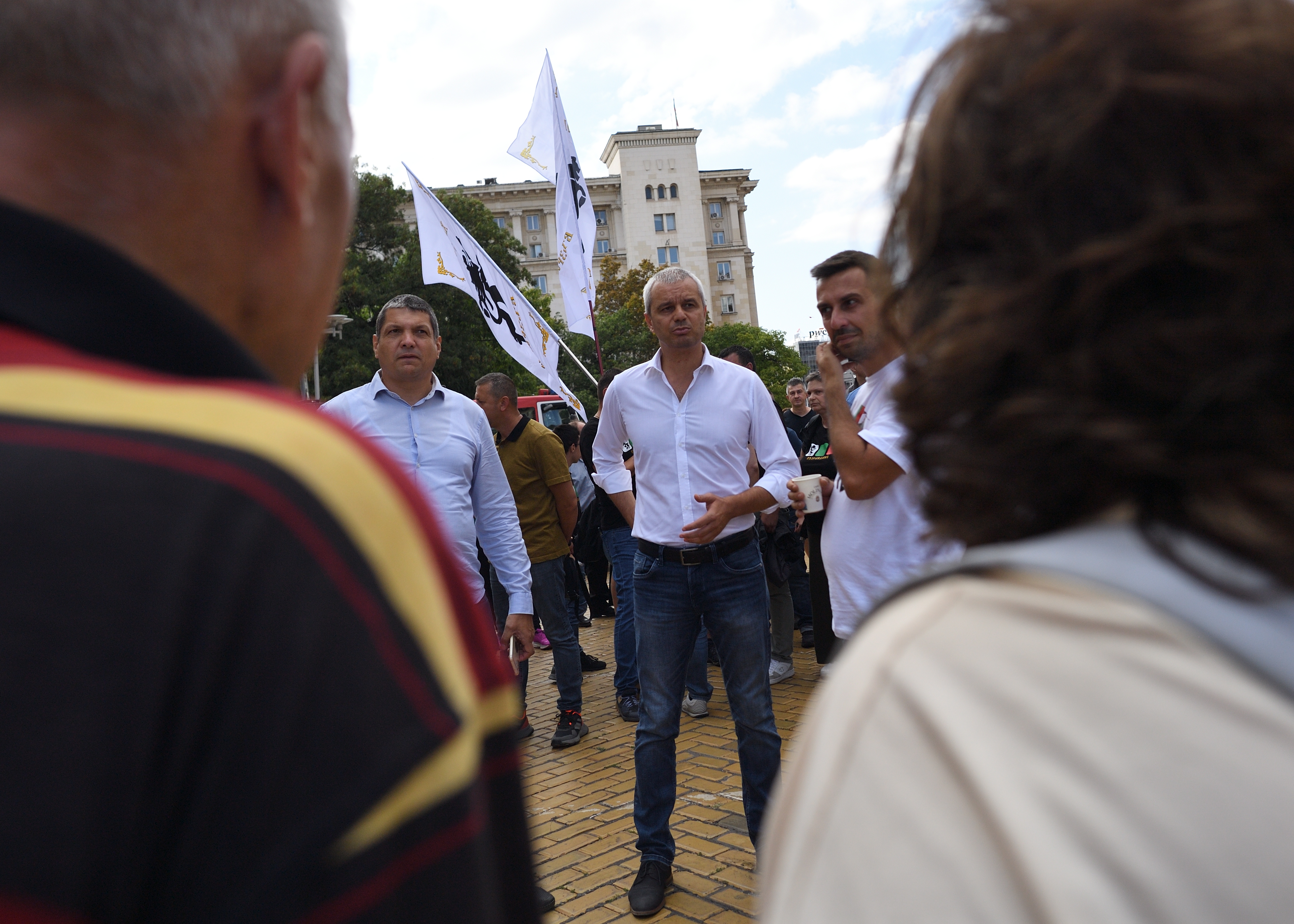
 The leader of the 'Revival' party, Kostadin Kostadinov (C), attends a protest outside the Parliament building in Sofia, Bulgaria, 13 September 2025. Thousands of protesters, organized by the ultranationalist Vazrazhdane party, are opposing Bulgaria's planned entry into the eurozone and adoption of the euro in 2026. EPA/VASSIL DONEV
 Prime Minister Rosen Zhelyakov's government announced on Thursday it would step down after weeks of street protests against state corruption and a new budget that would have hiked social security contributions and taxes on dividends.
The decision comes just three weeks before the Black Sea nation of 6.7 million people is due to join the euro zone on January 1.
All 227 lawmakers attending Friday's session of the 240-member chamber voted in favour of the government's resignation.
They are also expected later on Friday to approve a revised 2026 budget on its first reading.
President Rumen Radev, who himself had urged the government to resign, will now hand the largest party in parliament, GERB, the mandate to form a new government. However its leader, Boyko Borissov, has indicated it will turn down the mandate.
In such a scenario, unless two other parties accept the mandate to form a government, Radev will appoint an interim administration and call a snap election. This could pitch Bulgaria back into a cycle of repeated polls if no one can form a functioning coalition.
Bulgaria, a member of NATO and the European Union, has held seven national elections in the past four years as successive governments failed to keep control of a fractured parliament.
(Reporting by Daria Sito-SucicEditing by Gareth Jones)