



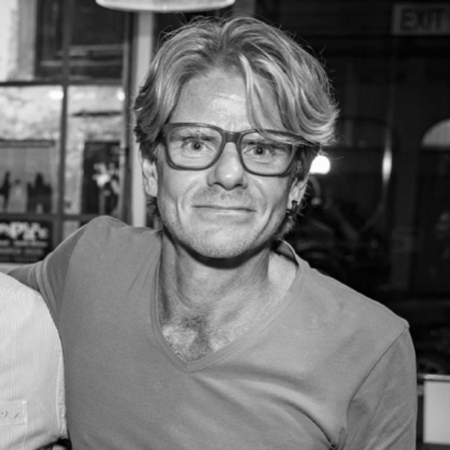
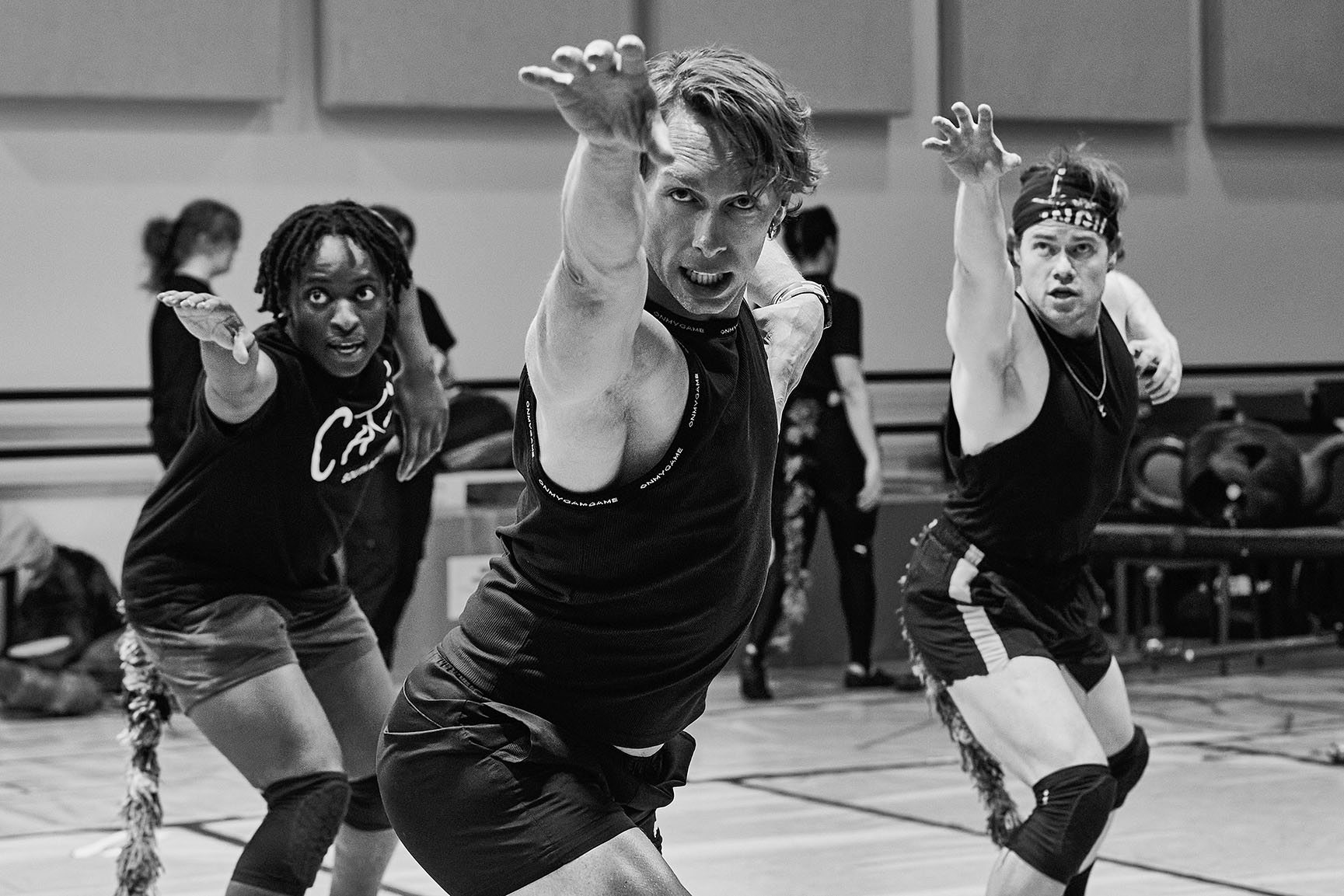
 Austin Tshikosi (Mungojerrie), Matt Krzan and Logan Timbre (Skimbleshanks). (Photo: Jesse Kramer)
 Cats is “definitely not for the faint-hearted”, says Matt Krzan, a theatre performer who has had a close relationship with this era-defining musical for 22 years – that’s half his life spent with the show, on and off the stage.
London-based Krzan, who is both a veteran cat and a besotted fan, has been in Cape Town for the past two months teaching Cats to a South African cast for a new production that opens on 10 December at Artscape before a globetrotting tour during which it will ignite stages in at least half a dozen foreign countries.
He says that, based on what he’s seen in rehearsals, there’s not a faint heart among them; rather, he says they are hungry to learn, eager to please and ready to endure the rigours of what’s considered the toughest musical there is.
Aside from the sheer physical stamina demanded of the cast, there’s the level of buy-in to get not only under the skin and fur, makeup and hairdos of almost 30 different cats, but to accept as real the frankly loopy storyline developed by the show’s makers in a brave attempt to make the children’s cat poems of TS Eliot cohere into something resembling a credible narrative.
Back in the early 1980s, much of that inventiveness fell to Trevor Nunn, the show’s original West End director, while it was composer Andrew Lloyd Webber who took Eliot’s words and set them to music that would captivate the world.
/file/attachments/orphans/Catsinrehearsal_JesseKramer_137082.jpg "Cats in rehearsal. (Photo: Jesse Kramer)")
It was Nunn who insisted in a letter to Lloyd Webber that the entire cast of characters “MUST BE CATS”, adding that it should include “Cats introducing us to other cats, cats telling us what only cats can ever possibly know; cats divulging secrets, cats arguing, cats of different classes, cats sexually or romantically involved with each other… and finally cats remaining mysterious, inscrutable, unknowable and (need it be said?) inhuman.”
This central conceit – of a cast entirely composed of animals – was kept a secret from press and public until the show’s West End debut in 1981. By the time Cats opened, it had gone through considerable turmoil, including a battle by Cameron Mackintosh to raise capital to fund it (in the end, he and Lloyd Webber put in their own money), a pianist who had – on day one of rehearsal – quit (in dramatic style, he actually collapsed over the piano, claiming he could no longer play), and the withdrawal from the show by actress Judi Dench who sustained a serious injury during rehearsals. Dench had been cast as Grizabella, the cat who sings the show’s indelible showstopper, Memory.
By opening night, Lloyd Webber himself expected Cats to flop – he and Mackintosh are said to have asked Nunn to cancel the show (Nunn ignored them), and rumours had begun circulating that Dench had faked her injury to escape a sinking ship.
Instead, it was received as a triumph and Dench’s replacement, Elaine Paige, belted out one of the most memorable songs in human history – Memory is said by many to be musical theatre’s most successful song, with at least 600 covers of it in existence, including hit versions by Barry Manilow and Barbra Streisand.
What Cats did, apart from confounding expectation, was become a global juggernaut that changed the manner in which West End and Broadway blockbusters operated by establishing long-lasting, highly recognisable brand identities. The pair of yellow cat eyes with silhouetted dancers for pupils remains an instantly identifiable logo that has helped lure anywhere between 73 and 81 million people to see the show.
Without foreknowledge of its success, you’d need to be a bit eccentric – mad, even – to imagine doing Cats at all. It’s built on a kind of surreal logic, an hallucinogenic creative impulse that’s as much deranged as it is magnificent: Grown-up audiences made to accept a stage full of grown-ups prancing about in leotards pretending to be cats. And the plot? It’s barely there, more a device used to make a series of children’s poems set to music make some sort of sense.
Lloyd Webber, of course, already knew a thing or two about musicals by the time he began tinkering with it in the late 1970s. Getting the production to the point of acceptability was very much a team effort, though; it was the choreography, the junkyard set and its punky costumes, wigs and makeup, plus a cast full of eager, full-throated and seemingly tireless bodies that ultimately made Cats a triumph.
And there’s something to be said for its intrepidly touch-and-go whimsical “storyline”; the New York Times, in a generally positive review, referred to its “lack of spine”.
It’s effectively two-and-a-half-hours of escape from reality than it’s an actual story. Much of it involves members of the extensive Jellicle Cat tribe simply introducing themselves. In song, they explain their personalities and tell us their names, which are in themselves delightful, and range from Old Deuteronomy and Mungojerrie to Rumpleteazer and Macavity (the latter, incidentally, is a criminal cat based on Arthur Conan Doyle’s Professor Moriarty), but do not necessarily amount to character-based cause for development.
Nevertheless, Cats has been called everything from “a ridiculous hallucination” to the “gateway drug” of musical theatre. Somehow it all works – there’s magic in it, and the songs are both catchy and varied. Nunn says that after the first stage run-through, everyone in the theatre cried.
/file/attachments/orphans/Catsrehearsal_JesseKramer_627594.jpg "Cats rehearsal. (Photo: Jesse Kramer)")
/file/attachments/orphans/AustinTshikosiMungojerrie_JesseKramer_440791.jpg "Austin Tshikosi (Mungojerrie). (Photo: Jesse Kramer)")
/file/attachments/orphans/DylanJansevanResnburgasRumTumTuggerleftwithcastmembersduringrehearsal_JesseKramer_944324.jpg "Dylan Janse van Resnburg as Rum Tum Tugger (left) with cast members during rehearsal. (Photo: Jesse Kramer)")
Never mind its impact on performers and critics, it is also a money spinner. Despite its unusual premise that initially deterred investors, Cats has had unprecedented commercial success, with a worldwide gross in excess of $3.57-billion.
The original London production ran for 21 years and 8,949 performances, while the first Broadway production racked up 18 years and 7,485 performances, making Cats the longest-running musical until its record was overtaken by another Lloyd Webber production, Phantom of the Opera; in a purpose-built theatre in Japan, it ran for more than 36 years (and more than 10,000 performances) from its opening in 1983 until the pandemic shut theatres worldwide.
And then there are the hardcore devotees. An article in the UK’s Guardian newspaper ahead of the much-derided 2019 feature film of the musical reported on Cats megafans, some of whom had seen the stage show hundreds of times (one New York retiree claimed he’d seen it 703 times by the time its Broadway run ended in 2000).
Krzan has watched it many more times than even its most ardent non-performing fans, albeit not in a way that would count among the statistics. Mostly he’s seen it from the stage itself, or from the wings or in some way shape or form as part of the cast.
About 22 years ago, at the start of his career, he was a swing on the production, which meant learning a number of different roles and being on standby to step in whenever someone became sick or injured, and then worked his way up. He’s played many of the male parts, and has spent much of his career as dance captain on the production.
Now, as assistant director, his job has been to add his special brand of polish, his heart and soul really, to the cast, teaching them the choreography and blocking that’s so much in his brain and part of his muscle memory.
While most of us immediately associate Cats with Memory, the tune that caught my attention in the rehearsal room was The Rum Tum Tugger, the first of two solos performed by the show’s rock-star cat, played in this version by Dylan Janse van Rensburg, who pounced into Cats rehearsals straight off headlining another Lloyd Webber musical, Joseph and the Amazing Technicolor Dreamcoat.
If you’re unfamiliar with the show, Rum Tum Tugger is in many ways the Jellicle Cat tribe’s sex kitten. You will know him when you see – and hear – him. He turns heads the instant he sashays onto stage, hips swinging and grinding, his statuesque body lapping up focus from the younger cats, who all but lose their minds as he twists and grinds and unleashes his feline swagger.
Much of Rum Tum Tugger’s appeal – and that of the show, in fact – is the sinuous quality of the cats’ movements, concocted by the late Gillian Lynne, a legendary choreographer, who developed sensuous, sinewy, feline-appropriate yet nevertheless quite sexy routines that have to some extent hypnotised audiences for almost half a century.
Rum Tum Tugger’s gyrating hips can in fact be seen literally hypnotising a couple of the other cats on stage, that mesmerising effect compounded by Janse van Rensburg’s honey-smooth voice, something audiences will soon discover is about as golden as Cape Town’s summertime sunshine.
/file/attachments/2985/DylanJansevanRensburgbringsrockstarenergytohisroleasRumTumTuggerinCats-PhotobyNardusEngelbrecht_156093_3b4fb4e0508638fca83d25ccee4b9ad1.jpg "Dylan Janse van Rensburg brings rock star energy to his role as Rum Tum Tugger in 'Cats' (Photo by Nardus Engelbrecht)")
/file/attachments/2985/Cindy-AnnAbrahamsisscintillatingasGrizabellawhoperformstheshowstoppingMemoryinCats-PhotobyNardusEngelbrecht_484827_7f33964ca38f4725117bf574d47e6c82.jpg "Cindy-Ann Abrahams is scintillating as Grizabella, who performs the showstopping 'Memory' in 'Cats' (Photo by Nardus Engelbrecht)")
If Rum Tum Tugger represents the somewhat egotistical, self-important aspects of a cat’s personality, the cat who brings a sense of responsibility and calm, caring control to the tribe is Munkustrap, who is also the rock-star cat’s older brother.
It’s Munkustrap that Krzan has most often embodied on stage, having at one point played him for three years straight, without a single day off, any injury or twinge simply ignored in order to go on with the show.
Krzan says it’s in his nature to work hard, give of his best, perform like there’s no tomorrow. He says it is weird now to be working on the show and not perform in it. The joy he receives, while not in the form of audience adoration, is from knowing that this cast will be ready to face what is likely to be the toughest theatre run of their lives.
For audiences, though, the joy lies in letting go, in giving in to the experience. Cats pulls you into a trance, a fantastical world where reality is escaped entirely for well over two hours as you enter a surreal song-and-dance extravaganza free of politics and screens, but with plenty of emotional highs and lows.
Who cares that there’s no traditional storyline, no big obstacle in the way of the protagonist trying to achieve some goal. It is thrilling, captivating and incredibly charming. And it is 30 people on a stage, performing with everything they’ve got to create lasting memories. DM
Cats opens in Cape Town at the Artscape Opera House on 10 December and plays until 11 January 2026. It transfers to Joburg’s Teatro Montecasino on 17 January and plays through 22 February.