




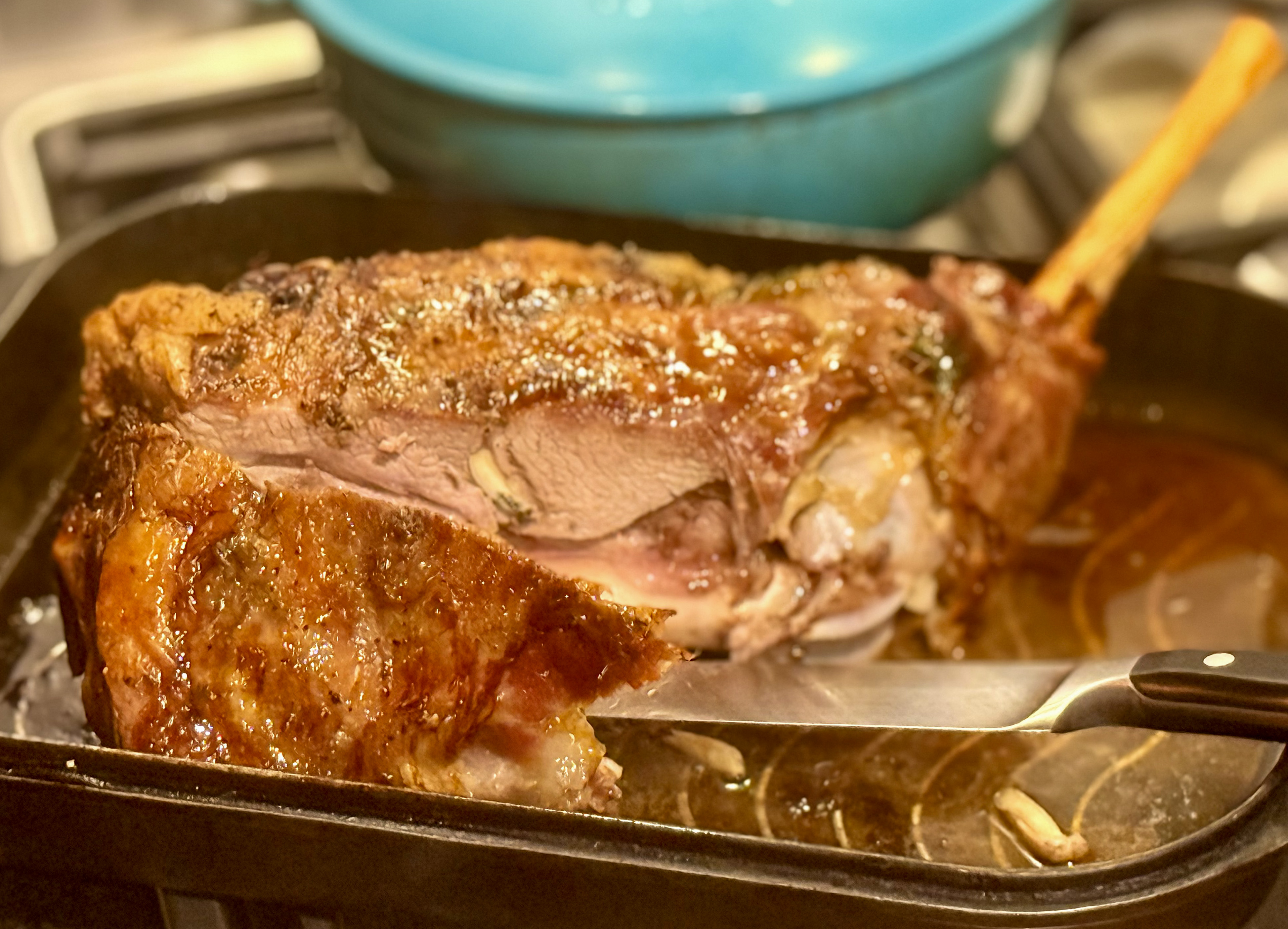
 Tony Jackman’s roast leg of lamb with garlic and oregano. (Photo: Tony Jackman)
After years of cooking a leg of lamb in many other ways, I decided to go back to basics. But, while my-son-in-law is a whizz at growing all sorts of herbs and vegetables — with insect-repelling plants nearby — rosemary is missing (for now — I’m going to take some cuttings in a couple of weeks time).
But any herb can do its work with a leg of lamb and if you were to add a third ingredient to the mix — lemon — that, along with the oregano and garlic, would deliver a joint with something of Greece about it. I often squeeze some lemon juice over lamb, anyway, it’s a perfect fit.
Other than the change of herbs this was very much what the kids grew up eating for supper on so many Saturday nights. There’d be tufts of rosemary sticking out like a funky green hairstyle. Bits of garlic hiding in the meat and showing themselves when you slice through.
It turns out pink at the centre but with plenty of more well done meat at the edges for those who might be squeamish about pinkness in meat. It’s a crowd pleaser.
The key, though, is to get the balance of temperature and time right. Ideally, you want tender meat that’s a little pink at the centre — medium to medium rare is best for my taste. With medium rare, the pink is more visible; with medium it’s more of a blush. Many leading chefs argue for medium these days when it comes to lamb, my old chef comrade Reuben Riffel among them.
There are of course those chefs who like their lamb very pink — rare, that is — and they tend to be overly emphatic about it. It’s food, we all have our tastes and preferences, let’s not allow ourselves to be dictated to.
Also, serving it medium is likely to please all palates, including those who insist it should be well done. There’ll be plenty of well done meat around the edges, especially at the bottom of the joint. The blushing meat at the centre will be the most tender. Of course, many proper lamb lovers will want a goodly portion of that glorious golden fatty crust as well.
Here is my timing-temperature balance for a fairly typical large South African leg of lamb: 15 minutes at 200°C, followed by an hour and a quarter at 180°C. Turn it off, leave the oven door open, and prepare to serve dinner.
But there are a few other steps first…
Tony’s oven-roast leg of lamb with oregano, garlic and lemon
(Serves 4, with seconds and maybe some midnight leftovers for Grandad Tones)
Ingredients
1 large leg of lamb, about 2kg to 2.5kg
4 garlic cloves, peeled and cut into slivers lengthwise
12 small sprigs of fresh oregano
Salt to taste
Black pepper to taste
4 Tbsp olive oil
Juice of 1 lemon
Leeks (about 2 cups when sliced)
Baby carrots
100ml fortified wine such as hanepoot or jerepigo
Vegetable stock, enough to cover the leeks
Method
Preheat the oven to 200°C.
Check the outer fat content of the meat. Most of this is best left as it is, as it is the fat that creates so much of a leg of lamb’s flavour. But where the fat is very thick in parts, shave some of it off.
Peel the garlic and slice it into thin slivers, counting three slivers for each of the 4 cloves — 12 slivers in all.
With a small, sharp knife, make incisions at the top of the joint about half way through the flesh. Insert a garlic sliver and an oregano sprig into each hole.
Season the joint all over with salt and black pepper — be generous.
Heat oil in a heavy metal oven dish on a moderate heat on the hob and brown the meat well all over.
Transfer the dish to the preheated oven and set a timer for 15 minutes.
After 15 minutes, turn the heat down to 180°C and set a timer for an hour and 15 minutes (75 minutes).
Twice during the roasting, open the oven door and baste the leg with its juices. The last time you do this (with about half an hour left to cook), squeeze the lemon juice over the meat as well.
I served the lamb with sliced leeks simmered in vegetable stock and seasoned with salt and pepper, as well as baby carrots simmered in water with fortified wine and salt and pepper. Reserve the liquid from both vegetables.
Remove the leg from the oven and place it on a large plate.
Pour the cooking stock from the leeks AND the carrots into the lamb pan juices and reduce on a high heat on the stove top.
The meat will have rested by now and relaxed, so it’s time to carve and serve. Ladle some pan juices over the lamb when serving. DM
Tony Jackman is twice winner of the Galliova Food Writer of the Year award, in 2021 and 2023.
Follow Tony Jackman on Instagram @tony_jackman_cooks.