




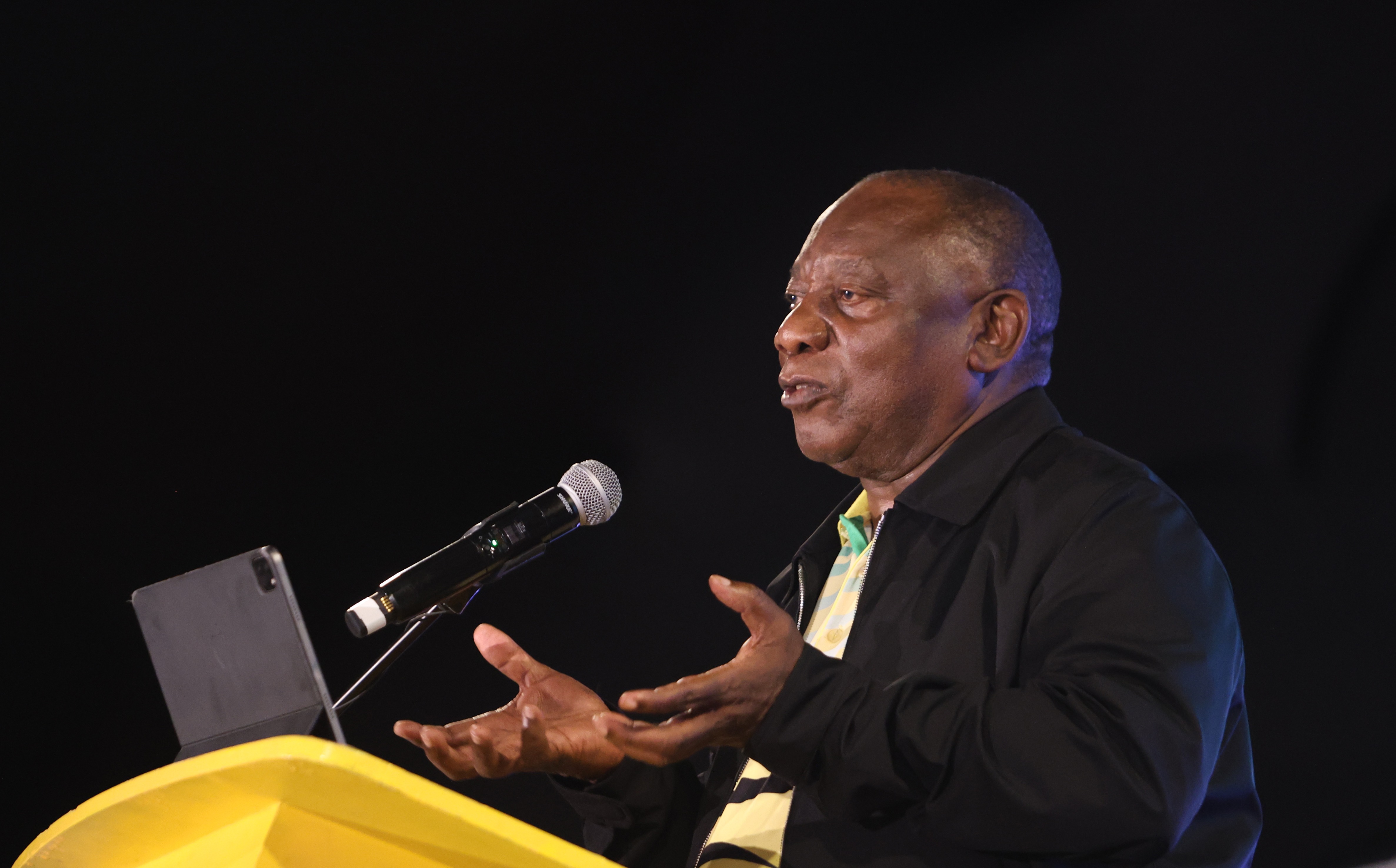
 President Cyril Ramaphosa delivers the closing remarks at the 5th National General Council of the ANC in Boksburg on 11 December 2025. (Photo: Felix Dlangamandla)
 1. Ramaphosa will lead the 2026 local government election campaign
The ANC closed its National General Council (NGC) with a show of unity as reports of a plot to remove President Cyril Ramaphosa dissipated into thin air. Boosted by a successful G20, Ramaphosa will lead the party’s local government campaign in 2026/27.
The party is trying to stave off a further electoral decline, which stripped it of its overall majority in 2024. This means he will stay in office at least until the party elects his replacement in 2027.
“No chairs flew,” said Ramaphosa to laughter and applause as he closed the meeting on Thursday, 11 December, and reflected on earlier rumours in the media.
Read more: Will Ramaphosa stay or go? What you need to know about the ANC’s NGC
/file/attachments/orphans/WFD_9499_206498.jpg "President Cyril Ramaphosa closes the 5th National General Council of the African National Congress held in Boksburg on 11 December 2025. (Photo: Felix Dlangamandla)")
For now, the Government of National Unity (GNU) in its present configuration stays, but with caveats. This includes an emphasis on “progressive policies”, which probably means National Health Insurance (NHI) as well as more muscular land reform.
Every branch of the ANC will audit ward-based challenges and make those a priority, said Ramaphosa. The party has also started a service delivery hotline and call centre at its Luthuli House headquarters. The ANC said there would not be political interference in local government procurement and appointments – effectively a promise to stop cadre deployment. (This is a promise it will find difficult to keep, given recent history.)
2. Keep an eye on ANC secretary-general Fikile Mbalula
As this article showed, Mbalula has emerged as a candidate to run for the ANC presidency. At the NGC, his organisational report (a weighty and well-written tome) received an extended standing ovation and singing by almost 1,600 delegates.
/file/attachments/orphans/6I1A5736_830678.jpg "Fikile Mbalula addresses the 5th National General Council of the African National Congress in Boksburg on 11 December 2025. (Photo: Felix Dlangamandla)")
This means the ANC elective conference in 2027 could include a race between Mbalula and deputy president Paul Mashatile, who was previously regarded as a shoo-in. Mbalula could also be positioning for the job of deputy president, with its twin position in the state also being plum, if the party can stave off further decline.
The latest Ipsos poll has found that if an election were to be held tomorrow, the ANC would get 41% nationally.
3. The ANC wants to ‘detenderise’ the state
You read that right.
“The tenderisation and outsourcing of state functions have weakened the democratic state’s capacity to drive development,” said the final NGC declaration.
This is important because the outsourcing of state services through procurement is at the heart of State Capture and also of the collapse of local government services, as contractors often do poor-quality work. The state’s procurement budget is more than R1-trillion a year, so it’s not likely to be implemented in full as the state won’t be able to function.
The National Treasury’s new dashboard to help ensure transparency in procurement is an important tool to prevent corruption and possibly a more effective measure than a ban on “tenderisation”.
4. ‘We’re in an existential crisis’
The ANC has defined itself as being in an existential crisis.
“[We are in] an existential crisis which places national liberation at a crossroads. The struggle is at a forked road – it’s renewal or perish,” said Mbalula as he read the declaration.
/file/attachments/orphans/6I1A5718_696952.jpg "Delegates at the 5th National General Council of the ANC in Boksburg. (Photo: Felix Dlangamandla)")
/file/attachments/orphans/WFD_9487_480843.jpg "Delegates unite in song on the last day of the council on 11 December 2025. (Photo: Felix Dlangamandla)")
Liberation movements that become governments tend to face decline after 30 years in power – the point the ANC is at. Paraphrasing Mark Twain, a leading analyst in the financial sector says the news of the ANC’s death is exaggerated, but that it is in decline, although not in a death spiral.
That view was reflected in various ANC resolutions. The party has promised to field only “honest, capable and dedicated” candidates in the local government election. (You should pin that sentence.)
“We are not daunted nor cynical about the renewal of our movement,” said Ramaphosa.
5. Win back the support of the black middle class
The ANC has reasserted its role in the formation of a black middle class, or what it calls the “black middle strata”, and of a generation of black and women-owned businesses. The party has acknowledged that poor service delivery and corruption have alienated black professionals and middle-class people, and it wants to win back their support.
The ANC is planning to campaign against a multi-front attack on BEE policies – both the civil society group Solidarity and the DA are charging against black empowerment in massive campaigns. There are about 3.4 million people in this group, depending on the definition used.
6. The Integrity Committee will get more teeth; the NHI is coming
Ramaphosa said more members were stepping aside when charged in corruption-linked cases. But the Integrity Committee also noted that it was difficult to have its recommendations implemented by the party’s national executive committee. Delegates agreed that the Integrity Committee would get more independence. (This is easier said than done.)
The council meeting resolved that the implementation of the NHI would proceed. An Institute for Justice and Reconciliation Annual Barometer published this week showed massive support for an NHI despite business, the opposition and other bodies launching court cases against it. The barometer is one of SA’s longest and largest longitudinal studies of public opinion. DM