



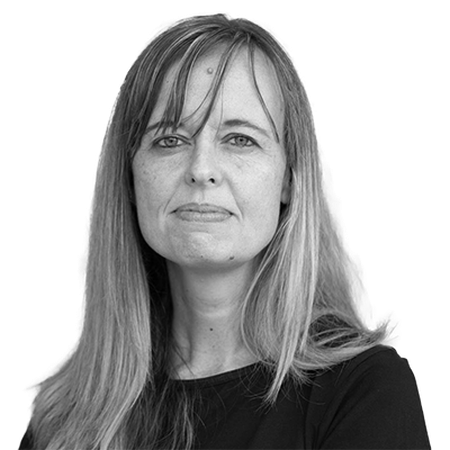
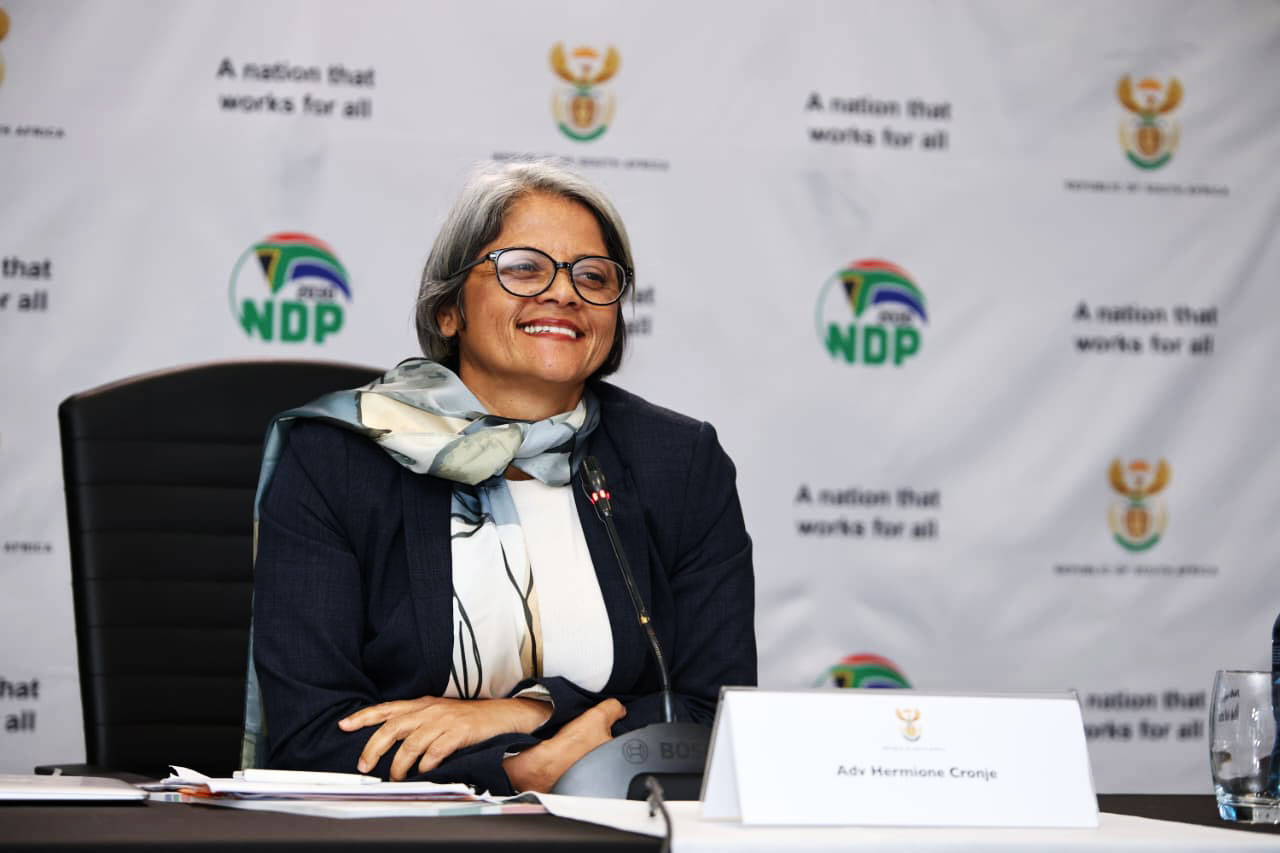
 Advocate Hermione Cronje appears in the interviews before the advisory panel for the selection of the National Director of Public Prosecutions. (Photo: Wandile Ngaxa / GCIS)
 /file/dailymaverick/wp-content/uploads/2025/10/label-analysis-2.jpg)
The appointment of a new National Director of Public Prosecutions (NDPP) is hugely significant.
This is one of the key roles in South Africa that can help shape everyday life for us all for the next decade and define the nature of the political climate. A captured National Prosecuting Authority (NPA) boss can, at the risk of hyperbole, help bring down the country.
That’s why it’s so unfortunate that it feels as if the all-important interview process to nominate candidates to President Cyril Ramaphosa has been hastily backloaded on to the dying embers of the year as an afterthought. By 11 December, South Africans are exhausted. For many people, it’s the last full work week for the year — and the country is dragging itself to the finish line.
Inevitably, if you hold NDPP interviews during the last work week of the year, there will be consequences. The main one is that the level of scrutiny and engagement with this process has been lower than it should be for such an important position.
To give one example, Justice Minister Mmamoloko Kubayi claimed on Wednesday that the DA — normally hyper-focused on this stuff — had not made a single submission on the candidates.
Read more: The best and worst moments from Day 1 of the interviews for the NPA’s top job
A sub-optimal process
Matters have not been helped by several other strange features in this process.
Amid criticism of one candidate, in particular, on the list, Kubayi sought to claim at the interviews’ outset that the shortlist of six candidates to be interviewed was not, in fact, a “shortlist” per se.
“We have not shortlisted. What we did as a panel was check the suitability of the candidates in terms of meeting the minimum requirements,” declared Kubayi.
This is despite the fact that the Ministry of Justice’s statement on the interviews referred to “six shortlisted candidates”.
But have it your way, Minister Kubayi: it wasn’t a shortlist, it was just a … short list.
/file/attachments/orphans/5_253115.jpg "Justice Minister Mmamoloko Kubayi. (Photo: Lwandile Ngaxa / GCIS)")
Then there’s the fact that, as UWC academic Jean Redpath pointed out, the NDPP job advert deviated from the requirements for the job as laid down in the NPA Act by suddenly adding a new criterion: a “minimum of 10 years’ executive management experience”.
Redpath described the focus on executive management as opposed to litigation experience as “perplexing”.
There’s the equally perplexing composition of the selection panel, which included just two lawyers and nobody with prosecutorial experience.
Should the nomination of the next NPA boss really be left in the hands of the likes of SA Human Rights Commission head Chris Nissen and Commission for Gender Equality chair Nthabiseng Sepanya-Mogale, both of whom helm scandal-tainted Chapter Nine institutions?
Read more: Meet the seven panellists who are steering the interviews for the NPA’s top job
And finally, there’s the Menzi Simelane-shaped elephant in the room.
/file/attachments/orphans/WhatsApp-Image-2025-12-11-at-1609_858666.jpg "Advocate Menzi Simelane appears as the first candidate on the second day of interviews before the advisory panel for the selection of the NDPP, at the Auditor-General’s offices in Pretoria. (Photo: Wandile Ngaxa / GCIS)")
That someone who has already been found by the courts to have been an “irrational” appointment as NDPP under Jacob Zuma could make it to the interviews is nothing short of ludicrous.
It is so ludicrous, in fact, that a number of people in the legal sector believe he was included as a “decoy”: as a stalking horse to attract outrage, eat up much of the oxygen around the process, and in so doing ensure that relatively less scrutiny is given to some of the other candidates, who also automatically seem more palatable by comparison.
That may sound conspiratorial, but it’s not unprecedented: this kind of manoeuvring was straight out of the Jacob Zuma playbook.
And if Simelane was thrown in as a distraction, it has worked spectacularly well.
Simelane’s inclusion has been the story of the process. At least one local broadcaster carried Simelane’s Thursday interview live, but not the other two far superior interviews on that day. The DA has threatened to interdict any appointment arising from the panel’s recommendation as a result of Simelane’s shortlisting.
Any further discussion of Simelane’s candidacy risks exacerbating what has simply been a waste of everyone’s time.
Read more: Here are the four women and two men (one dodgy) shortlisted for top anti-corruption job
The favoured candidate
Speculation is rife that the preferred candidate of the political establishment is former Financial Intelligence Centre (FIC) boss Xolisile Khanyile — a perception certainly not helped by the fact that one of Khanyile’s references was from Deputy Finance Minister David Masondo.
A major feather in Khanyile’s cap is that during her time at the FIC, she is associated with getting South Africa off the greylist, with greylisting a topic Khanyile repeatedly returned to in her interview.
FIC insiders say that in reality, Khanyile’s involvement was limited, and the Treasury did not give her a second term.
/file/attachments/orphans/WhatsApp-Image-2025-12-11-at-0957_386174.jpg "Advocate Xolisile Khanyile appears on the second day of interviews before the advisory panel for the selection of the NDPP. (Photo: Wandile Ngaxa / GCIS)")
There is a confusing aspect of Khanyile’s candidacy, once again spotted by the indefatigable Redpath.
One of the legal requirements for the NDPP is that the relevant individual must have “the right of appearance in any court of the Republic”. Khanyile does not have the right of appearance, because she is no longer a prosecutor: since leaving the FIC she has been working as a consultant.
Redpath suggests it’s possible that this issue could be circumvented by Khanyile bestowing upon herself the right of appearance after being appointed as NDPP, but this is a complicated grey area that could lay Khanyile’s appointment open to a court challenge.
The fact that Khanyile has not been a prosecutor since 2017 will also fuel speculation, quite possibly unfairly, that the emphasis placed in the job ad on management experience rather than litigation may have been tailored to best suit a candidate of this kind.
In her interview, Khanyile was given a dressing-down by Kubayi for inconsistencies on her CV, but aside from this, she received a reasonably easy ride from the panel.
She was notably not asked about something civil society had pushed for her to be grilled on: the prosecution of 130 community health workers in the Free State when she was Director of Public Prosecutions in the province in 2014.
The community health workers were largely elderly women who staged a sit-in at the provincial health department and were subsequently prosecuted on Khanyile’s watch for holding an “illegal gathering”. They were convicted, but the convictions were overturned on appeal.
Khanyile delivered a pretty upbeat assessment of South Africa’s criminal justice sector to the panel.
She described the conviction rate as “high” and separately opined, “In organised crime, I think the NPA is doing very well”, begging the question of why, then, it is necessary for South Africa to have two separate inquiries currently looking into cartels.
One of her priorities as NDPP, Khanyile said, would be ensuring “that our country looks really good”.
Khanyile’s optimism seemed to be well received by the panel — who pushed back on a far more bleak assessment of the NPA by the next candidate, Hermione Cronje.
Cronje delivers some home truths
One got the sense that Cronje arrived at her interview determined to speak her truth about certain issues, even if it torpedoed her candidacy.
She was the sole candidate to give detailed examples of how the NPA was hollowed out by State Capture, which led to Cronje leaving the institution in 2011. She described how posts in the Asset Forfeiture Unit (AFU) began to be filled in questionable ways, leaving her with a team that was “not suitable”.
Cronje told the panel of her pride when the AFU secured its first preservation order in another jurisdiction — only to find out that Simelane, then acting NDPP, had subsequently met with the defendant and decided “he didn’t see the underlying criminal activity”.
Lured back to the NPA in 2019 to launch the Investigating Directorate (ID), Cronje did not mince her words about the state of “dysfunction” in which she found the NPA, even with the days of State Capture ostensibly in the past.
“The narrative was that, ‘Actually, everything’s fine in the NPA.’ That was definitely not my experience,” said Cronje.
She described what she termed a “skills catastrophe” in the NPA, with the teams working on State Capture not being “equal to the task”.
/file/attachments/orphans/C-_Users_danie_OneDrive_Desktop_WORK_DM_27-Nov_ED_163719_458331.jpg "Top prosecutor Hermione Cronje led the NPA's Investigating Directorate from 2019 to 2022. (Photo: Elizabeth Sejake Rapport / Gallo Images)")
At one stage, Cronje said, she commissioned a skills audit, but the results were “so depressing” that the NPA wouldn’t release them.
Cronje told the panel of her frustration at being given the task of leading the ID, and rapidly discovering that there was little to no institutional support for the work she was trying to do — leading to her leaving in defeat in February 2022.
This led panel members to question what guarantee they would have that Cronje would go the distance if appointed as NDPP. Her response was brutally honest, possibly to her detriment.
If she was made NDPP but not given the budget or support needed to make the reforms she envisaged, “I have no intention of sticking around,” said Cronje — an unheard-of level of candour for a candidate in this kind of forum.
She also made no bones about the fact that her approach was likely to get people’s backs up, but was unapologetic.
“I’m the kind of person who will get the job done even if there are some bodies in the wake,” she said drily.
Cronje’s unfiltered honesty seemed to unsettle some members of the panel, and she was accused of “exaggerating” the skill issue at the NPA.
She was unruffled, maintaining: “I am not convinced we have the skills … to put together the kind of [State Capture] charge sheet that is needed.”
But the advocate also stressed that the situation was not hopeless.
“I believe that we have solutions to these things, but we’re never going to implement them if we don’t address the reality,” she said.
There is no doubt that Cronje, in some ways, is a hard sell as NDPP due to her self-confessed lack of personal diplomacy.
She admitted to having “tendencies to stray outside of my lane”, was perfectly candid about the fact that many people in the NPA would probably oppose her appointment, and added: “Many people are worried when I speak.”
But the impression one was left with is that this would be a truly independent NDPP: good luck to future Presidents or justice ministers attempting to influence prosecutorial decisions by leaning on Cronje. Good luck.
If what is wanted is an NDPP with the guts and vision to implement truly bold, truly meaningful reform, Cronje emerged as head and shoulders above the other candidates.
But it is, of course, in many powerful people’s interests that the NPA not be reformed — so don’t put too much money on Cronje actually getting the nod. DM