



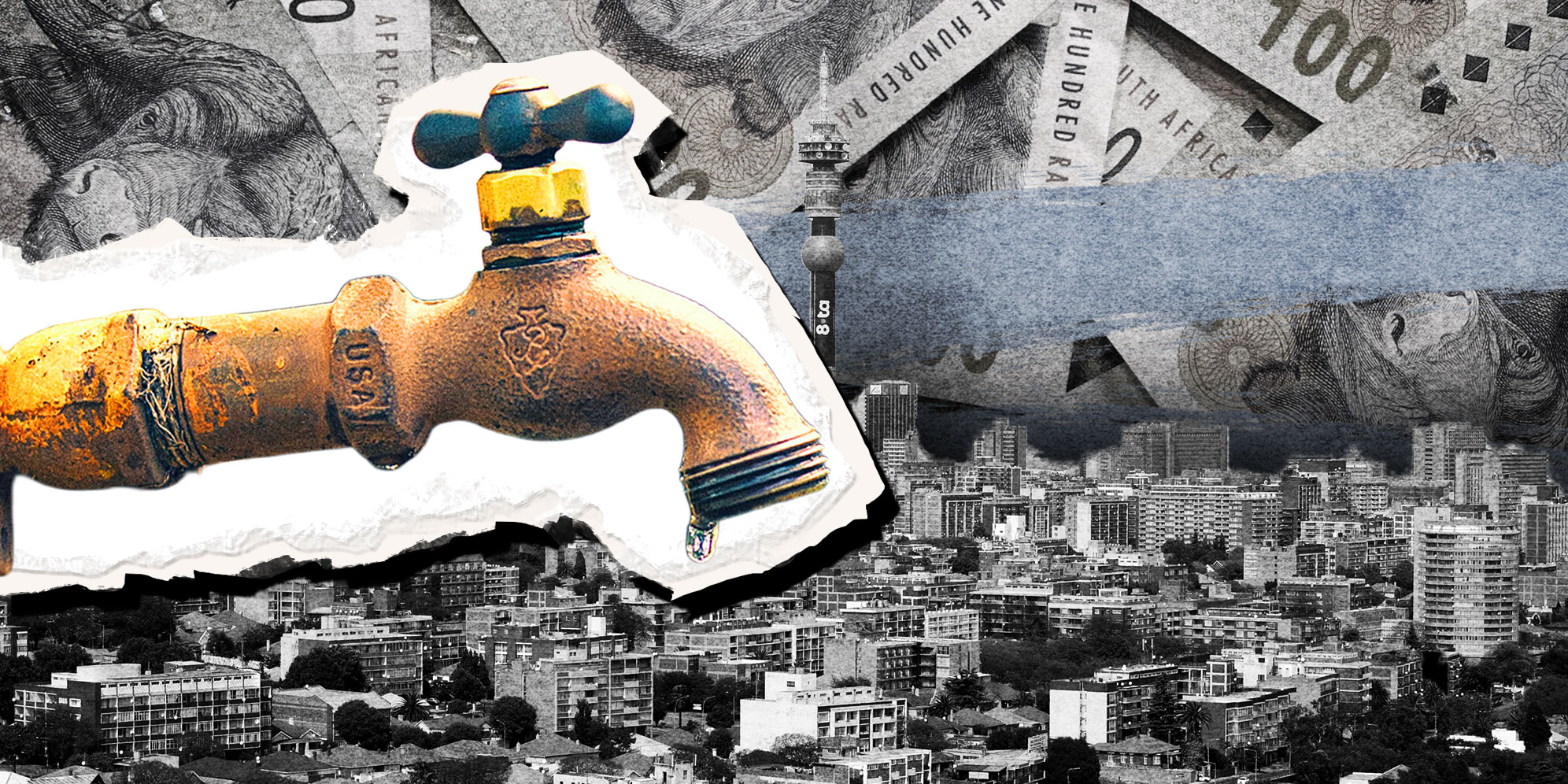
 Illustrative Image: Tap. (Image: Unsplash) | Johannesburg’s skyline. (Photo: Getty Images / Herman Verwey) | Money. (Photo: Istock) | (By Daniella Lee Ming Yesca)
Figures tabled in Joburg Water’s quarterly report to the Johannesburg City Council in December 2025 reveal that government entities owe hundreds of millions of rand to the City’s beleaguered water utility. Meanwhile, Joburg Water is struggling to pay contractors due to cash-flow constraints.
/file/attachments/2985/142025-12GovdeptsthatoweJW_619694_154f3e6c76f8bfb41b79d7546c0b13db.png)
The biggest government culprits for non-payment are:
- Department of Education owes R188,993,073.
- Department of Health owes R99,212,453.
- Department of Housing R52,539,324.
- Department of Infrastructure Development owes R74,704,430.
The biggest parastatal culprits are:
- Transnet owes R43,251,082.
- Prasa owes R41,226,568.
- Eskom owes R54,901,456.
The total amount owed to Joburg Water by government departments and state-owned entities is R627,832,749.
The majority, R370,479,976, has been in arrears longer than three months.
Again, the biggest culprits in long-overdue payments are: Education (R131-million); Health (R7-million); Infrastructure (R58-million); and Housing (R43-million).
The habitual late payers are Eskom (R20-million outstanding); Transnet (R42-million); Passenger Rail Agency of SA (Prasa, R32-million); and Transnet Freight Rail (R3-million).
While the report tabled simply notes these outstanding amounts, there is no indication of what Joburg Water is doing to retrieve the money. The report was tabled and accepted without debate.
Read more: R4bn diverted from Joburg Water — Auditor‑General says cash exists ‘on paper’
Who is being disconnected for non-payment?
According to Joburg Water, if a water account is not paid within 30 days of the customer statement date, the City sends a pre-termination notice. A customer has 14 days from the date of notice to pay in full or to make partial payment arrangements.
If there is no response or payment within the 14-day window, Joburg Water is then supposed to proceed with a Level 1 disconnection without further notice. For residential properties, this typically involves installing a water-restricting device to provide a minimum basic supply of water, rather than a complete cut-off. For businesses, a complete disconnection is possible.
Failure to respond to the Level 1 disconnection notice within another 14 days will result in the account being handed over to attorneys for legal action. Joburg Water says if a water-restricting device is tampered with, a Level 3 disconnection is implemented, and the customer is required to open a new account and pay a new deposit to restore services.
Read more: Joburg’s water infrastructure — a picture of decline and underinvestment
The report to council notes that the amount of overdue debt increased slightly from 37% in the fourth quarter (April-June) of 2024/26, to 48% in quarter 1 (July-September) of 2025/26.
The amount issued for disconnections in quarter 4 was R9.4-billion (R3.5-billion successfully disconnected) and R11.4-billion in quarter 1 of 2025/26 (R5.5-billion successfully disconnected).
Properties investigated for illegal connections for the quarter decreased from 28,197 in quarter 4 to 12,314 in quarter 1 of 2025/26 financial year due to reduced use of the contracted service, the report states.
Confirmed illegal connections increased from 26% in quarter 4 to 33% in quarter 1.
Ironically, the same report notes that Joburg Water has an R872-million problem with overdue payments that it owes for work done in the months of July to September. The report states that 87% of the late payments were attributed to cashflow constraints – meaning that the more than R600-million owed by government departments and entities would go a long way to sort this out. DM
This story is produced by Our City News, a non-profit newsroom that serves the people of Johannesburg.
/file/attachments/2985/WhatsAppImage2025-11-21at1946001_346702_1cea9e715c05dc0a538fc79753ac3401.jpeg)