



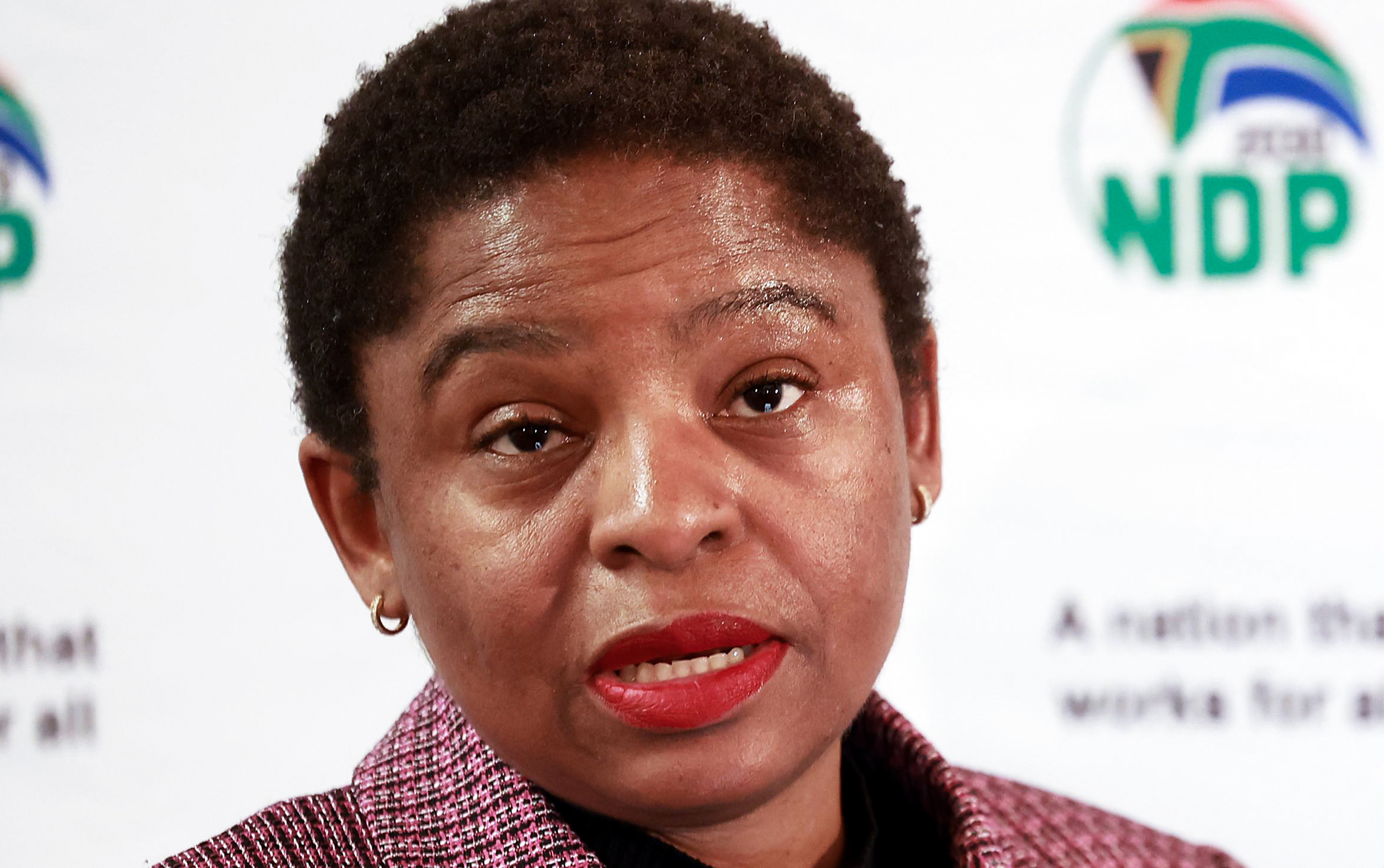
 Minister in the Presidency Khumbudzo Ntshavheni. (Photo: Elmond Jiyane / GCIS)
 The Cabinet has approved the National Strategy to Accelerate Action for Children (Nsaac), a framework that aims to intensify efforts to advance the welfare and development of children and adolescents across South Africa.
Khumbudzo Ntshavheni, minister in the Presidency, announced the Cabinet’s decision on Wednesday, 10 November, noting that the strategy emphasised “collaboration and shared responsibility” to ensure that every child had an opportunity to thrive. The 5th National Plan of Action for Children 2025–2030, which will ensure the implementation of the Nsaac, was also signed off on.
Mesuli Kama, the network and mobilisation lead at the Hold My Hand campaign, a national movement in support of the Nsaac, called the approval of the strategy a “significant milestone”.
“It’s significant in that government has finally committed to driving this strategy, creating the platform for everyone, including [government] departments themselves, to use this as a guide to make the call for action,” said Kama.
“Now that the strategy has been officially signed, it shifts the mindset… It’s a galvanising strategy.”
The 10 national priorities under the Nsaac are:
- Strengthening families and supporting parents and caregivers;
- Reducing infant and child deaths;
- Eliminating HIV transfer to babies;
- Improving child nutrition;
- Boosting early learning and brain power;
- Preventing disability and promoting inclusion;
- Ending abuse, violence and exposure to harmful substances;
- Improving adolescent access to health, including sexual and reproductive care;
- Ensuring quality education and linking school-leavers to work; and
- Building teenagers’ identity, agency and connectedness.
The plan involves strengthening existing programmes across government departments, while also requiring all of society to work together to accelerate action, according to the Hold My Hand campaign.
Cabinet’s approval of the Nsaac comes about eight months after President Cyril Ramaphosa’s announcement in his State of the Nation Address that the government would adopt the strategy.
It also follows the handover of the Children20 Declaration, a set of recommendations stemming from youth-driven dialogue, to the President during the G20 Social Summit in November.
Read more: Children20 Declaration represents hopes of young people for a better world, says child leader
Developing the Nsaac
The process of developing the Nsaac started about two years ago, said Kama. Incidents such as the Enyobeni Tavern disaster in East London, in which 21 young people died, and reports of low literacy rates among Grade 4 learners, sparked renewed commitment to addressing the welfare of young South Africans.
The Presidency convened a technical task team with representatives of civil society organisations and departments that realise children’s rights to develop the strategy.
During the development process, the Presidency entered into a memorandum of agreement with the DG Murray Trust to form the Hold My Hand campaign as an accelerator that could interface between the government and civil society partners in supporting the Nsaac, said Kama.
He noted that the strategy sought to establish presidential leadership for children and teenagers, and a clear set of national priorities to accelerate progress. It also identified mechanisms for combined action by government, civil society, trade unions and the private sector.
“The Presidency is where this will be coordinated. Now, the next move is to strengthen the Office on the Rights of the Child, because it’s going to be crucial in monitoring implementation of children’s rights as guided by the strategy,” said Kama.
The Hold My Hand campaign has already been involved in identifying “key levers of change” to advance the welfare of children. Over the past year, it has driven a public engagement campaign, aimed at children and caregivers, building awareness around issues affecting young people.
“We have started to do some work. For example … within the early hearing detection and intervention space … we had already started engagements and the community of practice with implementation partners, where we’re thinking together around having universal hearing screening in South Africa,” said Kama.
“We don’t have that hearing screening for newborn babies. They are sometimes identified very late, and hearing is very important for learning.”
While the Hold My Hand campaign was not an implementer, it served to coordinate other organisations in supporting the Nsaac, noted Kama.
The Department of Social Development told Daily Maverick that the vision of the Nsaac was that all children in the country achieved optimal wellbeing and could grow to their full potential.
“This requires a whole-of-society approach and sustained investments in maternal health and the earliest years of childhood through to adolescence, to improve and accelerate development outcomes for children across all stages of their lives,” said the department.
The implementation of the Nsaac would involve identifying the high-level changes needed to support an effective child rights governance system, said the department.
“Child rights governance is a deliberate process of organisation planning, provisioning and accounting by all members of the national child rights community to advance a shared vision for children. It aims to establish and strengthen the governance system necessary to effectively implement child rights, as enshrined in the South African Constitution and in the international and regional child rights instruments that South Africa has ratified,” said the department.
‘Nothing for us, without us’
Bontle Motatsa (18) served as a children’s representative at the Children’s Sector Consultation on the Nsaac in 2024. At the time, she was the North West president of the Representative Council of Learners.
/file/attachments/orphans/PHOTO-2024-10-18-11-12-153_726042.jpg "Bontle Motatsa says the Cabinet’s approval of Nsaac shows that the government is listening to young people. (Photo: Siya Duda)")
Reflecting on why it was important to have children’s input on the NSAAC, Motatsa said: “The Nsaac itself is a strategy that is mainly focused on children... What we always say is ‘nothing for us, without us’. If you are going to make a strategy that affects a certain group of people, you have to make sure ... it takes into consideration their lived experiences, how they feel about it. Not just perceptions that were drawn from statistics and offices [of government].”
All too often, dialogues and conferences did not result in real change, said Motatsa, adding that the Cabinet’s approval of the Nsaac showed that the Presidency and government departments were listening to young people and enabling implementation.
“They are actually cancelling the ‘blue-tick’ culture, and they are allowing us to implement things and not just speak about them,” she said.
“It means that they are taking our perspectives, our experiences and the problems that we face daily more seriously.”
Among the priority actions that Motatsa would like to see coming out of the newly approved Nsaac are poverty alleviation, increased educational resources and less exposure to abuse among children in South Africa. DM
Tamsin Metelerkamp is the Children’s Reporter at Daily Maverick. The creation of this role was made possible with the support of the DG Murray Trust.