




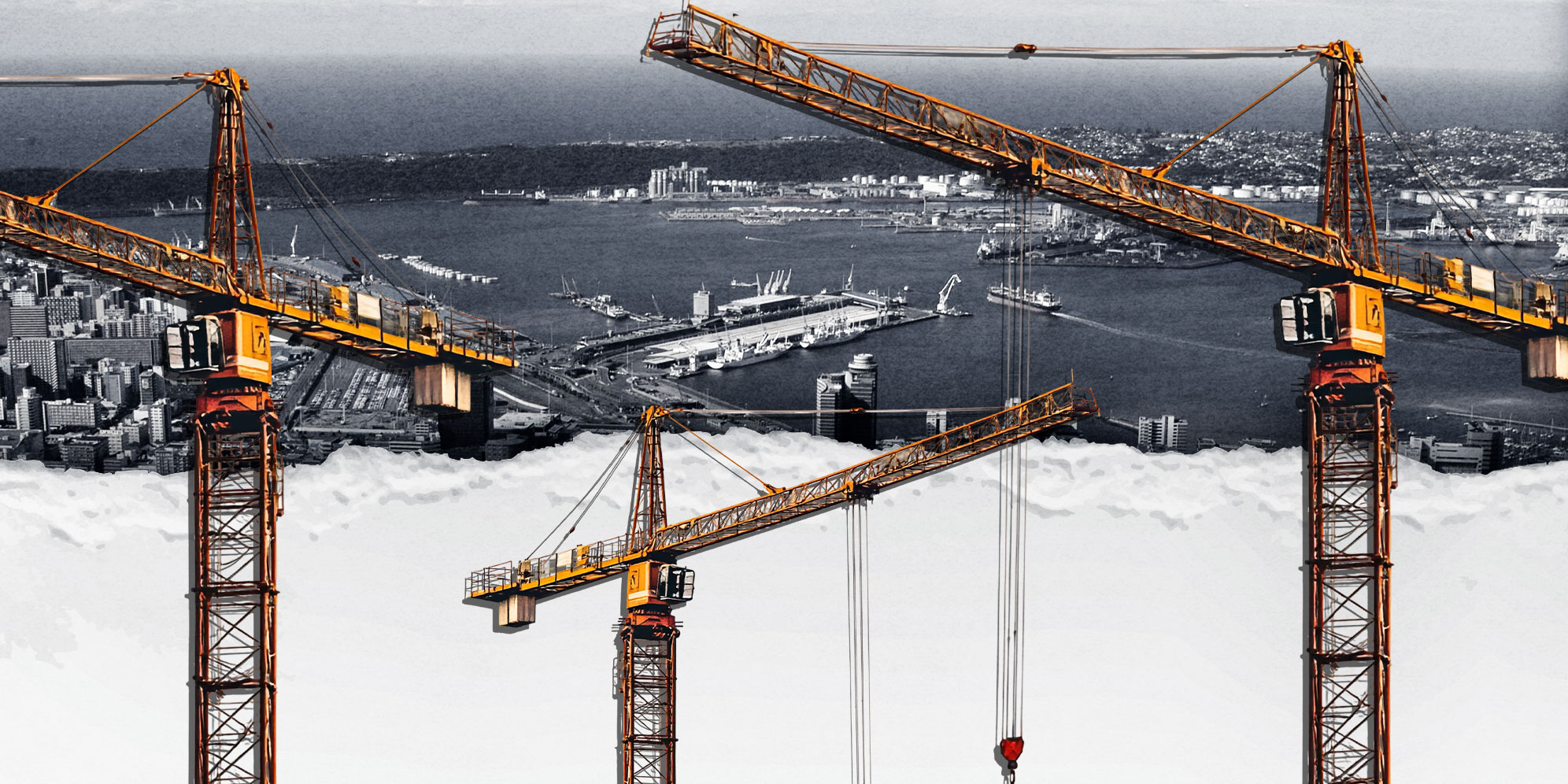
 Illustrative Image: Aerial view of the city of Durban and the harbour. (Photo: Gallo Images) | Cranes. | Torn paper. (Images: Freepik) | (By Daniella Lee Ming Yesca)
 I was quite cheered when I looked through the details of a big economic story yesterday.
It wasn’t just another in the endless processions of press releases that tell me the JSE has had a rip-roaring year (do they think you and I hadn’t noticed?), it was, strangely, a SENS statement from an SOE.
The SOE in question was Transnet. And the announcement was that they have finally signed an agreement with International Container Terminal Services (ICTS) about Pier Two at Durban Harbour.
Pier Two to our harbour system is a bit like Discovery to our medical schemes industry. It is pretty much the dominant piece of hardware.
As a result the lack of investment at the Durban port over the years has led to huge problems. You’ll remember all the stories about ships anchored offshore, waiting for their turn to come in and dock and offload their containers.
Now, under what I understand is quite a novel contract, Transnet is setting up a new company with ICTS. They are very nearly joint shareholders. Transnet will have precisely one more share than ICTS, giving them a majority shareholding. But the terminal will be run by ICTS.
This means that the more containers that are loaded and offloaded by ICTS during this time, the more money they will make. And to do that they obviously need to invest heavily in more equipment there.
Transnet expects them to invest R11-billion, and to do it pretty quickly.
The statement also explains that it will be able to increase the terminal’s capacity quite dramatically. More excitingly for those of us interested in these things, it is also expected to “improve gross crane moves per hour from 18 to 28”.
Now, the last time I was involved in anything quite as exciting as improving “gross crane moves per hour” it concerned my then young son and a Duplo train set.
Even now, if I happen to drive past a crane at work I feel the need to stop for a moment and take a look.
It’s probably the most fun equipment to operate that doesn’t involve actually moving.
But the best part of this is that it comes after a period of quite good news.
At the top level of the economy we’ve seen the JSE doing incredibly well, our government debt is lower, the inflation target has been reduced and we’re off that Financial Action Task Force grey list.
As I write this, the US Federal Reserve’s interest rate cut last night has strengthened the rand to the point where it’s touching 16.90 to the dollar.
Even the price of cocoa, the main ingredient in chocolate, has dropped by 45% since the start of the year!
So if, like me, you are a part of our incredibly broadly defined middle class, things are really beginning to look up. And for the first time in a while.
Well, I hate to be that person, but unfortunately very little of this is getting through to the vast majority of our people.
And recently there has been a flood of data illustrating how people feel.
The headline is probably that about 49% of people polled in October by Afrobarometer believe a military government, or a dictatorship of some kind, would be better than what we have now.
Yesterday, the Institute for Justice and Reconciliation released its Reconciliation Barometer.
Despite what you might see and hear and read in the middle-class media staffed by people like myself, fully 61% of people want a National Health Insurance to be implemented.
Considering that the vast majority of people don’t have medical aid and presumably access to private healthcare, you can’t blame them. It also explains why the ANC is so determined to campaign on this issue.
This survey also finds that very few people have trust in our politicians, but you probably knew that.
The real issue, obviously, is that so many people believe our current system is not working for them. Anyone forced to live as so many are would believe the same thing.
Of course, some things have improved – the end of load shedding is surely good for everyone, even if you do sometimes still suffer load reduction.
But as we inevitably start to think about next week’s public holiday, the trips home or being on holiday, and then the start of 2016, I think the big priority for next year is pretty clear.
We have to take all of the good news at the top level, the debt reductions and lower interest rates and gross crane moves per hour, and start to really get to work. And in the process try to get more money into more households.
Yes, there is a lot of hard stuff to be done. But we’ve already made progress, we have got the processes started.
On balance, I think 2026 might see us making real progress.
And not just because of our Proud Policy of Undue Optimism. DM