




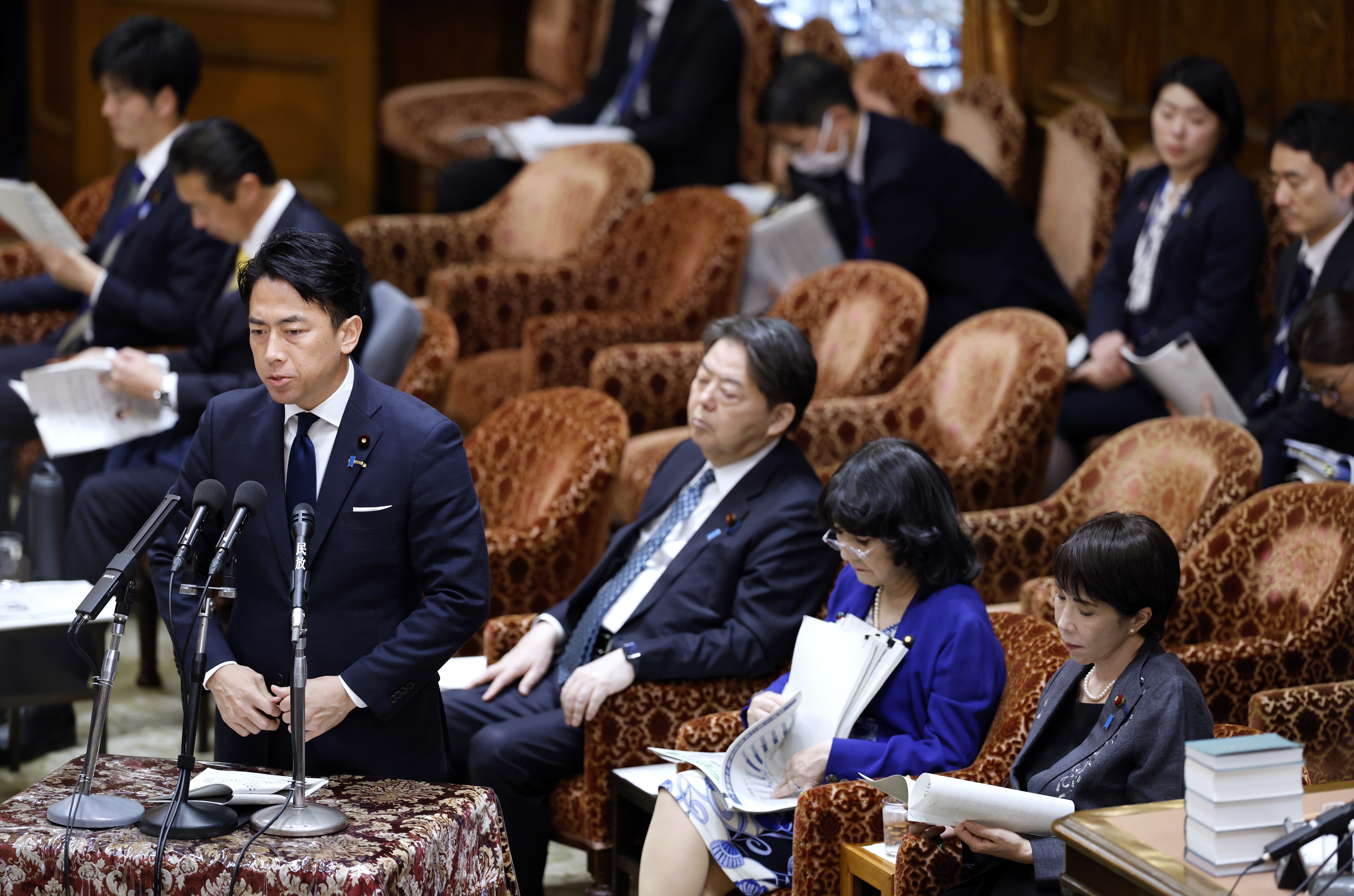
 Japan's Defense Minister Shinjiro Koizumi attends a House of Representatives Budget Committee meeting at the Diet in Tokyo, Japan, 09 December 2025. Defense Minister Koizumi made comments following an incident in which a Chinese military aircraft directed its radar at a Japan Self-Defense Force plane. EPA/FRANCK ROBICHON
 The run-in near Japan's Okinawa islands comes after Japanese Prime Minister Sanae Takaichi triggered a dispute with Beijing last month with her remarks on how Tokyo might react to a hypothetical Chinese attack on Taiwan.
China claims democratically governed Taiwan and has not ruled out using force to take control of the island, which sits just over 100 km (62 miles) from Japanese territory and is surrounded by sea lanes on which Tokyo relies.
"China's actions are not conducive to regional peace and stability," a State Department spokesperson said late on Tuesday, referring to the radar incident.
"The U.S.-Japan Alliance is stronger and more united than ever. Our commitment to our ally Japan is unwavering, and we are in close contact on this and other issues."
Japanese Chief Cabinet Secretary Minoru Kihara welcomed the comments, saying they "demonstrate the strong U.S.-Japan alliance".
Speaking in Beijing, Chinese Foreign Ministry Spokesperson Guo Jiakun avoided direct criticism of the U.S. remarks, reiterating that China's training and exercise activities were in line with international law and conducted safely in a restrained manner.
"We hope that the international community can tell right from wrong and not be hoodwinked by the Japanese side. Japan's allies, in particular, should heighten their vigilance and not be manipulated by Japan," he added.
Japan late on Tuesday scrambled jets to monitor Russian and Chinese air forces conducting joint patrols around the country.
On Wednesday, Japan's coast guard said its ships spotted four Chinese coast guard vessels near the disputed but Japan-administered Senkaku islands in the East China Sea.
China's coast guard said it was carrying out a "legal" operation to safeguard the country's rights and interests. China calls the uninhabited islands the Diaoyu.
MOST SERIOUS INCIDENT IN YEARS
The Chinese fighter jets aiming their radars at the Japanese planes on Saturday was the most serious run-in between the East Asian militaries in years.
Such moves are seen as a threatening step because they signal a potential attack and may force the targeted plane to take evasive action. Tokyo blasted the moves as "dangerous".
Beijing, however, said that the Japanese aircraft had repeatedly approached and disrupted the Chinese navy as it was conducting previously announced carrier-based flight training east of the Miyako Strait.
Speaking to reporters in Taipei on Wednesday, Taiwan President Lai Ching-te said China's drills were "very inappropriate behaviour".
"We also call upon China to demonstrate the responsibility befitting a major power. Peace is priceless; war has no winners. Peace must be fostered by all parties, and China shares this responsibility," he said.
Relations between Asia's two largest economies have soured sharply since Takaichi told parliament last month that a Chinese attack on Taiwan could amount to a "survival-threatening situation" and trigger a potential military response from Tokyo.
Beijing has demanded she retract the remarks, accusing Tokyo of threatening it militarily and advising its citizens not to travel to Japan.
U.S. Ambassador to Japan George Glass has publicly expressed support for Japan in several social media posts since the diplomatic dispute began, but President Donald Trump and other senior U.S. officials have remained silent.
Trump, who plans to visit Beijing next year for trade talks, phoned Takaichi last month, urging her not to escalate the dispute, people with knowledge of the matter told Reuters.
(Reporting by Daphne Psaledakis in Washington and John Geddie in Tokyo; Additional reporting by Ben Blanchard in Taipei, Liz Lee in Beijing, and Anton Bridge and Kantaro Komiya in Tokyo; Editing by Tom Hogue, Stephen Coates and Kate Mayberry)