



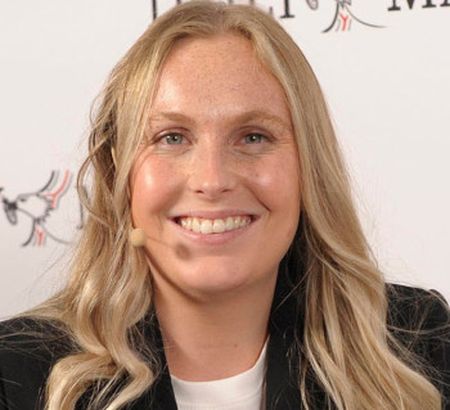
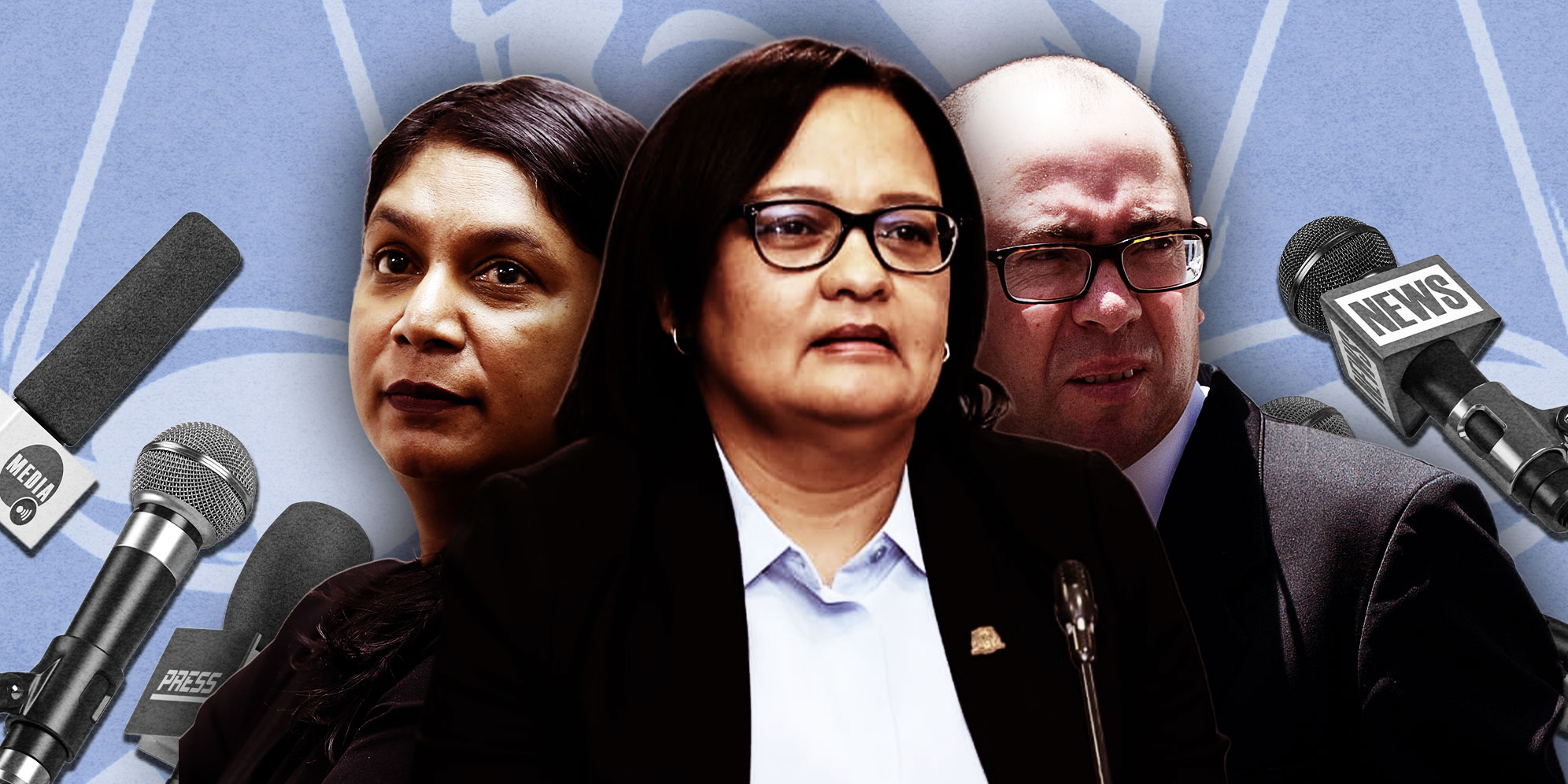
 Illustrative image: Advocate Andrea Johnson. (Photo: Felix Dlangamandla) | Advocate Nicolette Bell. (Photo: GCIS / Lwandile Ngaxa) | State prosecutor advocate Adrian Mopp. (Photo: Gallo Images / Foto24 / Nasief Manie) | Microphones. (Image: Freepik) | NPA logo. (Image: Wikicommons) | (By Daniella Lee Ming Yesca)
 Director of Public Prosecutions in the Western Cape, advocate Nicolette Bell, one of three candidates interviewed for the position of National Director of Public Prosecutions (NDPP) on Wednesday, 10 December, was frank: “To prosecute, and to prosecute successfully, we need evidence. We need witnesses to come forward and to testify. But witnesses are scared.”
Her comment came on the back of the murder of Marius van der Merwe, a Madlanga Commission witness, outside his home in Brakpan, Gauteng, on 5 December. Van der Merwe – a former Ekurhuleni metro police officer – gave anonymous testimony before the commission about the alleged torture and murder cover-up of a robbery suspect in 2022. He said he had been tasked with the disposal of the body.
Read more: Madlanga Commission Witness D’s murder forces focus on whistleblower security
Daily Maverick’s Caryn Dolley reported that among those Van der Merwe implicated was suspended Ekurhuleni metro police boss Julius Mkhwanazi.
Van der Merwe was not under witness protection. Daily Maverick’s Vincent Cruywagen reported that he turned down an offer to be put into the programme. Police have since identified three “persons of interest” in his killing.
His murder is the latest incident in an ugly string of whistleblower assassinations.
Justice Minister Mmamoloko Kubayi (who chairs the NDPP interview advisory panel) has received intense criticism after saying the Justice Department would engage the Madlanga Commission about reviewing how witness testimonies were broadcast to improve their safety, reported News24. Political parties accused her of attempting to shift blame from the state’s failure to protect witnesses, reported the publication.
Bell told the seven-person advisory panel on appointing a new NDPP that the protection of witnesses was paramount to obtaining successful prosecutions. Her Deputy Director of Public Prosecutions in the Western Cape, advocate Adrian Mopp, later said the same thing.
Mopp and Bell are among six candidates competing for the top post at the National Prosecuting Authority (NPA), and were interviewed along with Investigating Directorate Against Corruption (Idac) head Andrea Johnson on Wednesday.
/file/attachments/orphans/2_589698.jpg "The advisory panel for the selection of the National Director of Public Prosecutions (NDPP), chaired by Minister of Justice and Constitutional Development Mmamoloko Kubayi (centre), began interviewing the six candidates who met the minimum requirements, starting with advocate Nicolette Bell. (Photo: GCIS / Lwandile Ngaxa)")
The marathon session saw panellists sit for more than nine hours interviewing the three candidates.
Chairperson of the Global Coalition to Fight Financial Crime, advocate Xolisile Khanyile, former NDPP advocate Menzi Simelane and former NPA Investigating Director advocate Hermione Cronje will be interviewed on Thursday, 11 December.
Read more: Here are the four women and two men (one dodgy) shortlisted for top anti-corruption job
Let’s look at some best and worst moments that emerged from the candidates’ interviews on Wednesday.
Best moments
Auditor-General of SA Tsakani Maluleke said that the panel had received nine public comments on Bell’s nomination, most of which were supportive.
Bell spoke at length during her interview about her experience in managing people (an essential quality for the role). She described her management style as “consultative”.
Bell reminded the panel that she was responsible for ensuring that Judge John Hlophe’s inexplicable decision to unlawfully acquit former State Security Minister Bongani Bongo of corruption did not stand.
Bongo was on trial for corruption in the Western Cape Division of the High Court in Cape Town for allegedly trying to bribe Eskom inquiry evidence leader Ntuthuzelo Vanara to collapse Parliament’s probe into issues at Eskom.
In March 2021, Bell decided to appeal against Hlophe’s decision to acquit Bongo.
“What I learnt from that case is: prosecution must have a plan. We must present the court with all the evidence. And the courts must know that we will challenge the outcome if we are not happy.
“It instils confidence that we are all equal before the law. It doesn’t matter what the profile of the accused is; we will follow the letter of the law. We will take the matter on appeal,” said Bell.
***
Kubayi pointed out that of Mopp’s 33 years as a prosecutor, 24 of them have been spent in management. “Your experience in terms of prosecution is vast,” she said.
She questioned him on his vision for the NPA, and what he would do differently.
Mopp said there were two “anchors” that underpinned his vision. The first was independence.
“There is still the narrative that the NPA is captured,” said Mopp. He said one way to demonstrate independence was to make clear that the prosecution unit’s decisions were informed only “by the law and the facts”.
The second anchor, Mopp said, was “ethical leadership”. He told the panel he would “welcome and endorse” lifestyle audits.
“If the view is that a person who has been subjected to a lifestyle audit is more credible than one who is not, then we must embrace that. Because that is part of instilling the confidence that we want to have,” he said.
***
Asked about her vision for the NDPP position and how she would respond to the challenges within the NPA, Johnson said:
“Currently, in terms of the NPA’s performance, the three areas where the performance is not what it should be are the areas of corruption, GBFV [gender-based violence and femicide] and organised crime,” she said.
“Coming in, what a National Director would have to do is to understand what it is that we do not have; that we need to have as prosecutors and as an institution. What is glaringly clear is that in terms of the capacity, all of those specialised units need more capacity. But numbers, of necessity, [do] not equate to performance. We therefore need capacity that has the relevant capabilities,” added Johnson.
She said that this meant the NDPP needed to ensure that prosecutors were trained in the relevant fields.
Johnson said the NPA’s aspirant prosecutor programme was too “generic”.
“The prosecutor programme has got to attract and retain a higher graduate than what it currently does,” sha said.
Worst moments
The panel grilled Bell on her vision for the NPA.
“Advocate Batohi has built a foundation,” she responded. Bell said her vision would be to “accelerate” the work that Batohi had done. She said she also wanted to “accelerate” the work that Idac was doing, adding that it “has to be financially and operationally independent”.
The Idac was made a permanent, independent unit within the NPA in August 2024, after President Cyril Ramaphosa signed the NPA Amendment Act into law.
Near the end of her interview, panellist Machini Motloung challenged Bell again on her vision for the institution, and how she would move differently from her predecessor.
“What I get from you, is what is currently in place,” he said frankly. Motloung wanted Bell to detail a “strategic shift from what we have, because what we have appears to be inadequate”.
However, Bell doubled down and reiterated her vision of hastening the work being done.
“Drastically changing the strategy of the NPA is not going to assist,” she said.
Bell also received criticism from Kubayi and other panellists about the decline in convictions for sexual offences in the Western Cape under her leadership. She replied that she had “monthly meetings with senior leadership” on how to improve.
***
Like Bell, Mopp was questioned at length by Kubayi and others on the panel about the Western Cape’s conviction rates for murder and sexual offences.
He attributed the problem to the quality of evidence that prosecutors received from the South African Police Service (SAPS).
“If you look at what causes us to have that level of conviction rate, essentially it is the quality of the evidence,” he said. Kubayi pushed Mopp to explain his response, saying that the police would disagree.
“We’ve had cases where the police have mingled with some of the evidence,” Mopp said, later adding that an affidavit was critical because that was what a case was founded on. However, he says the NPA had engaged with both metro police and the SAPS to explain what exactly was required.
***
Johnson was already at a disadvantage, being the final candidate for the day. Her interview began only at 4:30pm, and the panel was clearly tired and keen to wrap it up.
The panellists found numerous issues with her CV.
First, Kubayi questioned why Johnson had a reference on her CV from the City of Ekurhuleni legal adviser Kemi Behari, who was suspended earlier this month for allegedly failing to take disciplinary action against Julius Mkhwanazi.
Johnson said she had known Behari for “most of her adult life” and had listed him as a reference on her CV before his suspension.
Later, panellist advocate Nthabiseng Sepanya-Mogale said she was “a bit concerned about her level of vigilance”, referring to Johnson’s reference on her CV of an acting judge. “It borders on misleading,” she said. Johnson insisted she was vigilant, saying: “When it comes to my work, I really am [vigilant].”
Johnson was also grilled on her handling of the R280-million Estina Dairy corruption matter, which was struck off the roll in August 2024, and the R2.2-billion case involving former Eskom interim CEO Matshela Koko, which was also struck from the roll in November 2023.
Both matters were prosecuted by Idac, and both were struck off the roll because of unreasonable delays.
“We have been challenged and criticised, and legitimately so,” said Johnson. She admitted that Idac enrolled the Koko matter earlier than it should have.
Motloung pointed out that the panel received a “whopping” 209 public submissions on Johnson’s candidature. (Simelane received only 28).
All but one were objections. DM