




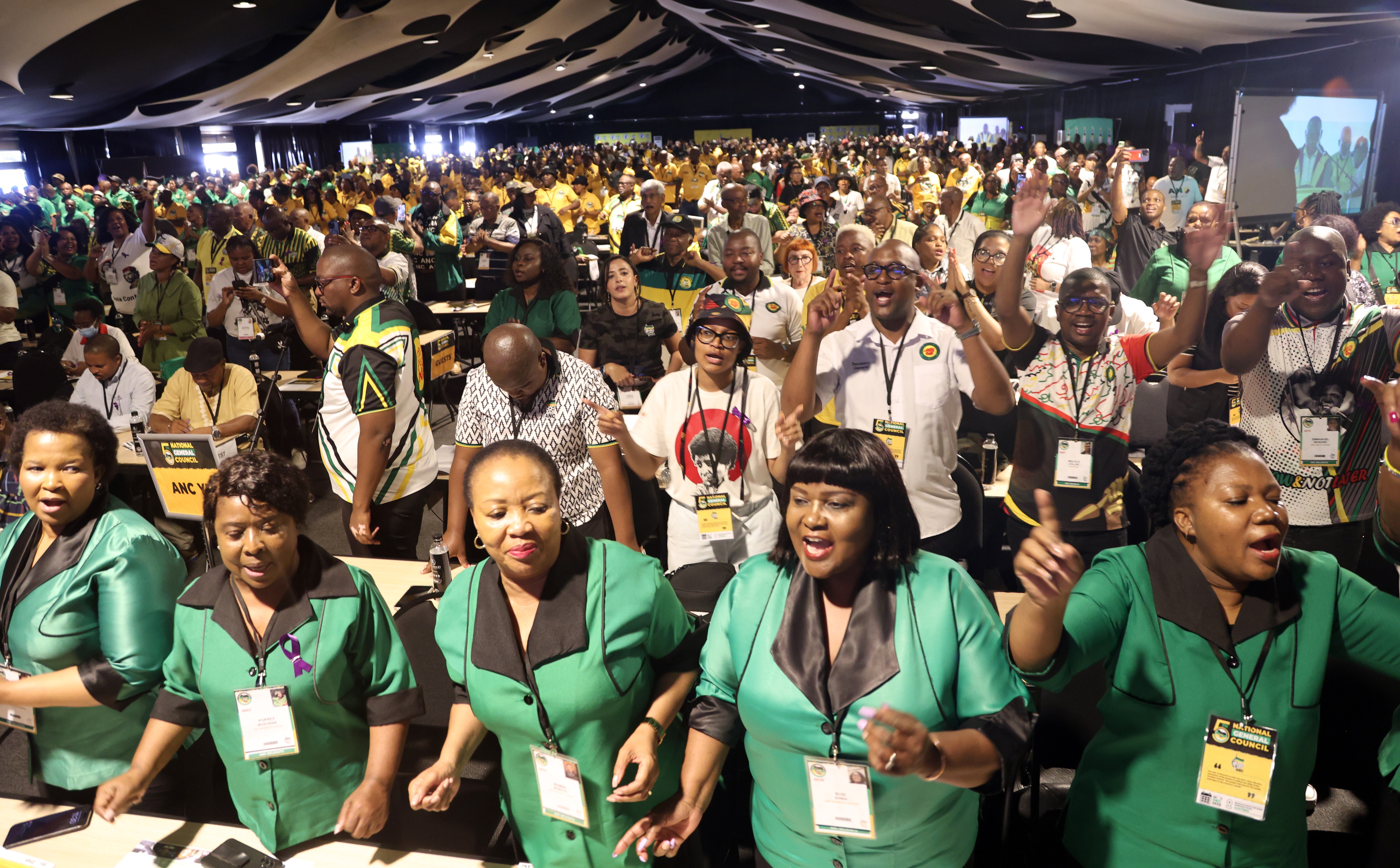
 ANC delegates at the 5th National General Council of the African National Congress in Boksburg on 8 December 2025. (Photo: Felix Dlangamandla)
 At the ANC’s 5th National General Council (NGC) in Boksburg on Monday, 8 December, secretary-general Fikile Mbalula moved from his usual defensive posture while delivering the party’s mid-term report, saying the party’s decline is long-standing rather than a sudden rupture.
According to Mbalula’s analysis, a mid-term review between the party’s 2022 and 2027 national elective conferences, the ANC’s decline dates back to 2016.
“The electoral setback suffered by the ANC and the democratic movement began in 2016 with the loss of major metros, accelerating with the emergence of over 80 hung councils after the 2021 local elections, and culminated in the 2024 strategic setback when the ANC lost its outright majority in Parliament, Gauteng and KZN,” reads his 294-page report.
/file/dailymaverick/wp-content/uploads/2025/08/ED_567576.jpg "ANC secretary-general Fikile Mbalula. (Photo: Gallo Images / Luba Lesolle)")
Reflecting on the bruising 2024 election results, Mbalula said an “intense, coordinated and well-funded campaign” had been mounted to push the party below 50% and replace it with “a right-wing, anti-transformation coalition government (the so-called Moonshot Pact).”
The Moonshoot Pact, later known as the Multi-Party Charter, was an agreement between opposition parties, including the DA, ActionSA, IFP, Freedom Front Plus and others, to form a coalition to unseat the ANC if they had the numbers after the 2024 elections.
“Objectively, this campaign produced a counter-revolutionary convergence between right-wing parties and breakaway parties formed by former leaders of the liberation movement,” said Mbalula.
‘Voters no longer captive’
Those ANC “breakaway parties”, such as the EFF and MK party, accelerated the party’s decline in recent years as many of its traditional supporters either didn’t vote or voted for alternatives.
Referring to the rise of the uMkhonto Wesizwe (MK) party, Mbalula’s report says on Gauteng: “The ANC’s core base has fractured. The shift of protest votes from the ANC, first to the EFF and now to the MK Party in Gauteng, shows that this discontent is becoming entrenched. Large sections of the working class and poor no longer believe ANC promises on jobs, housing and services.”
“The ANC can no longer command support; it must now compete for it, and negotiate with other parties claiming to represent the same constituencies.”
“Voters have demonstrated that they are not captive to the ANC and will ‘shop around’ for alternatives that better address their conditions: the DA for stability and middle-class interests; the EFF and MK party for alienated and protesting poor communities.”
/file/attachments/orphans/6I1A5274_995300.jpg "President Cyril Ramaphosa addresses the 5th National General Council of the African National Congress in Boksburg on 8 December 2025. (Photo: Felix Dlangamandla)")
In its analysis of KZN, Mbalula’s report, however, found the ANC was weakened but still had a chance to regain lost ground.
“At the same time, no opposition party has replaced the ANC ideologically or organisationally. The MK party’s rise is largely emotional and reactionary; the IFP’s resurgence remains geographically concentrated; and the DA and EFF remain marginal in African working-class communities.
“The balance of forces remains fluid and contestable. The core conclusion is that the ANC is weakened structurally, politically and morally, but not defeated. Restoring hegemony remains possible if renewal, governance reform and mass work are pursued decisively.”
GNU ‘a strategic setback’
After the ANC fell short of a majority in the 2024 elections, it entered the Government of National Unity (GNU) – a move Mbalula described not as weakness, but as a survival strategy.
“The electoral setback of 2024 initially gave these forces the illusion that the ANC had reached its end. The ANC’s swift tactical manoeuvre to rally parties around an inclusive unity government defeated this pre-election strategy. Their shared goal of eliminating the ANC from governance did not materialise,” Mbalula said.
Mbalula insists the party retains significant influence: “Despite our subjective weaknesses, we must not underestimate the strong position the ANC holds within the GNU – controlling two-thirds of the ministries critical to transformation and development.”
Mbalula maintained that 18 months after the GNU was formed, it was the correct route to take to take the country forward, although it had faced repeated crises, particularly over ideological and policy differences. Its biggest test was perhaps in February 2025 when it failed to pass the national Budget, and again in March, a first for South Africa. It was finally approved in May 2025.
/file/attachments/orphans/WFD_9283_700305.jpg "Mzwandile Masina, Dickson Masemola (rear, left and right) and former presidents Thabo Mbeki (left) and Kgalema Motlanthe at the 5th National General Council of the African National Congress in Boksburg on 8 December 2025. (Photo: Felix Dlangamandla)")
Although the GNU was able to work through some of the differences, Mbalula said the weaknesses in the GNU threatened the stability and credibility of the 7th administration, pointing to the DA’s conduct.
“Relentless attacks on transformation policies and South Africa’s foreign policy stance by the DA, despite their agreement to the Statement of Intent. These attacks have been amplified through global networks, the courts, the media and state roles they hold within the GNU.”
/file/attachments/orphans/WFD_9264_581176.jpg "President Cyril Ramaphosa arrives at the 5th National General Council of the African National Congress held at Birchwood Hotel in Boksburg on 08 December 2025. (Photo: Felix Dlangamandla)")
The report warns that although the ANC sees opportunities in the current political mix, “time is not on our side”.
“We must move with the speed of lightning in executing plans so that tangible results are felt on the ground, particularly on inclusive growth, job creation, poverty reduction, combating crime and corruption and improving service delivery… Ultimately, the GNU will be judged not on plans, but on execution.”
Branches — old and rural
The ANC’s analysis of the state of its branches and why members leave the organisation, however, provides a sobering view.
Of the 811 branches that responded to an ANC survey underpinning the NGC analysis, the mid-term report says the bulk of the party’s branches are rural – mostly from Limpopo, Mpumalanga and the Northern Cape – followed by township branches. Suburban branches trail behind, with informal settlement branches providing the lowest response rate.
The age profile of members reflects another long-term challenge the party has been struggling with. The average branch chairperson is 49.3 years old, with women slightly older than men. A “very limited” number of young cadres hold chair positions – even though the country’s median age is 28.
Membership stability is patchy, with youth membership remaining far lower than adult membership. Branches say members leave because the organisation feels distant and inward-looking:
- 52% say the ANC is “not responsive to community issues”.
- 40% cite factionalism and leadership conflicts.
- 22% point to poor internal communication.
- 23% blame irregular meetings.
- Only 19% of branches report no major retention challenges.
/file/attachments/2985/ANCbranchmembershipbreakdown_273949_02ebbb90a4fe813832e847852e42df6a.png "The ANC's distribution of branches across geographical areas. (Source: ANC NGC Midterm report)")
/file/attachments/2985/stateofbranchmemberships_684398_7b7aeb36ec6a25f3bd98bbcf79376dfc.png "The current state of ANC membership. (Source: ANC NGC Midterm report)")
2026 local government elections
As the country prepares for the 2026 elections, the ANC said its deployees ought to play the strategic role required to transform South Africa.
“Every ANC-governed municipality must demonstrate irrefutable progress in implementing the Spatial Development Framework to ensure that all rural and urban areas possess reliable infrastructure, thriving local economies, sustainable livelihoods, affordable quality services and shared prosperity.”
“This National General Council must take tough decisions regarding the calibre of cadres who will lead local government in the coming term, and the firm accountability measures required to implement the District Development Model – so that government plans, budgets and acts as one seamless whole,” Mbalula said.
/file/attachments/orphans/WFD_9287_342628.jpg "Siboniso Duma, Nomagugu Simelane and Bheki Mtolo at the 5th National General Council of the African National Congress. (Photo: Felix Dlangamandla)")
In the next two days, delegates at the ANC’s NGC will be split into commissions to continue policy discussions. Mbalula poured cold water over suggestions that there would also be a succession debate, following speculation that there would be calls for President Cyril Ramaphosa’s removal and that the event is a precursor to the party’s next elective conference.
“This general council is not going to discuss succession. That talk belongs to the branches at that stage relevant to it, which will be in 2027. This general council is about preparing the ANC to win elections, consolidating renewal of the ANC,” Mbalula said. DM