




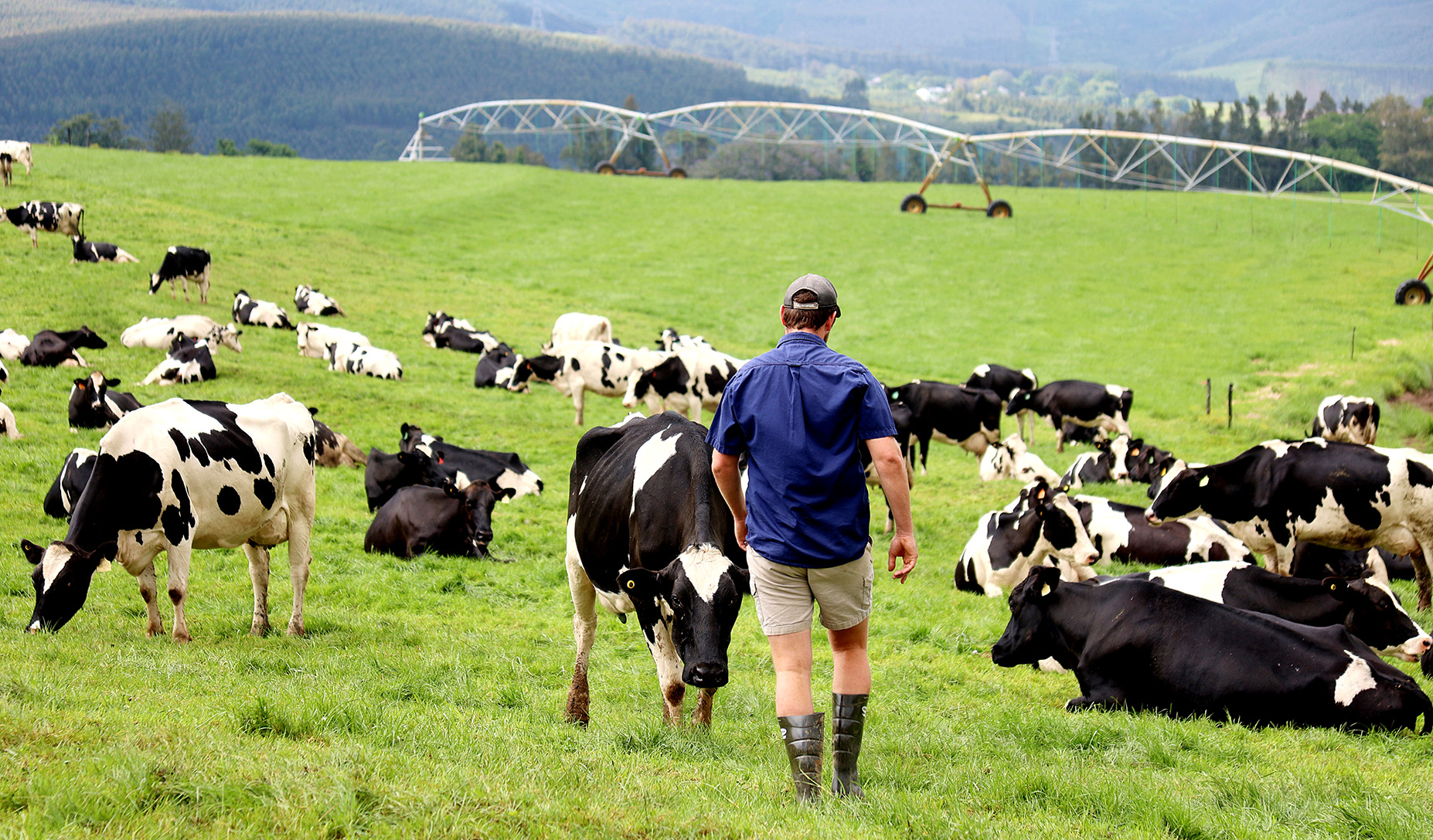
 A KwaZulu-Natal dairy farmer checks his cattle. (Photo: Leano Larona)
 The dairy sector in KwaZulu-Natal is calling for urgent intervention and says the foot and mouth disease outbreak has become critical. The province is home to roughly 220,000 dairy animals.
The Milk Producers’ Organisation released a statement on Monday, 8 December, describing the situation as an escalating foot and mouth disease (FMD) outbreak that threatened national food security, rural livelihoods and the stability of the dairy value chain.
The organisation said that “despite the efforts of veterinarians, producers and provincial services to prioritise the most urgent cases, severe vaccine shortages prevent proactive containment of the outbreak. Current supplies only allow reactive, crisis-by-crisis management, which is not sustainable.”
On 4 December 2025, Daily Maverick visited farmers and veterinarians working around Ixopo, Creighton, Howick and uMzimkhulu.
‘State failure’
/file/attachments/orphans/FMD24_607250.jpg "KwaZulu-Natal dairy farmer Dave Moberly tells how he struggled to keep his cattle alive. (Photo: Leano Larona)")
Dave Moberly, a dairy farmer from Creighton near uMzimkhulu, is still reeling from the impact of FMD on his farm. Of 1,200 cows, 800 were infected, 500 severely.
He told Daily Maverick he was particularly upset because state procedures around access to the vaccine had failed him. Moberly heard there was an outbreak nearby and began looking for options on how he could secure vaccines. He learnt that the state did not have any vaccine, leading him to ask around to secure some for his herd. This had cost him more than R180,000.
Read more: Race to vaccinate 7.2 million cattle as foot-and-mouth crisis bites
He secured a supply of Botswana vaccine from a feedlotter, but that required state channels, including a sign-off in Pretoria and authorisation through the Allerton Provincial Veterinary Laboratory in Pietermaritzburg.
This led to a critical 10-day delay and an extra four-day wait after the department “forgot to get the vaccine”. Moberly said the outbreak on his farm should have been entirely preventable.
“Had we injected two weeks before when we were asking, we wouldn’t have been infected,” he said.
Moberly saw symptoms of FMD while he was in the process of securing vaccines. They noticed one of the animals frothing due to mouth lesions, and other symptoms such as a high fever, a sudden drop in milk production, excessive salivation and lameness.
/file/attachments/orphans/FMD25_692283.jpg "Farmers bandage infected cattle’s hooves to treat lesions. (Photo: Leano Larona)")
“The animals usually don’t eat and can’t walk due to how painful it is.” The virus began to spread before they got hold of the vaccines, Moberly said.
He said dairy cattle, especially the high-performing breeds, had more severe symptoms than beef cattle, which had a better recovery rate.
‘Horrific’
Moberly said living through an outbreak was “indescribable”.
“Our experience was just horrific. My son has been on that farm, and [he] is not the same. Hopefully, he’ll come around, but mentally, he’s been damaged. He hasn’t had a day off in six weeks.”
Moberly said the farm staff “took the most strain. They’re in one place, and what they saw was horrific. As I said, the cows started with a froth and then three days later, [they] started to find these big blisters on their teats. When you’re putting the machine on, the skin actually comes off. Not all of them, but a lot of them are bad, and you have to milk those cows. Otherwise, they die. They’d get blue udder, and they would die.
/file/attachments/orphans/FMD13_856314.jpg "Dairy cows can recover from FMD within weeks, but there can be permanent milk loss or reduced productivity. (Photo: Leano Larona)")
“So we had to employ another 10 people on that farm to lift tails so the cows don’t kick. And we even had guys with their hands up the cows’ butts to stop the guys at the bottom being kicked to death, because the cows are going mad.
“So it’s severe pain for the cows. To see your cows go through that is mentally disturbing. It’s like that for three weeks, day after day, and you think you’re winning and then tomorrow there’s 50 cows infected,” Moberly said.
Despite feeling vulnerable, waiting anxiously for “impending and almost certain doom”, farmers are employing basic biosecurity measures. This includes spraying vehicles with sanitising chemicals, sanitising footwear, limiting the movement of owners and workers and performing regular checks on the herd.
Animal health
/file/attachments/orphans/FMD2_222852.jpg "Veterinarians Gareth Myles and Savannah Stutchbury. (Photo: Leano Larona)")
Dr Gareth Myles, a veterinarian from Howick Veterinary Clinic, emphasised that private practitioners’ “hands are tied” because the control of FMD was solely regulated by the government’s state veterinary services.
Private vets are not authorised to be involved in the control of the disease.
Dr Savannah Stutchbury, from the same clinic, said the virus was “incredibly infectious. If it gets into a herd, it just goes through.”
Myles said, “You’ll have 10 cases on day one, 100 cases on day two, and over 500 cases on day three. So it’s incredibly aggressive.
“We get involved when we’re asked to, but our intervention is limited. We deal directly with the affected farmers, give advice where we can on animal welfare concerns and we try where we can because we understand, we have a different understanding of how the disease is controlled, regulated,” Myles said.
“In our practice group within Creighton, Ixopo, you’re probably looking at 30,000 to 40,000 dairy cows. Perhaps even more that are at risk, and that’s excluding the informal sector, which I wouldn’t be surprised if it’s equal to, if not double that,” Myles said.
/file/attachments/orphans/FMD34_696126.jpg "Disinfectant is used on roads and at entrances to farms around Ixopo in an attempt to stop the further spread of FMD. (Photo: Leano Larona)")
“So we’ve got biosecurity and vaccination... our only two tools to combat this disease, and biosecurity only goes so far.” He said what was needed was vaccination, and that the biggest stumbling block was availability.
/file/attachments/orphans/FMD19_766307.jpg "A farmer dips his boots in a disinfectant solution before entering his dairy hub. (Photo: Leano Larona)")
Myles said a concern was the speed at which the vaccination was rolled out once it became available. He and other vets Daily Maverick spoke to said South African vaccination strategies were outdated.
“Much like the concept of a firebreak… if we can get ahead of the disease and vaccinate at-risk cattle, rather than vaccinating cattle that are currently affected … because there’s some evidence to suggest that once there’s foot and mouth on the farm, I won’t say vaccination is pointless, but you’re actually not really controlling the disease.
“We need to get ahead of the disease, and the only way we’re gonna do that is by vaccinating at-risk populations in a strategic manner,” Myles said.
The vets said they understood why control of this disease was run by the state, but pointed out that the state was not doing a good job of preventing it by having biosecurity risk checkpoints and providing vaccines promptly.
Financial impact
Dairy farmer Moberly said it would take him a year to recover, but he was also lucky that he could recover. Fellow farmers have said they face closure.
“Just to give you an example of the financial impact, our milk went from 21,000 litres a day to 11,500 litres a day. That is about R1.5-million a month that we’re going to lose. And that is just (on) milk production.
/file/attachments/orphans/FMD4_695265.jpg "KwaZulu-Natal dairy farmer Nigel Smith says all the damage and loss could have been avoided had the government taken action at the beginning of the outbreak. (Photo: Leano Larona)")
“It excludes the veterinary costs, which were another R500,000 this month, already R500,000 extra, over and above what we normally spend.
“You know, we’ve had to buy antibiotics. We’ve had to buy glycerine for the teats, having a guy at the bottom of the road, spraying every car that comes through. It just costs us. And it makes me angry. All this should never have happened. If we just had a state that was a little bit more on the ball, we’d have been okay,” Moberly said.
Daily Maverick asked the Department of Agriculture and Rural Development for comment on Monday morning. This report will be updated once a reply has been received. DM