




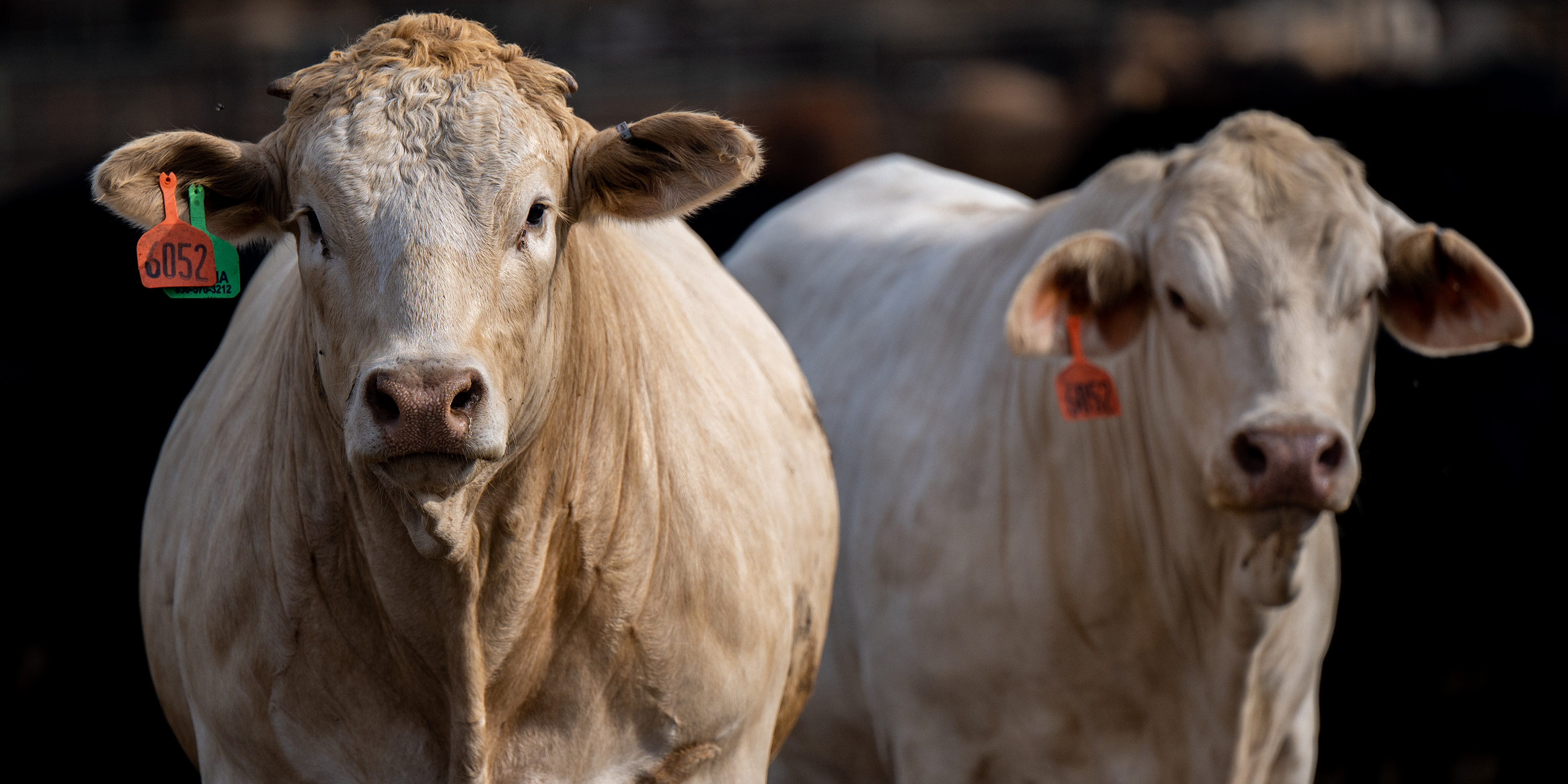
 The RFID tags, usually placed in livestock’s ears, are essential for tracking movement and origin, aligning with national regulatory requirements. (Photo: Brandon Bell / Getty Images)
 Foot-and-mouth disease (FMD) outbreaks slammed the brakes on South African beef exports this year – a brutal blow for a red meat industry that relies on shipping big volumes abroad.
Read more: Race to vaccinate 7.2 million cattle as foot-and-mouth crisis bites
To regain market trust and prevent losses, the industry is transitioning to a strict, unified national traceability system. The recent launch of Phase 2 of the Red Meat Industry Services (RMIS) Traceability Platform, which now allows for application programming interface (API) integration with digital livestock management systems, marks a step towards a “single traceability framework from farm to fork”.
Investing in radio frequency identification (RFID) tags, databases and management systems involves costs that large commercial farms can typically manage. For smallholder or communal farmers, however, the expense and technical knowledge needed are prohibitive barriers.
Read more: Farmers call for stronger biosecurity as South Africa battles foot-and-mouth disease outbreaks
“For you to register [on the RMIS platform] there is a certain purchase price of ability and of technical skills. If you do not have it, then you lose access to the market,” Daniël Rautenbach, co-founder of Pointr Solutions, a business that connects hardware and software for analytics in farming and processing, told Daily Maverick.
Now, Rautenbach is spearheading a project in a small Free State town aiming to reverse that loss of market access.
The purchase price of ability
Agricultural technology (agri-tech) promises productivity boosts, yet its rapid advances leave rural and smallholder farmers struggling to keep up.
“I don’t believe that farmers are being left behind or unwilling to adapt to a modernised business model,” AgriSA’s national rural safety officer, Jason Kümm, said. “However the challenge is significantly more difficult in an environment where infrastructure is limited.
“The greatest challenge in most rural communities remains the lack of reliable connectivity.”
Read more: Can digital infrastructure bridge the gap between SA’s farms and the future?
Kümm added that poor connectivity is only part of the problem. “High upfront costs and the lack of training opportunities slow adoption even further. But when tools are affordable and intuitive, farmers adopt them much faster.”
Financial woes
This infrastructure gap exacerbates an already dire financial situation. Structural deficits, such as a lack of formal land tenure (which prevents farmers from using land as collateral) and the fact that specialised finance for small, medium and micro enterprises has limited access, means capital is not flowing to those who need it most.
“Economies of scale make it difficult for commercial businesses to service these small-scale farmers,” Abrie Rautenbach, head of agribusiness at Absa Corporate and Investment Banking, said.
He explained that access to finance, technical support, on-time inputs and mechanisation are the biggest challenges faced by emerging farmers as traceability becomes a requirement in the country.
Absa supports smallholder farmers by offering financial training, credit guarantees and a blended finance product developed with government for clients without equity.
Read more: Nature doesn’t wait — agricultural financing needs to be agile to be effective
“Tech and traceability are going to become a standard part of operation within agriculture.” Kümm said. “This is not only going to affect international markets, but increasingly domestic markets as well. Farmers who can prove compliance, sustainability and quality will be better positioned to access premium markets.”
A digital experiment in Bethulie
Daniël Rautenbach and Pointr Solutions are not waiting for the gap to close on its own. They have launched a project in Bethulie in the Free State, in a community where communal farmers face these barriers daily.
Pointr specialises in software that captures operational farm data, enabling better decision-making. Their system is already compatible with the RMIS’s national traceability platform.
The Bethulie project aims to bring this traceability system directly to smallholders, teaching them how to use the technology. This involves Pointr sponsoring RFID ear tags and providing training on tagging and software use.
“It’s important for us to make sure [the local farmers] have agency in this whole movement,” Daniël Rautenbach explained. “We have to get their opinions, we have to make sure we meet them where they are and that they can also determine the trajectory we are moving towards.”
The initiative is currently in a pilot phase, with Pointr providing all technology and services free of charge to the farmers. They have sponsored 500 tags to test the system's viability.
If successful, the plan is ambitious. Rautenbach stated: “We are going to roll it out with the plan to register every single livestock unit in the community on a central database so that we can see which cattle, which sheep belong to whom.”
By connecting the farmers’ data via Pointr’s software to the RMIS platform, their livestock becomes traceable and export-compliant. This validation allows smallholders to access formal buyers, securing market-related prices instead of being confined to the informal market’s lower rates.
Read more: Meet the small-scale farmers who are pioneering sustainable solutions through community empowerment
“It is quite important to promote information systems in the agricultural industry, but it is not just to promote it, it is to make it accessible to everyone,” Pointr’s Rautenbach said.
Traceability, according to Kümm, should be viewed as a tool enabling market access. “The challenge lies in the implementation, education and support systems to assist emerging sectors with practical tools,” he said.
Digital literacy gap
Simply giving farmers an app or a tag isn’t enough. The speed of tech-driven agriculture demands new literacy skills that are often overlooked.
“The software and hardware that we create replaces a lot of the manual work that many farmers would have done in the past,” Daniël Rautenbach said. “It is difficult because people want to replace the replaceable work to make their industry more sustainable and effective, but you don’t want to leave people without work.”
Read more: SA students tackle food insecurity with groundbreaking tech solutions
The Bethulie project highlighted that apart from infrastructure and access, digital literacy is also lacking. “They need to know how to work with technology,” Rautenbach stressed. “I’m talking about farmers in general as well. It’s important to know where to answer your emails, how to use Excel, how to open PDFs.”
The Pointr team is tackling this by developing a six-week certification programme. “The idea of the programme is to give [farmers and farmworkers] a certificate at the end of the six weeks so that even matriculants, or people who don’t have a job yet, can signal to the farmers ‘I have the skills to be a good resource for you in this digital world’,” Rautenbach said.
Data as currency
The red meat industry is digitising at speed. Data is no longer confined to paperwork as it serves as proof of origin, health and movement. It is, as Kümm put it, “a currency within agriculture”.
Farmers who cannot generate that data will simply not exist in the markets that matter. Pointr’s Bethulie project offers one version of a different future.
“The advantage of technology is that it takes away work, yes, but it also creates new opportunities,” Daniël Rautenbach said. “But the new opportunities that it creates again require you to have a certain level of understanding around this technology.”
Ultimately, the impact remains a choice, Kümm reckons. “If designed and implemented with intention and in a manner that supports emerging or small-scale farmers, technology in agriculture can be used as an equaliser, removing the gap completely.” DM