




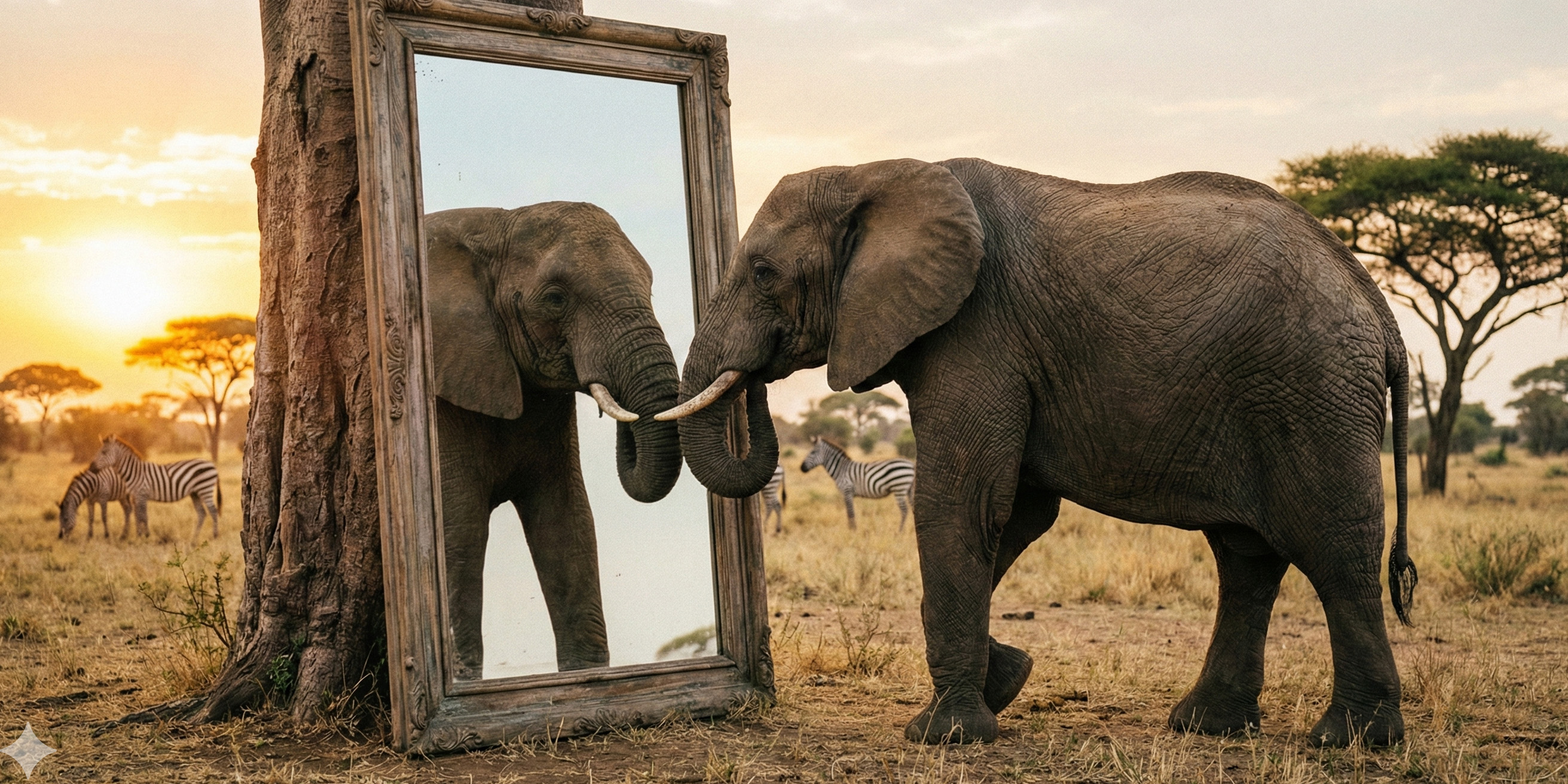
 Elephants cannot see themselves in the mirror. (Image: Google Gemini AI)
 The dents in the metal plating above the massive mirror tell a story, and it is a reflection of one chapter in the saga of a small herd of tame elephants in Limpopo that has advanced the cause of science in fascinating ways.
In front of the mirror is a horizontal pole, and the experiment with the mirror was aimed at assessing if elephants can recognise their own likeness staring back at them.
“The elephants leaned over the pole and hit it with their tusks. They also tried to lean over the pole to reach the mirror to touch their reflection,” researcher Nhlahla Mashaba told Daily Maverick.
His conclusion – which will be written up with a leading scientist in a forthcoming paper – is that elephants cannot see themselves in the mirror.
This paper will join the swelling ranks of academic studies drawn from this group of seven pachyderms owned by Sean Hensman, who operates Adventures with Elephants (AWE) in the southern Waterberg west of Bela-Bela. No less than 30 peer-reviewed academic papers have been produced in the past 15 years based on observations and the study of this herd, comprised of orphans from culls.
“This is one of the most broadly researched elephant herds in the world,” Hensman told Daily Maverick.
The scale of the studies on these animals is indeed broader than a bull elephant. This correspondent first visited AWE in 2015 when the US army was funding research into the bomb-sniffing capabilities of elephants.
“The sensitivity of detection surpasses that of TNT-detection dogs working under similar conditions, suggesting that the potential application of African elephants within the biosensor-field should not be underestimated,” the authors concluded.
A 2017 study looked into the “Sexual dimorphism in African elephant social rumbles”, whereas a 2018 paper made the case that elephants evolved strategies to reduce the bio-mechanical complexity of their trunk.
A 2020 study found that elephants could detect high levels of sugar based on scent alone. Beyond aiding and abetting the pachyderm’s “sweet tooth”, this cast light on the interactions between plants that have evolved to be attractive and the animals that disperse their seeds after feeding on the vegetation.
Hensman’s elephants have also been used to study the feasibility of an artificial intelligence “smart gate” to allow elephants in fenced settings to temporarily access neighbouring reserves to relieve the ecological and social pressures linked to overpopulation in enclosed spaces.
“If we can understand elephants, we can conserve them,” Hensman said.
Hensman (42) and his family came to South Africa from Zimbabwe after their farms were among those seized in late former president Robert Mugabe’s catastrophic grab of white-owned land.
His father Rory acquired two elephants in 1988 that were orphans of a cull and named them Jumbo and Miss Ellie. The farm would go on to become a sanctuary for elephants in such circumstances and Rory trained the animals for anti-poaching operations in the Zambezi Valley.
“Elephants are totally silent and give you a vantage point when you ride them, making them perfect for anti-poaching. He [Rory] was a big horseman and applied that to elephants in an ask-and-reward system,” said Hensman.
/file/attachments/orphans/6I1A2788_426980.jpg "Sean Lensman flanked by Chova (right) and Messina in the veld at Adventures with Elephants. (Photo: Felix Dlangamandla)")
Education and research
He has become an elephant whisperer of note himself and sees AWE’s mission as being focused on education and research. Education includes interactions with the public. AWE is also a business and it requires funds for the 32 staff it employs and the elephants’ care.
The interactions take place three times daily and last about an hour. When Daily Maverick was there recently, the show was in progress with 18 foreign and South African visitors taking part. Six of the seven elephants were standing apart in a row and a female, Naledi, was the focus of attention.
“Naledi will lie down and sleep for us now,” handler Oscar Severino told the audience. Naledi obliged, lying down sprawled on her side.
“You can all come forward and touch her now,” Severino said.
The excited tourists then gathered around Naledi – avoiding the blind spot around her rear – and touched her as Severino explained the functions of the various parts of an elephant’s body. He then asked a female tourist to ask, “Naledi, get up”, and she did just that on the command.
“It’s amazing. The elephant is one of the Big Five and I can’t believe they are so friendly,” said Andre Boto (25), a tourist visiting from Portugal.
Other activities on offer include walks in the veld with the elephants, or a chance to help wash and bathe an elephant in the dam.
There are critics who will see this as “animal exploitation” and view it as beneath the dignity of a majestic creature such as an elephant. But these animals were spared the bullet of a cull and they certainly appear to be well cared for. And they are like ambassadors who are bridging the gap between species and allowing humans a chance to experience their kind at close hand.
This small herd has also made a big impact on science, and there is much more spoor at AWE to follow for insights into their behaviour and ways to conserve the species. DM
This story first appeared in our weekly DM168 newspaper, available countrywide for R35.
/file/attachments/2985/DM-05122025-001_760736.jpg)