




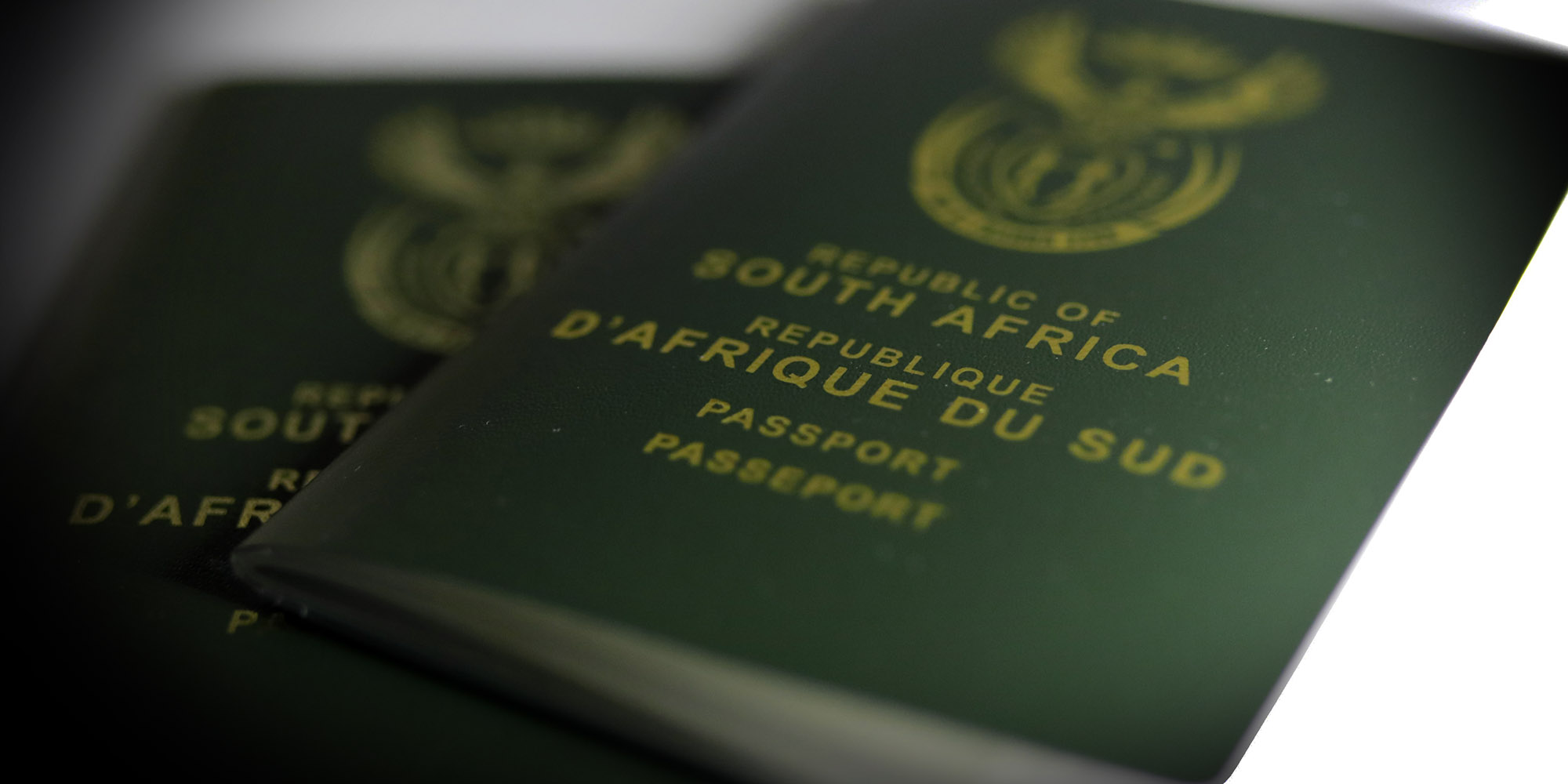
 Crossing African borders is still a test of stamina, as forms pile up, windows close and visas vanish into bureaucratic black holes. (Photo: Leila Dougan)
 In 2009, then-African Union chair Muammar Gaddafi envisioned a united Africa with a single currency, one military and a continent where Africans needed one passport to move freely.
Africa, however, not as ready for this move towards integration as the controversial Libyan leader proposed. Crossing African borders is still a test of stamina.
But South Africa’s Department of Home Affairs recently unveiled its Electronic Travel Authorisation (ETA) system, describing it at a September briefing to the Tourism Business Council as a “central pillar" of its vision "to deliver Home Affairs at home through digital transformation”.
Read more: Stalking Minister Schreiber at the e-Governance Conference in Estonia
The ETA allows travellers to apply for visas online, upload their biometrics and receive rapid approvals, all plugged into a new facial-recognition movement control system at OR Tambo and Cape Town International Airport.
The early rollout was focused on guests from China, India, Indonesia and Mexico attending G20 meetings, with plans to scale up once the system proves reliable.
Thulani Mavuso, spokesperson for the Department of Home Affairs and deputy director-general for operations, said a fully digital ETA “reduces administrative burden, minimises fraud, and enables faster, more user-friendly travel authorisation”. The department expects “increased visitor arrivals, more competitive tourism offerings, and broader economic activity across sectors reliant on intra-African mobility”.
If the ETA lives up to its promise, it could open a small crack in the wall of a continent whose challenges are far bigger.
A continent on standby
The African Union’s Agenda 2063 imagines “a continent of seamless borders”, but strict visa rules and high costs still make intra-Africa travel difficult.
Progress, according to the Africa Visa Openness Index's data, is inching forward, but is far from transforming travel.
Visa-free travel within Africa has only edged up from about a quarter of routes in 2019 to just under 30% in 2024. Nearly half of all travel routes still required a visa in 2024.
Mavuso noted that Home Affairs sees enhanced mobility within Africa as essential for advancing economic integration, trade, tourism and shared development. Enabling legitimate African travellers to move more freely is a core departmental priority, balanced with secure, rules-based immigration systems, he said.
“Where South Africa has removed visa requirements, such as with Ghana and Kenya, arrivals have increased immediately,” Aldrin Sampear, spokesperson for the Minister of Tourism said, adding that visa facilitation had "a significant impact on travel demand from African markets”.
Who gets a welcome mat
South Africa currently grants visa-free stays of up to 90 days for citizens of the US, UK, Canada, Australia, and much of the European Union.
Southern African Development Community neighbours enjoy exemptions, while countries like Kenya, Malawi, Mozambique, Lesotho, Eswatini, and Mauritius receive 30-day visa-free allowances.
But for many Africans, including citizens of Mali, Niger, Democratic Republic of Congo, Ethiopia, Guinea and Nigeria, visiting South Africa requires navigating a complex visa process.
Read more: New visa reforms could boost South Africa's economy by 1.2%
Nigerians, for example, must apply through VFS Global centres, providing multiple documents, including a mandatory yellow fever certificate. The South Africa-Nigeria Business Chamber warns of “serious delays at the South African missions in Nigeria” and advises factoring this into travel plans on its website.
In a written response to questions about Nigerian visa processing hurdles, a VFS Global official said: “The adjudication of the permit applications is done by the Department of Home Affairs. VFS Global has no role in the decision-making process nor the processing time involved.”
/file/dailymaverick/wp-content/uploads/2023/09/Airport-Generic005.jpg "Travellers at Cape Town International Airport. (Photo: Leila Dougan)")
Múyìwá Mátùlúkò, CEO of Nigerian-based media company Businessfront, has experienced visa delays related to travelling to South Africa for a business course.
“There was no communication from VFS or the South African embassy, and I submitted the same documents I had provided in my two previous, timely approvals,” he said. “This time, the process was simply slower, with no explanation.”
Read more: Remote work visa rollout falls flat: only 24 digital nomads granted access to South Africa
“It’s frustrating that travel within Africa is still so difficult,” he said. “A practical improvement would be adopting visas on arrival, or simplified continental entry policies across the region.”
Sampear acknowledged that travellers still face “limited visa centres, long processing times, in-person biometric requirements and documentation burdens”, but emphasised that Home Affairs was addressing these challenges.
Business Leadership South Africa's CEO, Busisiwe Mavuso highlighted visa delays as a major business impediment. The Presidency had identified the backlog, which once stood at hundreds of thousands, as the second biggest economic constraint after loadshedding, she said. "While recent reforms under Operation Vulindlela have helped clear some backlogs, the system remains cumbersome and resource-constrained, making it difficult for businesses to bring in international skills and delegates."
‘A whole different ball game’
Rune Engstrøm, business development director at Destinations Africa, a destination management company specialising in travel experiences in east and southern Africa, said that intra-Africa travel for Africans and foreign travellers alike remained a challenge.
He said that getting a visa for another African country was “a whole different ball game”. For Nigerian groups traveling to South Africa, he added, one often did not even get answers to the visa applications, leading to abandoned trips and cancellations after deposits had been paid.
BLSA said companies struggled with visa delays for executives and specialists, and there had been cases of visas being denied without explanation, disrupting critical business operations.
This void undermines South Africa’s role as a continental business hub and slows the very integration leaders claim to champion.
“Africa is a large continent with a very large number of often quite small economies, and it is difficult to grow fast if your market is small and your sources of skills and the embodied technology bound up in human experts are not accessible,” Alan Hirsch, head of the Migration Governance Reform in Africa Programme at the New South Institute, told Daily Maverick.
Read more: Spooked tourists say SA visa fiasco has chased them away
Tourism and professional services are the most obvious sectors to benefit from seamless travel, Hirsch explained.
Mavuso said enhanced identity management would be critical to unlocking this movement. The shift to fully digital, biometric-enabled identity systems allows each traveller to establish a secure digital identity, strengthens authentication, reduces opportunities for fraud and removes the need for physical documents that may be lost or forged.
According to Sampear, African visitors already form “over three-quarters of international arrivals” and contribute “tens of millions of rand annually”, supporting jobs across accommodation, retail, business events, health tourism, township economies and transport.
"Visa uncertainty has been flagged in BLSA’s advocacy as a factor that deters investment and complicates planning," Busisiwe Mavuso said. "Even when policy reforms are announced, delays in implementation and persistent backlogs create risks that reduce South Africa’s attractiveness as a global business destination."
Flight costs
Even travellers who secure visas face prohibitive airfares. Engstrøm noted that a ticket from Nairobi to Cape Town cost about R17,000 while he often flies from Norway to Cape Town for R12,000.
Ticket taxes and fees are the main culprit.
A flight example provided by the African Airlines Association illustrates that the tax component of a round-trip ticket from Dakar to Casablanca amounted to R6,475, compared with a base fare of R3,761.
Read more: Crucial Air Traffic and Navigation Services faces payroll and skills crisis
The association found that a mere 10% reduction in ticket prices could boost passenger demand by over 22 million people annually across the continent.
Limited intra-African connectivity “places structural limits on the growth potential of regional tourism,” Sampear said, noting that South Africa was collaborating with partners to improve route networks and strengthen airlift.
/file/dailymaverick/wp-content/uploads/2023/05/Airport-Generic017.jpg "A South African Airways desks at Cape Town International Airport in South Africa. (Photo: Leila Dougan)")
Islands of openness
South Africa ranks 29th on the Africa Visa Openness Index, far behind first place Rwanda, Benin, Gambia and Seychelles, all of which offer visa-free entry to African nationals.
Rwanda’s decision to go visa-free in 2013 resulted in a 24% jump in arrivals from the continent, according to the African Development Bank.
"Other African countries, such as Rwanda and Kenya, have adopted visa-free or simplified regimes, positioning themselves as more attractive destinations investment," Busisiwe Mavuso said.
In 2024, Kenya introduced its own ETC system after declaring visa-free travel for Africans. The new process inadvertently created a bureaucratic obstacle, forcing even previously visa-exempt South Africans to apply and pay. Kenya was forced to revise the policy after widespread criticism.
Read more: Key lessons from Kenya’s bold but poorly executed visa-free policy
The ETA has with safeguards put in place to prevent African travellers from being turned away, Thulani Mavuso said. These include “advance communication with airlines, transitional measures for travellers without ETAs during early phases, real-time verification support, and constant monitoring of system readiness.”
The ETA will only be expanded to more African countries once the new Movement Control System is live at all South Africa’s major ports.
BLSA argues that South Africa's visa regime hurts competitiveness. CEO, Busisiwe Mavuso said while positive steps like the Trusted Employer Scheme and a digital nomad visa are welcome, administrative capacity remains a significant challenge.
Paper borders, political walls
The African Union champions free movement, but its Free Movement of Persons Protocol remains stalled since 2018. It needs 15 ratifications to take effect, but has only four.
In contrast, 49 countries have ratified the African Continental Free Trade Area Agreement (AfCFTA), showing that Africa is eager to move goods, but uneasy about moving people.
Read more: How non-alignment shapes South Africa’s foreign policy in a multipolar world
Hirsch notes that the AfCFTA already includes provisions for easier travel and work for certain professionals, but they remain largely unimplemented.
Underlying many intra-Africa travel restrictions are richer and more attractive countries fearing a sudden inflow of economic migrants who might abuse visa exemptions meant for short-term stays, Hirsch argues in a research paper he co-authored about African continental initiatives for mobility. Alarm is often raised that there is a risk of criminals or terrorists abusing this privilege.
The African dream
South Africa’s wider immigration overhaul is set out in the 2024 White Paper on Citizenship, Immigration and Refugee Protection, which pitches digitisation as key to improving security and turning Home Affairs into an economic enabler.
Sampear said South Africa remains “committed to improving accessibility and supporting regional tourism growth”, citing visa modernisation, improvements to the ETA, strengthening airlift and using analytics-driven marketing to engage African travellers.
A more pragmatic path may lie in the AfCFTA. In his research, Hirsch and co-author Victor Amadi argue that leveraging the “greater enthusiasm for the ‘continental free trade’ protocol than for its ‘movement of persons’ twin”, could be the way forward and could start by easing movement for businesspeople, service providers and skilled professionals.
A continental market potentially worth $3.4-trillion, cannot operate efficiently if its citizens struggle to cross borders or, as Engstrøm said, submit visa applications that result in “just nothing happening”. DM