




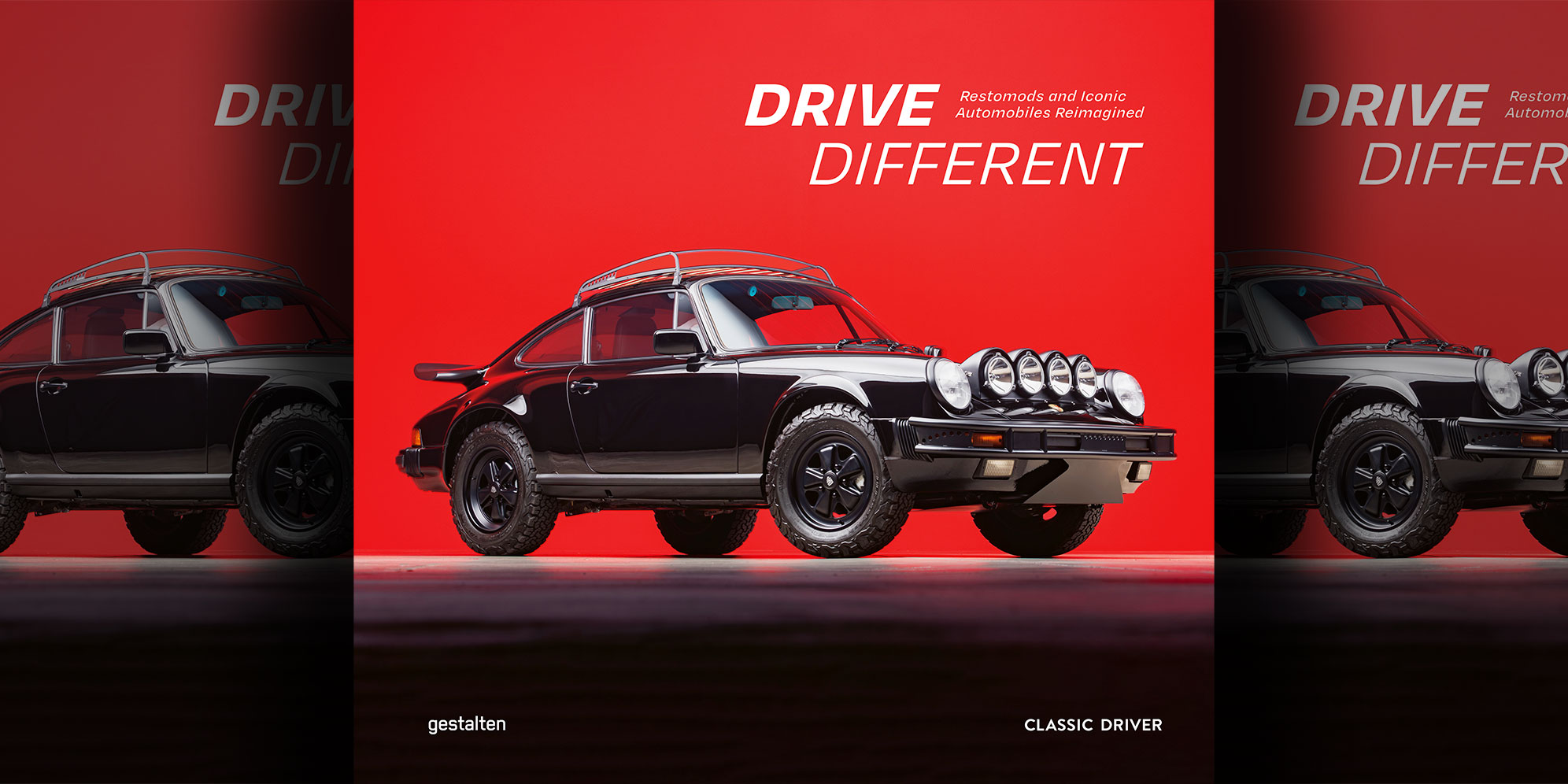
 Drive Different: Restomods and Iconic Automobiles Reimagined (Publisher: gestalten)
 Few pursuits merge nostalgia and innovation as seamlessly as the restomod movement. Drive Different, published by gestalten, is a visually captivating exploration of the art and craft behind these custom builds. Through a curated selection of groundbreaking restomods, the book celebrates the delicate balance between restoration and reinvention – where heritage is honoured and evolution embraced. Here is an excerpt written by Jan Baedeker and Mikey Snelgar.
Origins: Hot Rods, Purists and the Tinkerer’s Rebellion
To understand the DNA of restomod cars, we must travel back to postwar America in the 1950s, when GIs back from the front applied their mechanical know-how to old Fords and Chevrolets, giving rise to the hot rod scene. These cars were not restorations in the traditional sense, but reinterpretations: stripped-down, souped-up, made faster and louder. Performance and individuality trumped origin.
In the decades that followed, car customisation and tuning evolved from grassroots rebellion to a global subculture. In 1960s America, amid rising countercultures, the muscle car scene flourished as young enthusiasts modified affordable Fords, Chevys, and Dodges for straight-line speed and self-expression. California became a cultural hub, birthing drag racing, lowrider culture, and custom-car legends like George Barris and Ed “Big Daddy” Roth.
Meanwhile, in Europe, tuning took on a more performance-driven tone, especially in the Germany of the late 1970s and early 1980s, as companies like Alpina and AMG began refining models from BMW and Mercedes-Benz, laying the groundwork for the high-performance luxury tuning of decades to come.
By the 1990s, car culture had splintered into a spectrum of scenes. In Japan, movements like Bōsōzoku, Kaido Racer, and later, JDM Tuning, turned local icons like the Nissan Skyline and Toyota AE86 into global legends. In Germany, Brabus and RUF merged road-legal performance with meticulous engineering. In the USA, import tuning flourished on the back of affordable Japanese cars and street-racing culture, while hip-hop and MTV gave lowriders and custom paint jobs a fresh cultural cachet. Tuning and customisation had evolved into more than technical pursuits. These cars were now vehicles of identity, rebellion, and cultural commentary, expressed on the street through refined codes of distinction.
It wasn’t until the early 2000s that the term restomod began circulating in earnest. By then, car culture had matured – and fractured. On one side were the preservationists of the classic-car world, obsessed with patina and period-correct bolts. On the other hand, a new generation of collectors saw vintage metal as raw and affordable material for creating something deeply personal. As fashion and luxury began turning inward – towards bespoke tailoring, capsule wardrobes, and artist collaborations rethinking iconic bags and watches, the automotive world, too, began to flirt with the idea of reimagining verified classics, and making serious money along the way.
/file/attachments/orphans/OfficineFioravantifromDriveDifferentgestalten2025_FedericoBajetti_430466.jpg "Officine Fioravanti from Drive Different, gestalten, 2025. (Photo: Federico Bajetti)")
Artisans of Authenticity
And just like half a century ago, when Hollywood rebels like James Dean introduced nimble Porsches to Los Angeles’ street-racing scene, the automobiles of choice came from Zuffenhausen. In 2009, Rob Dickinson – former rock musician turned car designer – transformed the often-overlooked Porsche 964 into a canvas for obsessive craftsmanship and aerospace-grade precision with his company Singer Vehicle Design. Meanwhile, Rod Emory in North Hollywood became famous for creating the most iconic, yet personalised Porsche 356s on the planet. Taking a very different approach, the fashion designer Magnus Walker kicked off the urban outlaw movement with his air-cooled Porsche 911 that celebrated an eclectic, rat-style non-conformism over his fellow Californians’ perfectionism.
These were not just desirable machines – they became cult objects worshipped by a fast-growing community of restomod disciples. In the UK, Eagle took a similar approach to the Jaguar E-Type, crafting machines that felt less like restorations and more like cinematic reinterpretations. These cars did not simply mimic the past – they expressed how we wished what the past had looked, felt, and driven like.
The movement grew rapidly. Icon 4×4 in California reimagined vintage Toyota Land Cruisers and Ford Broncos with brutalist charm and military precision. Coolnvintage in Portugal built the surf-and-turf Land Rovers of our midsummer dreams. And Alfaholics in Somerset, England transformed humble Alfa Romeo GTAs into razor-sharp drivers’ cars.
Meanwhile, Northern Italy – long the home of coach-building artistry – became a breeding ground for some of the most desirable restomod sports cars. Historic names like Touring and Zagato were soon joined by new players: Automobili Amos, Borromeodesilva, Eccentrica, Garage Italia Customs, Nardone, and Officine Fioravanti all strived for the most creative interpretations of Italy’s greatest automobiles.
By the 2020s, even OEMs like Porsche, Jaguar and Land Rover were entering the game, offering factory-sanctioned restomod-style builds that blurred the line between heritage and innovation, counterculture and commerce. At the same time, the classics that were once affordable at the dawn of the new millennium had become tangible assets and blue-chip investment objects, selling at auction for record prices. As a consequence, the subcultural movement was transformed into a lucrative industry catering to the desires of the ultra-rich for even more bespoke creations. Suddenly, creative start-ups and backyard engineers were competing with the tailor-made programmes and Sonderwunsch studios of the world’s most renowned automotive luxury brands.
/file/attachments/orphans/GetLostProjectSafarifromDriveDifferentgestalten2025_GFWilliams_108284.jpg "Get Lost Project Safari from Drive Different, gestalten, 2025. (Photo: GFWilliams)")
The Age of Individualisation
Naturally, the rise of restomods mirrors a broader cultural shift. While mass production defined the 20th century, the 21st has become an era of curation. Inspired by post-modern remix culture, streetwear and luxury fashion began to overlap in the 2010s, dissolving the boundaries between high and low. Custom sneaker drops, tailored denim, personalised watches – suddenly, authenticity wasn’t about fidelity to the past, but about the story behind the object. The trend reached its peak when the visionary streetwear designer Virgil Abloh was appointed as artistic director by the French fashion house Louis Vuitton.
As artist collaborations became the new gold standard of the luxury world, we began to favour the maker over the manufacturer, the workshop over the factory. Restomods embody that spirit. They are far from just old cars with new guts; they are expressions of identity, connoisseurship, and emotional stability in a world of digital impermanence. Driving an Automobili Amos Futurista or a Coolnvintage Land Rover is a statement: that you value the tactile, the mechanical, the intentional. Like shooting with a custom-painted Leica film camera in the age of the iPhone, or commissioning a tailored Japanese denim suit when soulless hoodies dominate the algorithm.
/file/attachments/orphans/AGTZTWIN-TAILfromDriveDifferentgestalten2025_MarkRiccioni_979924.jpg "AGTZ TWIN-TAIL from Drive Different, gestalten, 2025. (Photo: Mark Riccioni)")
The Future: Algorithms Can’t Heal the Soul
As electrification looms and autonomous pods edge into view, restomods are increasingly seen not as anachronisms, but as artifacts of resistance. Some cars adopt EV drivetrains to whisper rather than roar. Others double down on analogue purity. Either way, they carry a sub-text: craftsmanship still matters. Beauty still matters. The journey still matters.
In the world of restomods, time doesn’t move in a straight line. It loops, it rewinds, it remixes. And as long as there are those who believe that machines can have soul – and that history deserves not just to be preserved, but constantly reimagined – there will be a place for the restomod. Not in the past. But defiantly in the present. And beyond. DM
Drive Different was published by gestalten in August 2025.