




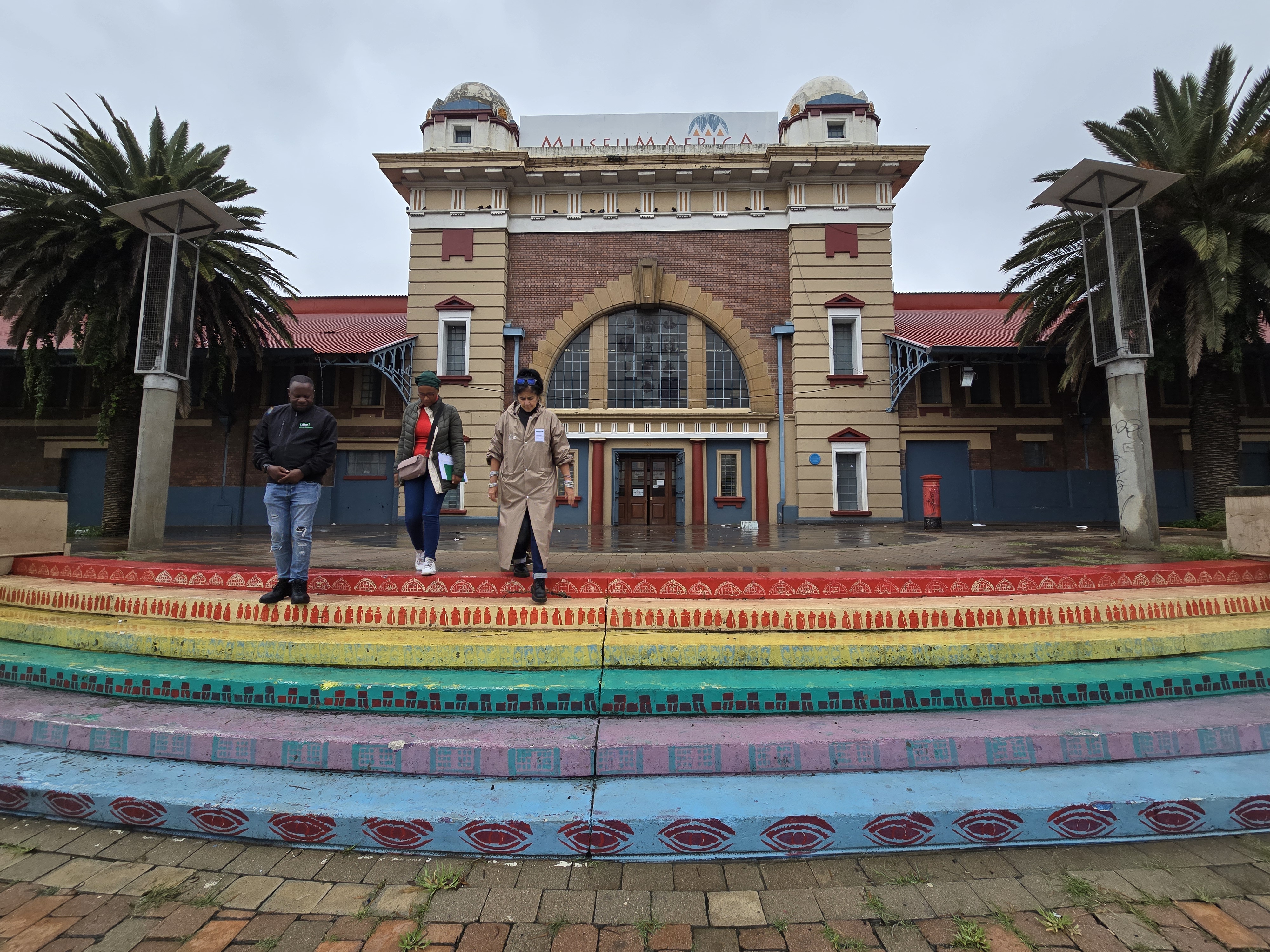
 Museum Afrika in Newtown is all set to host the South African Hip Hop Museum, which will officially open next year. (Photo: Bridget Hilton-Barber)
 Meet Osmic Menoe, custodian of South African hip-hop and one of the champions of Jozi My Jozi’s new campaign called Babize Bonke which invites people to experience the revival of the city through the eyes of its creative citizens.
“I am guided by passion and hustle,” says Meno, founder and director of the Back to the City Festival, Africa’s largest hip-hop and street culture festival. It went from a good idea in a small Newtown store in 2007 to a pan-African cultural hub that turns 20 next year, uniting artists, producers, dancers, graffiti artists and fans from across the continent.
Menoe is also the founder of the annual SA Hip Hop Awards. Through his company, Ritual Media Group, he uses hip-hop as a tool for inspiring and educating the youth, bridging the gap between street culture, the government and business, between underground and commercial.
/file/attachments/2985/osmicmenoe_423144_d55dc12464d764748c4b318dca53c79d.jpg "Cultural custodian and the driving force behind the South African Hip Hop Museum, Osmic Menoe. (Photo: Bridget Hilton-Barber)")
/file/attachments/2985/museumsign_928770_19aef3ec946e419e7d077c44d31d0924.jpg "The signage for the South African Hip Hop Museum. (Photo: Bridget Hilton-Barber)<br>")
Menoe is also in the wild throes of developing South Africa’s first ever hip-hop museum. It’s a massive space upstairs in Museum Afrika in Newtown, and while a section of it has been functioning as a recording and editing studio and workshop space since 2022, the spectacular South African Hip Hop Museum will officially open next year.
It feels like a cross between a nightclub, a recording studio and a VIP lounge. Dark walls, velvet drapes, funky room dividers in 70s patterns, retro couches, lots of gold and bling. At the entrance is the massive Hennessy Wall of Fame featuring 26 local hip-hop stars. Glass displays encase gold records and photographs, and alongside each is a signed gold bottle of Hennessy Brandy, R20,000 each apparently — and a set of headphones so you can tune right in.
“The museum will serve as a cultural archive and inspiration for future generations,” says Menoe. “It’ll showcase the history of the genre, the social context, the meaning, how hip-hop became a big social voice with big brand power.” He’s collaborating with hip-hop museums around the world from LA and Brooklyn in the US, to Japan and Germany.
Work has begun on the exhibition, showcasing the emergence of hip-hop in the US. There are album covers, posters, gritty inner-city photographs, breakdancers and a section where you can watch a snippet of the movies that influenced hip-hop.
The museum will trace the evolution of technology in the history of hip-hop, from analogue beatboxing to digital DJ-ing. He has a fabulous collection of analogue paraphernalia like old cassettes, mixed tapes, ghetto blasters and an old black-and-white TV set.
/file/attachments/2985/waxreplicasofhip-hopstars_860020_a9acdd85006f25943878c5a4cdb5b25b.jpg "Wax replicas of hip-hop stars to be displayed in the museum. (Photo: Bridget Hilton-Barber)")
/file/attachments/2985/walloffamedetail_933937_2f0c33ff0a8c2c6fdfd258e6f7cceb34.jpg "A detail from the Wall of Fame. (Photo: Bridget Hilton-Barber)")
/file/attachments/2985/signature_758853_3ea53e9eaedeff32f475a83a6bc528a4.jpg "A signature casette tape. (Photo: Bridget Hilton-Barber)")
/file/attachments/2985/retrotv_661933.jpg "A retro TV at the museum. (Photo: Bridget Hilton-Barber)")
/file/attachments/2985/moodboardinthemuseum_324726_2b1c7c331d632fef209cb037ac37a1e6.jpg "A mood board in the museum showing South Africa’s hip-hop timeline. (Photo: Bridget Hilton-Barber)")
/file/attachments/2985/menoesketch_452407_90ccf80655af118c97a1d810bf4a9d84.jpg "A sketch of a beatbox by Osmic Menoe. (Photo: Bridget Hilton-Barber)")
/file/attachments/2985/henessywalloffame_311628_9b3158e881eb5987de737431587fe641.jpg "The Hennessy Wall of Fame. (Photo: Bridget Hilton-Barber)")
/file/attachments/2985/exhibitatthemusem_673161_7bdc2bfb1c9e5561d690ad05cb085d1c.jpg "One of the exhibits on display at the museum. (Photo: Bridget Hilton-Barber)")
/file/attachments/2985/breakdancingoldphoto_831080_7a8c19d7c67b4b6c9f4498c8ebe63bff.jpg "An old breakdancing photo. (Photo: Bridget Hilton-Barber)")
“The youth need to see how hip-hop made something out of nothing, there’ll be rooms where you go vinyl and drop a needle, or listen to a mixed tape on a beatbox.” And Menoe has some wild plans for interactive talking walls, even holograms.
In the spirit of Madame Tussaud’s Wax Museum in London, Menoe has commissioned three life-size wax models of local hip hop stars that are in China awaiting shipment home. Other interesting hip hop paraphernalia and artefacts are waiting to be sorted: a glass case containing gold shoes, retro couches, vintage picture frames, photographs and album covers.
Menoe started out on the streets of Newtown with a shop called Ritual and then a club called OST. And Newtown is still his hood.
“Newtown has had its ups and downs, and I’ve been through every flow of the river,” he says. “The willingness to revive the Newtown precinct is there, but we need more partnerships, more programmed spaces and political stability within the city government.
“Jozi is a young city with kinetic energy. It’s all about passion and hustle. It’s a creative hub with so many characters and it shouts Go Wild. I’d love to see us working even more within the Southern African Development Community and the subcontinent in the future. Imagine if we had airlift, a string of budget airlines that could fly us to Harare or Maputo, or from Lusaka — imagine the possibilities.” DM
Bridget Hilton-Barber is a freelance writer who writes for Jozi My Jozi.