



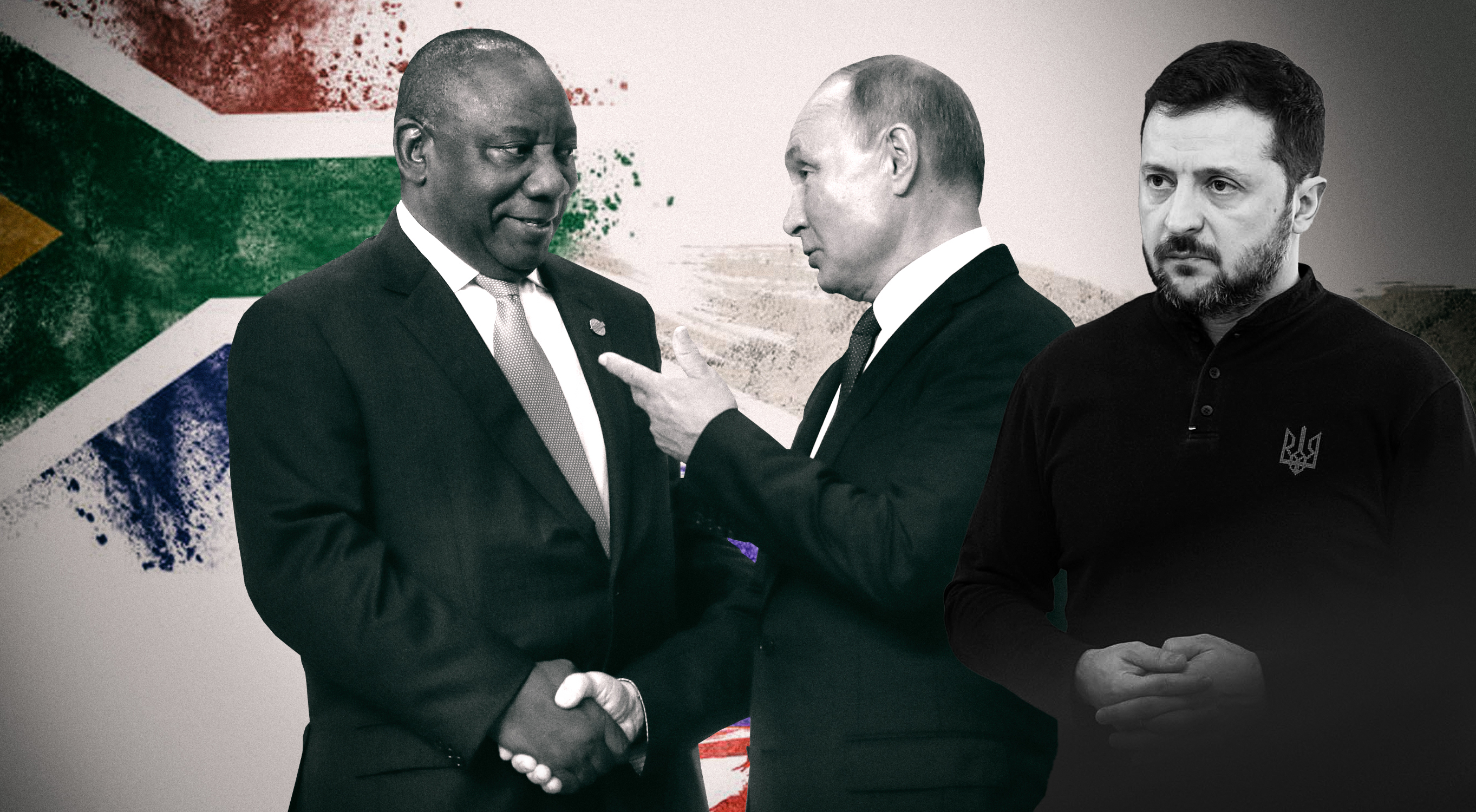
 Illustrative image | Russian President Vladimir Putin, centre, South African President Cyril Ramaphosa, left, and Ukrainian President Volodymyr Zelensky. (Photo: EPA-EFE / Sergei Chiriov / Pool)
 South Africa broke ranks with all its Brics partners and voted on Wednesday, 3 December 2025, for a UN General Assembly resolution demanding that Russia return the thousands of Ukrainian children it abducted during the war and deported to Russia.
Ukrainians in South Africa said they were “enormously grateful” to South Africa for its vote.
The resolution “Return of Ukrainian children”, introduced by Ukraine, Canada and the European Union, was adopted by 91 votes in favour to 12 against with 57 abstentions. It demanded that Russia “ensure the immediate, safe and unconditional return of all Ukrainian children who have been forcibly transferred or deported”.
It also urged Russia to cease further forced deportations without delay and also to end the separation of Ukrainian children from their families and legal guardians, changing their personal status, including through citizenship, adoption or placement in foster families, and indoctrination of Ukrainian children.
“South Africa’s vote today reflects the importance of the need to respect international law, and that children should never be targets of breaches of both international human rights and international humanitarian law,” said Mathu Joyini, South Africa’s ambassador to the UN in New York, in explaining South Africa’s vote for the resolution.
Two of South Africa’s nine BRICS partners, Russia, of course, and Iran voted against the resolution, while the others all abstained, as did most African countries. South Africa itself has also almost always abstained from such resolutions criticising Russia. But this time it joined all the Western nations and others in voting yes.
SA’s stance
The reason is largely that South Africa has consistently championed the return of the Ukrainian children, starting with President Cyril Ramaphosa’s direct appeal to Russian President Vladimir Putin to do so when he met him at the head of the African Peace Mission to Ukraine and Russia in June 2023. In April this year, when Ukrainian President Volodymyr Zelensky visited South Africa, he gave Ramaphosa a list of 400 abducted children whose return he asked South Africa to help secure.
/file/attachments/orphans/peterfab-Ukrainekids-SAvotesfor2_562850.jpg "Ambassador Mathu Joyini says South Africa supports, without qualification, the expeditious return of all displaced children to their families or designated welfare systems. (Photo: EPA / Sarah Yenesel)")
Joyini told the General Assembly that South Africa believed the issue of the missing Ukrainian children must be urgently resolved and added that, in collaboration with Canada, Qatar and the Holy See, South Africa was engaged in an initiative to protect the children and ensure their safe return.
“South Africa unequivocally regrets the displacement of children during times of conflict and, in the current context, calls on all sides to this conflict to refrain from actions that displace and abuse children, especially those in violation of the central prescripts of international law and international humanitarian law.
“We also firmly support, without qualification, the expeditious return of all displaced children to their families or designated welfare systems for them to resume and live their lives free from violence, in a social context that respects their identity and celebrates their humanity.”
Read more: Bringing back abducted Ukrainian children a tough assignment for SA
She said all children everywhere had inherent rights that must be respected and protected, “with their best interests being paramount and at the forefront of all decision-making processes that may affect them in any way. The Convention on the Rights of the Child is the cornerstone of this central respect for the rights of children,” she said.
“South Africa holds these rights as self-evident and implores all member states to refrain from politicising the lives of children. The rights of children should not become a bargaining tool in any conflict. Our humanity forbids such action.
“We remain committed to play a meaningful role as a bridge builder between the conflicting parties, including in the effort towards the return of Ukrainian children.
“We believe that children are the rock upon which we build the future. A future free from violence, a future where their heritage and ingenuity is celebrated and their diversity acknowledged.”
She added that South Africa firmly supported a peaceful resolution of the Russia-Ukraine conflict, reached through a negotiated settlement with all parties around the table.
Children as ‘war trophies’
The resolution asked UN Secretary-General António Guterres to engage with Russia to facilitate the return of the children.
It also noted that Russia’s abduction and deportation of the children violated the Geneva Conventions, which it said “prohibit individual or mass forcible transfers, as well as deportations of protected persons from occupied territory to the territory of the occupying power, regardless of their motive”.
/file/attachments/orphans/13515972_813536.jpg "The President of the UN General Assembly, Annalena Baerbock. (Photo: EPA / Andre Borges)")
In the debate, Annalena Baerbock, President of the UN General Assembly, asked its members to “Imagine you’re a 16-year-old going about your day […] when suddenly soldiers armed with machine guns wearing balaclavas to mask their faces burst into your home. They force you into your vehicle and drive you away in an unknown direction, and you find yourself stuck for months in a nightmare, with a different name, not allowed to speak your own language, cut off from contact with your loved ones.”
She said this was the story of just one Ukrainian child, among the thousands forcibly relocated, adopted or sent to military training by Russia. The authoritative Ukrainian NGO Bring Kids Back UA says it has documented 19,546 children unlawfully abducted to date, though it believes there are more. It says Russia has so far returned only 1,876 children.
“This resolution is not about politics,” Ukraine’s representative told the assembly. “[It] is about humanity.”
She said there could be no doubt that every child deserved a home where they felt loved, supported and taken care of. Amid Russia’s war of aggression against Ukraine, children had been killed, injured, raped, separated from their families and deported.
“It is unimaginable that someone could view children as war trophies,” she said.
The representative of the Russian Federation strongly rebuked the many allegations levelled against her country, saying they were a “particularly cynical lie” intended to derail current peace efforts.
Moral obligations
Kateryna Aloshyna, President of the Ukrainian Association of South Africa, said: “This decision shows South Africa’s leadership in promoting children’s rights globally.
“We are enormously grateful to the South African government, President Ramaphosa, and to all South Africans who for years have marched in support of Ukrainian deported children, prayed for their return, and written letters to parliamentarians and the government. We truly believe this resolution will help bring at least some of the children back home.”
She particularly commended Joyini’s statement that: “The rights of children should not be a bargaining tool in any conflict.”
The Ukrainian Association of South Africa statement added that the UN resolution would facilitate the return of Ukrainian children through the use of the UN Secretary-General’s offices.
“It also obliges Russia to provide the names of all the Ukrainian children and ensure their immediate, safe and unconditional return. Importantly, it sets a clear requirement for Russia to end the practice of forcible transfer, deportation, separation from families, and changes to children’s personal status, including citizenship, as well as to stop their indoctrination.”
The association said the return of Ukrainian children enjoyed wide support in South African society, noting that thirteen South African human rights NGOs had called for the return of the children, and children’s rights experts from South Africa and Ukraine had produced a policy brief that included the UN resolution as one of the recommendations.
And it noted that Anglican Archbishop Thabo Makgoba had written a letter urging SA to support the UN resolution, in which he said: “In the many arguments to find the means to end to this terrible conflict, it is imperative that we do not for a moment lose sight of the moral obligations of leadership in considering the impact on the lives of citizens, especially the innocent and defenceless, and assessing the path to peace.” DM