




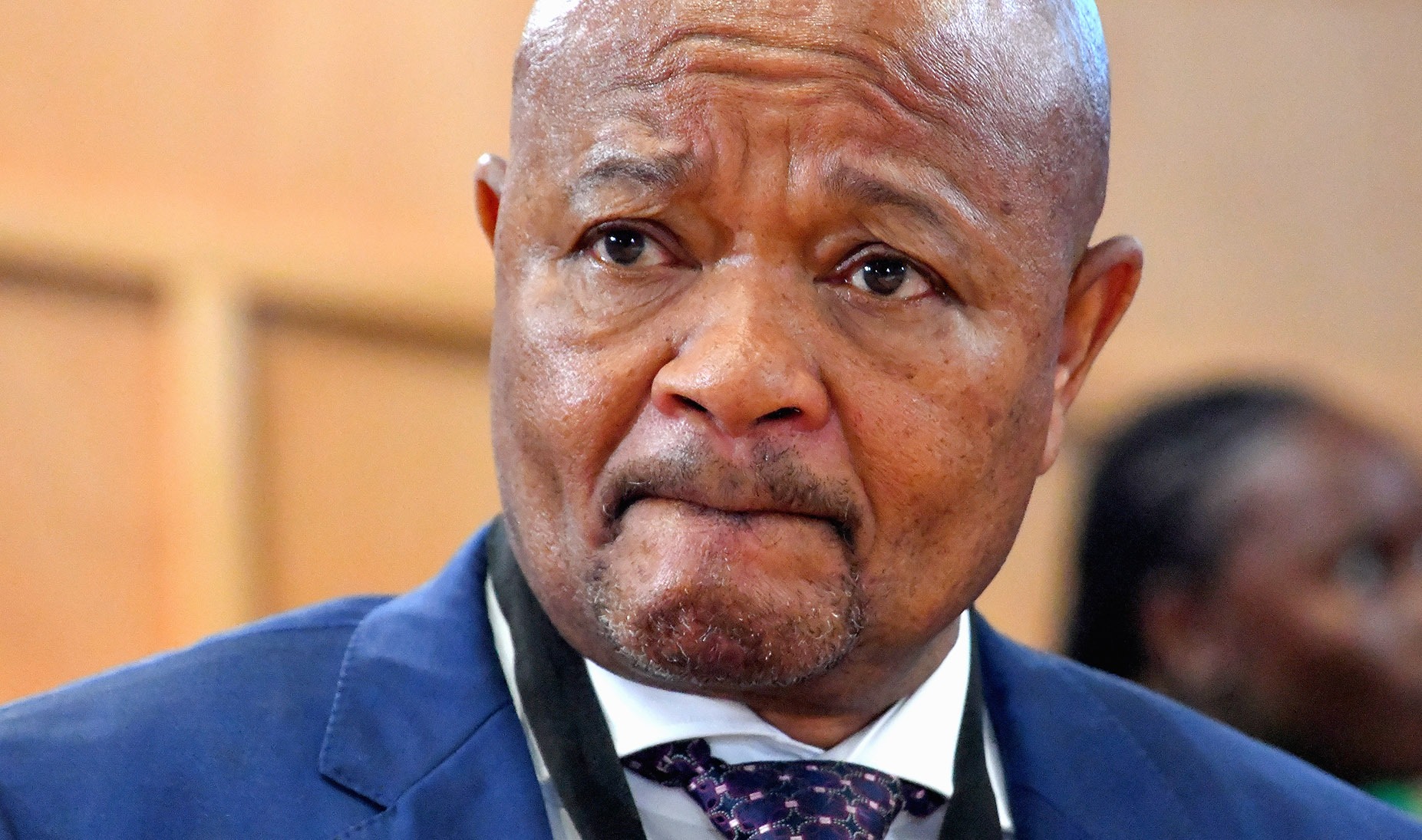
 Sidelined Police Minister Senzo Mchunu testifies at the Madlanga Commission Of Inquiry, sitting at the Brigitte Mabandla Judicial College in Pretoria on 4 December 2025. (Photo: Gallo Images / Frennie Shivambu)
 On Thursday, 4 December 2025, Justice Mbuyiseli Madlanga, chair of the Madlanga Commission, said he found it “very strange” that Senzo Mchunu, the minister of police now on special leave, never mentioned the impending disbandment of the National Political Killings Task Team (NPKTT) to Police Commissioner Fannie Masemola on 28 December 2024, when the two attended a funeral together.
Mchunu issued a directive to Masemola to disband the team on 31 December, without discussing it with him beforehand, despite the gravity of the decision.
Mchunu was relentlessly cross-examined on his second day at the commission, as Madlanga systematically poked holes in his version that there was nothing improper about his decision to disband the NPKTT.
Read more: Senzo Mchunu defends decision to disband National Political Killings Task Team as ‘inevitable'
Madlanga said: “On 28 December 2024, the minister and Masemola had attended a funeral together. They exchanged the usual New Year wishes afterwards. Yet not once did Mchunu mention that he had already decided to disband the NPKTT or that he would begin drafting the directive the very next day.”
/file/attachments/orphans/ED_589584_253837.jpg "Sidelined Police Minister Senzo Mchunu confers with his legal team at the Madlanga Commission of Inquiry at Brigitte Mabandla Judicial College in Pretoria on 4 December 2025. (Photo: Gallo Images / Lefty Shivambu)")
Mchunu is testifying on the disbandment of the NPKKT and responding to allegations that he had links with tenderpreneur and organised crime accused Vuzimusi “Cat” Matlala and their alleged go-between, Brown Mogotsi. The NPKTT was investigating Matlala at the time of its disbandment.
KwaZulu-Natal police commissioner Lieutenant General Nhlanhla Mkhwanazi has alleged that top officials had conspired to obstruct investigations into criminal syndicates. Mkhwanazi alleged that Mchunu disbanded the NPKTT, set up in 2018, to shield politically connected members of a criminal syndicate from prosecution.
Mchunu has denied any links to Matlala and has claimed that Mogotsi is “just a comrade” from whom he never “requested or received” anything.
Matlala testified during his appearance before Parliament’s ad hoc committee at Pretoria’s Kgosi Mampuru Prison that he had a relationship with several police officials, including former police minister Bheki Cele. He claimed he paid Cele R500,000 in bribes while spending hundreds of thousands of rands towards supporting Mchunu’s nascent ANC presidency campaign.
Madlanga unconvinced
Madlanga noted that Mchunu issued his directive without consulting a single senior SAPS leader, despite Mchunu saying he and Masemola had a good relationship. Mchunu said there had been meetings on 1 November and 22 December with the police to review the NKPTT, but its potential disbandment was not discussed.
Madlanga found it perplexing that throughout the lifespan of the NPKTT — during multiple interministerial committee meetings — the unit was consistently praised for its work. Mchunu justified the disbandment on the basis that the NKPTT was never meant to be a permanent structure. But the document he relied on was years old.
Madlanga asked him on what basis, exactly, did he believe SAPS senior management “must have expected” that the NPKTT could be shut down at any moment.
Mchunu pointed to a preliminary report in which Masemola noted that the task team had “achieved what they were supposed to achieve” — insisting this sentiment must have existed before the directive was issued.
/file/dailymaverick/wp-content/uploads/2025/10/ED_574708-1.jpg "Justice Mbuyiseli Madlanga chairs the Madlanga Commission Of Inquiry at Brigitte Mabandla Judicial College in Pretoria. (Photo: Gallo Images / Luba Lesolle)<br>")
Read more: Senzo Mchunu crafted a clean image — KZN’s top cop has blown it up
He said the SAPS leadership would have seen that the NPKTT had not only performed exceptionally well, but had fulfilled its mandate, citing declining political murder figures: 11 cases in 2023 and seven in 2024.
According to Mchunu, by the time of the November 2024 meeting, “There would have been that kind of understanding…” that the task team’s work was essentially complete.
But Madlanga was unconvinced. He pointed out that Mchunu’s justification would only make sense if he had actually consulted SAPS management — and if they had expressed these views before he took the decision on 31 December 2024. Since no such consultation took place, the minister’s explanation simply did not hold.
When Madlanga asked him whether, at the November 2024 review meeting or at any point before 31 December 2024, there had ever been a discussion about disbanding the NPKTT, Mchunu admitted — plainly — that there had not.
‘Open to revisiting the decision’
Referring to the “very good relationship” Mchunu claimed to have with Masemola, Madlanga asked: who, if not the national commissioner, did the minister believe was best placed to brief him on whether the NPKTT should be disbanded?
Mchnu’s reply was confusing. He said he would be “informed by discussions” and would draw his own conclusions — not necessarily by asking anyone to brief him on disbandment. He claimed he simply “took it” that the discussions up to that point had informed everyone that the SAPS was moving toward structural changes, and that “somebody needed to take a decision, and I took the decision”.
Mchunu has previously testified that the NKPTT would be absorbed into a revived police murder and robbery unit.
Read more: The company they keep — Cele and Mchunu on Matlala, Mogotsi and a murdered convict
After a series of evasive answers, Mchunu finally conceded that the person best placed to brief him before issuing his decisive directive was, in fact, Masemola.
Asked why he had not engaged with Masemola before issuing the directive, Mchunu said: “This decision flows from 29 December 2024, when I finally took a break to reflect on what we had been doing all along.”
/file/attachments/orphans/ED_589590_398646.jpg "Senzo Mchunu testifies at the Madlanga Commission of Inquiry on 4 December. (Photo: Gallo Images / Frennie Shivambu)")
Mchunu previously told Parliament the decision had been taken while he was at home contemplating his thus-far six-month tenure as police minister.
“On 30 December, I reflected and decided to issue the directive, and then we would start engaging afterwards. In the meantime, there would be space for all of us to engage if it came to a point where we had to review the decision.”
The chair was not persuaded. If Mchunu was open to reviewing — and possibly even reversing — the directive after the fact, what was the rush?
Mchunu replied: “The decision was taken to disband so that we could then focus on whether we all agreed or not. I was flexible and open to revisiting the decision, but you don’t postpone taking a decision when you believe it needs to be taken. I didn’t see anything wrong with taking it.”
What of other task teams?
Lieutenant General Hilda Senthumule testified before the commission that more than 10 task teams were operating nationally.
When asked whether the minister had disbanded any other task team, Mchunu pointed only to a unit within the Police Inspectorate — and then conceded that, in fact, no other task teams had been disbanded.
Madlanga challenged Mchunu on his claim that the NPKTT’s expenditure could not be justified. Did he compare its costs with those of other task teams? Mchunu admitted: “No, I didn’t compare.”
Madlanga asked Mchunu why he was focused on the NKPTT and not on other task teams.
His justification was that, in his assessment, his attention had been drawn specifically to the NPKTT, and that, because SAPS was discussing organisational structures linked to murder and robbery, “There are other task teams that fall in that category.”
Asked when the idea of disbanding the NPKTT first struck him, Mchunu said it came to him on “29, 30 and 31 December 2024” when he was no longer “working up and down” but simply sitting and reflecting on the previous five months.
On Thursday, commission spokesperson Jeremy Michaels said: “The commission is concluding its public hearings for 2025 by tomorrow (Friday), 5 December. We will then focus on delivering the commission’s interim report to President Cyril Ramaphosa by 17 December, which is the revised deadline as set out in the amended Terms of Reference.” DM