




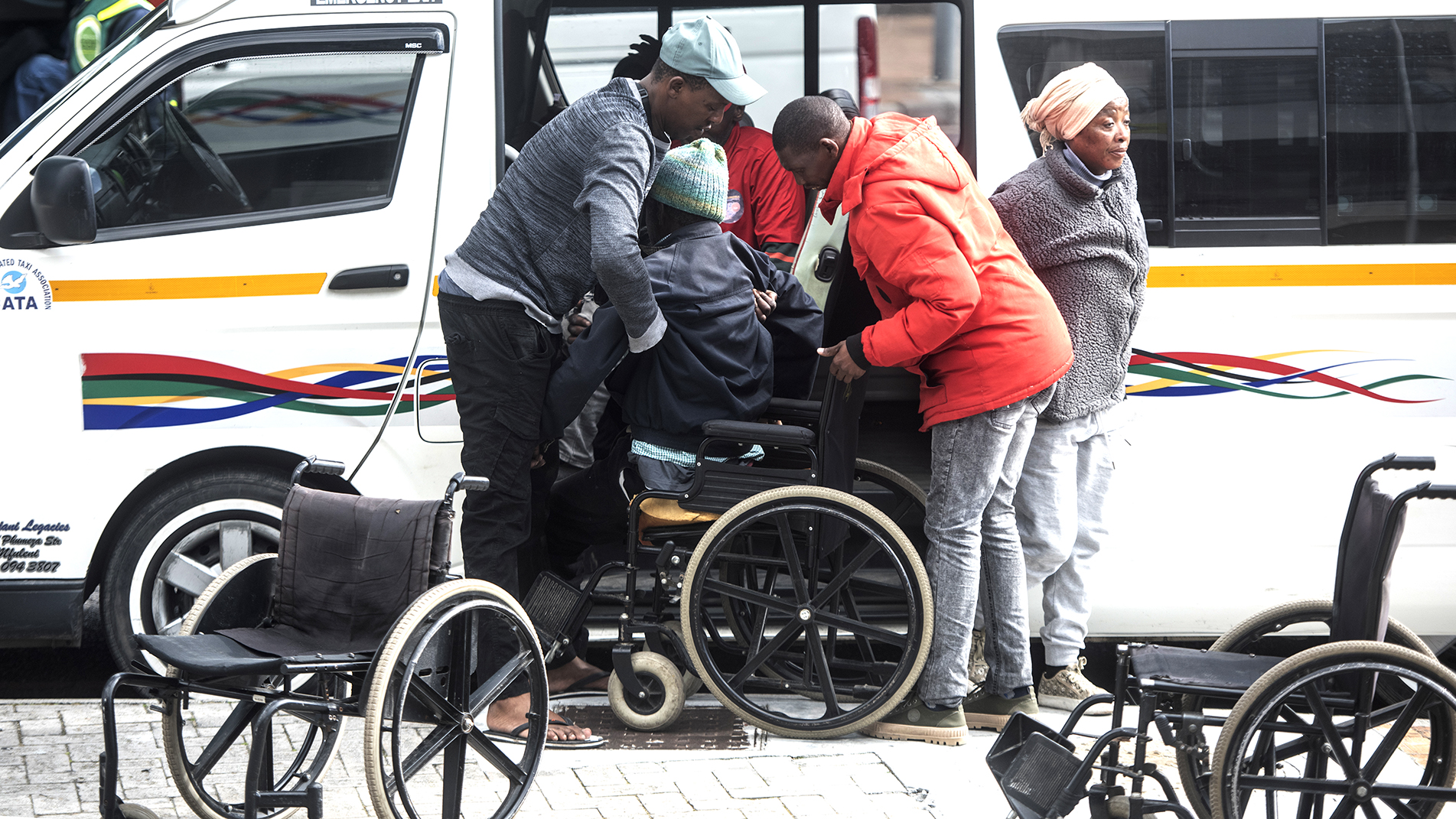
 Disabled people protest peacefully at the Cape Town Civic Centre against cuts to the Dial-a-Ride service on 25 August 2025. (Photo: Gallo Images / Brenton Geach)
 National Disability Rights Awareness Month in South Africa ran from 3 November to 3 December. However, visually impaired Cape Town residents Sergil January and Benjamin Pedro never felt less visible.
Both January and Pedro are employed at the Cape Town Society for the Blind (CTSB), as an awareness officer and an orientation and mobility specialist, respectively. They have both been Dial-a-Ride users since 2022, after being on the waiting list for 16 years, said Pedro.
Pedro uses the service regularly to commute from his home in Athlone to work in Salt River, and then to Eerste River, where he spends his weekends.
January uses Dial-a-Ride for his commute from Retreat to Salt River and back, and to visit his son in Athlone.
However, the future of this service now hangs in the balance.
Proposed downscaling
In a statement on 7 August 2025, the City of Cape Town announced that Dial-a-Ride would return to its “original mandate” of serving “those with the most critical transport needs”, owing to budgetary constraints.
Established about 30 years ago and operating under the umbrellas of MyCiTi and logistics company HG Travelling Services, Dial-a-Ride’s original mandate is as a “dedicated kerb-to-kerb service for people with disabilities who are unable to access mainstream public transport services”.
It has been used for travel to and from work, schools and universities, hospitals and clinics, religious gatherings and social visits, thereby providing access to the rights to work, education, health, religious expression and leisure, among many others.
Legal proceedings
From 8 September, eligibility for the service will be restricted to individuals in manual or motorised wheelchairs and those with severe walking impairments, strictly for their commute “to and from formal employment”, according to the statement.
Thus, ad-hoc or private travel, students, organisations transporting individuals with disabilities, elderly passengers and people with visual, mental or cognitive impairments will no longer be supported, according to letters sent out to blind and visually impaired users, sourced via the CTSB.
/file/attachments/orphans/ED_570079_119531.jpg "Disabled people during a peaceful protest at the Cape Town Civic Centre against cuts to Dial-a-Ride services on 25 August 2025. The City announced that, owing to budget constraints, it would be changing the eligibility criteria for disabled persons who use the service. (Photo: Gallo Images / Brenton Geach)")
A formal legal application, supplemented by affidavits signed by 19 individuals confirming the proposed cuts’ disruption to their daily lives, was subsequently lodged at the Cape Town High Court by the Western Cape Network on Disability and #UniteBehind, facilitated by the People’s Legal Centre.
The organisations sought an interim interdict to stop the cuts for 60 days, which was granted and implemented, according to a joint statement released on 10 October.
An ongoing legal review now requests that the court “declare the planned cuts to Dial-a-Ride unlawful and order that they be abolished completely”.
Until the review process is concluded, the existing interdict remains in force, with Dial-a-Ride continuing operations as before, according to Anthony Ghillino, chairperson of the Network, and a wheelchair user himself, who has also used the services since 2002.
However, many Dial-a-Ride users have claimed they have had significant difficulties booking – or been entirely unable to book – ad-hoc trips since this announcement, despite the continuation of the services in the interim, according to CTSB chief executive Judith Coetzee.
/file/attachments/orphans/unnamed2_514685.jpg "The Cape Town Society for the Blind operates within the broader mandate of the Western Cape Network on Disability. The network’s case against the City of Cape Town was born from the society’s collaboration with the People’s Legal Centre, a Cape Town-based nonprofit organisation. (Photo: Kiara Wales)")
Read more: City of Cape Town’s new transport plan puts big legacy projects on backburner
Minister in the Presidency for Women, Youth and Persons with Disabilities Sindisiwe Chikunga and Rob Quintas, the mayoral committee member for urban mobility, along with other senior urban mobility officials, recently held a meeting to discuss the service’s long-term sustainability.
“It was clear that both spheres of government recognise the need to improve the funding models for Dial-a-Ride,” Quintas said.
According to Ghillino, the Network has engaged in quarterly meetings with the City’s Universal Access Transversal Committee. He expressed frustration at the most recent meeting taking place eight days before the decision’s announcement, with “no mention of the intended cuts to the [Dial-a-Ride] service” therein.
The Network expressed its dissent with the lack of citizen participation in the decision, and said it contradicted the Promotion of Equality and Prevention of Unfair Discrimination Act mandate that “denying or removing from any person who has a disability, any supporting or enabling facility necessary for their function in society” is classified as unfair discrimination.
Read more: ‘Trust in public transport is at its lowest,’ says Western Cape MEC
/file/attachments/orphans/unnamed_205300.jpg "On 8 September, the day of the new regulations’ originally proposed start date, Benjamin Pedro, a visually impaired Dial-a-Ride user, had to take a day off from his job as a technology instructor at the Cape Town Society for the Blind, missing a field trip with his class. (Photo: Kiara Wales)")
The individual impact
Both January and Pedro, who are completely blind, rely on Dial-a-Ride for access to health, socioeconomic and job opportunities, for which they would cease to be eligible under the proposed reforms, Coetzee confirmed.
“People may assume that because we have the ability to walk independently, that we can travel independently,” January said. “That is not the case.”
Pedro said Dial-a-Ride’s importance is largely tied to its affordability, compared with e-hailing services such as Uber, which are considered more accessible to those with disabilities, but are also more expensive.
/file/attachments/orphans/unnamed1_746794.jpg "Despite there being a MyCiTi bus station directly outside of the Cape Town Society for the Blind, the service remains unsuited to blind or visually impaired users due to the absence of verbal announcements of buses’ arrival at stations, stops and routes followed, among other factors. (Photo: Kiara Wales)")
January said he pays an average of R21 for his Dial-a-Ride trips. It’s cheaper than MyCiTi’s fees because the bus service does not distinguish between able-bodied passengers and those with disabilities. “You pay an equal fee to the able-bodied person, notwithstanding the differences in work opportunities and those opportunities’ accessibility,” he said.
However, he complained that the service’s name is misleading.
He explained that users calling in are given a daily timeframe between 10am and 11am to make ad hoc bookings – “to do grocery shopping and go the doctor and such” – at least one week in advance, with the first 15 individuals’ applications being accepted, while those using the web-based app are required to book three days in advance.
Pedro also said that physical safety is a chief concern for visually impaired people, which Dial-a-Ride addresses by ensuring that their pick-ups happen in close proximity to users’ exact location. He recounts being hit by an oncoming truck a few years ago while crossing the road outside his place of work, because he was unable to hear the vehicle coming.
/file/attachments/orphans/ED_249870_136344.jpg "Sergil January, an awareness officer at the Cape Town Society for the Blind, relies on Dial-a-Ride for his daily commute from home in Retreat to work in Salt River, and to visit his son in Athlone. (Photo: Kiara Wales)")
Both January and Pedro are unhappy about the proposed downscaling. January believes the City’s allocation of R252-million in the current financial year on footways, formalising cycle lanes and developing new non-motorised transport infrastructure, in particular, is unfair.
“It really frustrates me when the City thinks less of me than a bicycle lane,” he says.
Read more: ‘Inclusion means actual inclusion’ — ending the marginalisation of young children with disabilities
/file/attachments/orphans/ED_570076_212035.jpg "Disabled people at the Cape Town Civic Centre protest against cuts to the Dial-a-Ride service on 25 August 2025. (Photo: Gallo Images / Brenton Geach)")
Institutional perspective
Ghillino explained that Dial-a-Ride’s budget, which he says was initially adopted as an interim solution to the lack of accessible public transport, has historically been funded in thirds. Equal amounts of funding were contributed by the government at national, provincial and municipal levels.
He believes the problem lies chiefly in a lack of national funding, but says there is a “bigger problem” in that the allocated funding of about R30-million has not increased in line with inflation since Dial-a-Ride’s inception.
Quintas highlighted that “universally accessible transport is significantly constrained by funding shortages at the national level, and it underscores the expectation that municipalities should be supported in providing transport for persons with disabilities”.
According to the Western Cape Department for Social Development, “the government cannot do it alone”. Representatives said “the key is to capacitate registered and credible NGOs so that they may be able to do more in supporting persons with disabilities”.
The department cites the Cape Care Fund as an example of a “well-functioning, compliant nonprofit organisation”, which, through support, can “actively contribute toward the strengthening of the communities they serve”.
This comes as the Network hands over a petition to Parliament calling for urgent amendments to the National Land Transport Act, to ensure public transport for people with disabilities.
“People with disabilities simply want to enjoy the things and freedoms that citizens of Cape Town and South Africa as a whole take for granted every day,” Ghillino said. DM