




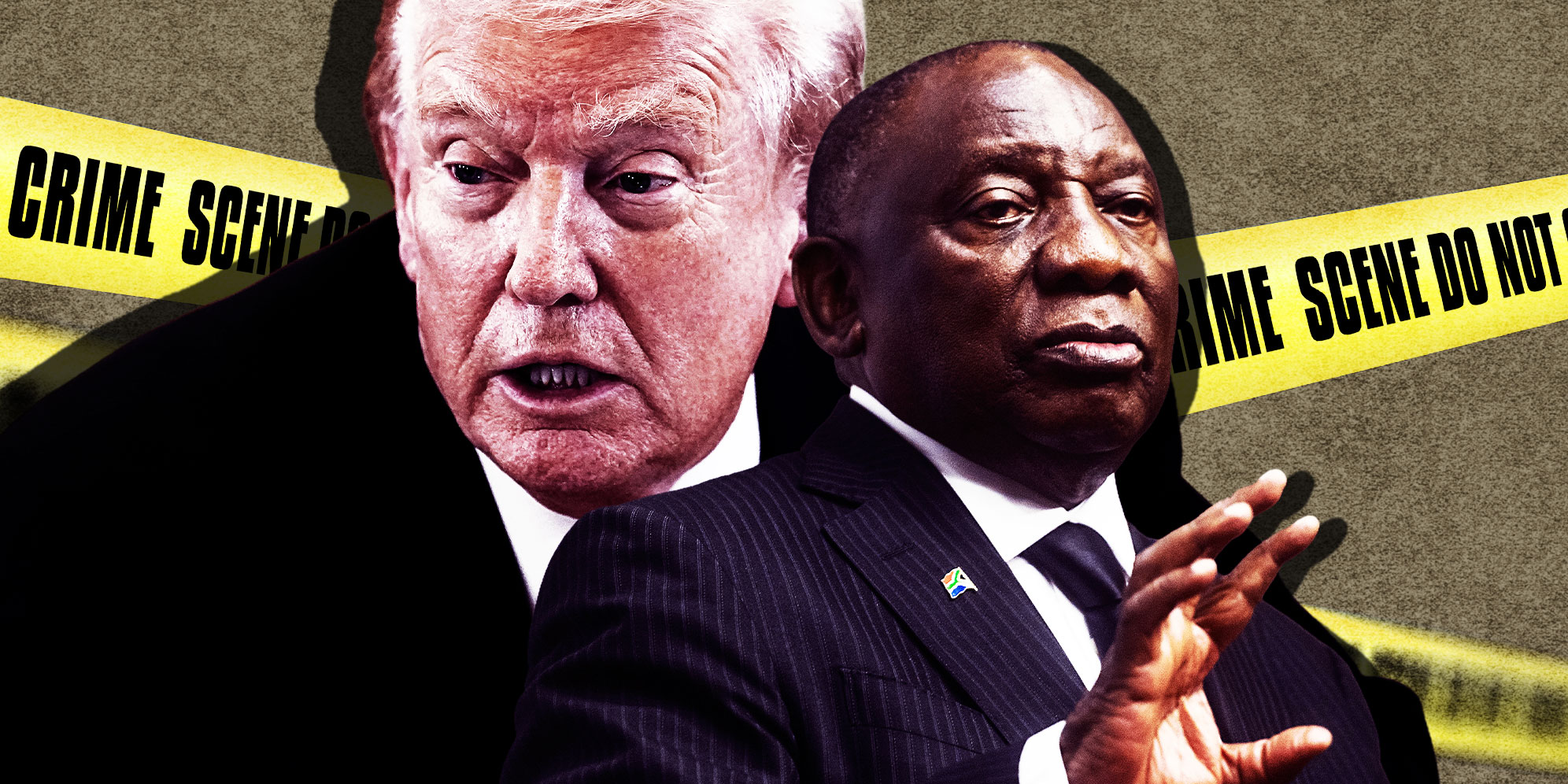
 Illustrative Image: US President Donald Trump. (Photo: EPA / Aaron Schwartz) | SA President Cyril Ramaphosa. (Photo: Gallo Images / Brenton Geach) | Yellow crime tape (Image: Freepik) | (By Daniella Lee Ming Yesca)
 Weighty political issues are attached to South Africa’s most recently released official crime statistics that provide details about the country’s lawbreaking landscape.
These issues can influence crime fighting on the ground and even affect the way South Africa is viewed on the global stage.
The official crime statistics were released in two batches last Friday, 28 November 2025, and together cover a total of six months.
Matters attached to certain crime categories covered in the figures reiterate the nexus between politics and crime, a combination that has contributed to shaping South Africa’s history, including apartheid and State Capture.
At the presentation of the statistics last week, Acting Police Minister Firoz Cachalia spoke about two parallel hearings — the Madlanga Commission of Inquiry, and Parliament’s ad hoc committee — that are investigating accusations that a drug trafficking cartel has infiltrated South Africa’s law enforcement and politics.
Read more: Murders in SA drop (slightly) — Police release crime figures amid drug cartel infiltration scandal
This scandal is the reason why Cachalia is filling the police minister role.
His predecessor, Senzo Mchunu, was placed on special leave earlier this year after accusations linked to that saga, which he denied, surfaced that he was colluding with questionable individuals to become ANC president.
Last week at the crime statistics release, Cachalia referenced political interference, saying: “We need a professional police service which acts outside of the political process without fear or favour.”
Below is a breakdown of certain types of lawbreaking, referenced in the crime statistics, and connected political issues.
Two farmers killed vs Trump’s ‘false’ allegations
US President Donald Trump has repeatedly spoken against South Africa this year and amplified false claims that white Afrikaners are specifically being targeted, in terms of violent crime and farms being taken from them.
The US is even offering refuge to Afrikaner “victims of government-sponsored race-based discrimination”.
This is happening while Trump has deemed certain other groups unwelcome in the US.
On Tuesday, referencing Somali immigrants, he said: “Their country stinks and we don’t want them in our country...
“We’re going to go the wrong way if we keep taking in garbage into our country.”
During a Cabinet meeting, President Trump made a series of disparaging remarks about Somalia and Somali refugees living in Minnesota, including that they “bitch” and should “go back to their country and fix it.” pic.twitter.com/aUw7UZSzu1
— New York Post (@nypost) December 2, 2025
In terms of his stance against this country, he posted to his social media platform, on 26 November, that the US chose not to participate in the G20 Summit recently held in Gauteng because South Africa’s government was “killing white people, and randomly allowing their farms to be taken from them”.
President Cyril Ramaphosa hit back a few days later.
He said the US’ stance was unfortunate, and “it is even more unfortunate that the reasons the US gave for its non-participation were based on baseless and false allegations that South Africa is perpetrating genocide against Afrikaners and the confiscation of land from white people”.
/file/attachments/orphans/1napArtboard1card_349296.jpg "Graphic showing the crimes and statistics from April to September 2025 and the politics behind them. (By Daniella Lee Ming Yesca)")
According to the official crime statistics released last week, between the start of April and the end of September, in terms of the location of killings, 139 murders took place on agricultural land, farms, plots or smallholdings.
Figures under the heading “Murder of farming community” and subheading “Victim linked to farm/smallholding” show that two farmers were killed over those six months.
Five farm employees, eight residents, two shepherds and another individual described as “not specified” were also murdered during that time. (The races of these individuals are not contained in the statistics.)
While awful, this is not indicative of a genocide or of white people with farms being specifically targeted.
This shows that Trump is using a narrative to try to politically manipulate South Africa.
Drugs and infiltration accusations
Politics and illicit drugs also overlap.
Take, for example, a decision Trump announced last week about former Honduran president Juan Orlando Hernández, who was jailed for 45 years in the US last year for drug trafficking.
Trump said: “I will be granting a Full and Complete Pardon to… Hernandez who has been, according to many people that I greatly respect, treated very harshly and unfairly.”
(This has a similar ring to what Trump previously claimed about South Africa, that it was “treating certain classes of people VERY BADLY”.)
Hernandez was reportedly released from US custody on Tuesday.
Read more: Jailed for 45 years, ex-Honduras president ‘haunted’ by 2010 Soccer World Cup photo
Daily Maverick previously reported that he was present at the 2010 Fifa World Cup in South Africa, and a photograph suggested he was with cocaine traffickers.
This country’s law enforcement scandal, meanwhile, that started erupting about five months ago, hinges on accusations that a drug trafficking cartel known as the Big Five has infiltrated policing and politics.
A figure accused of being part of the Big Five, but who is not facing criminal charges for this, is Vusimuzi “Cat” Matlala, who is connected to several police officials.
He faces other charges, including attempted murder, in Gauteng.
/file/dailymaverick/wp-content/uploads/2025/11/ED_585836-1.jpg "Vusimuzi ‘Cat’ Matlala. (Photo: Fani Mahuntsi / Gallo Images)")
According to the crime statistics covering the six months from April to September, a total of 108,135 drug-related crimes were recorded across the country.
When the statistics were released last week, more focus was on the three months from July to September this year, when 56,403 drug crimes were recorded nationally.
During that same period, over five years, drug-related crimes have steadily escalated. (Between July and September 2021, there were 30,224 drug-related crimes in South Africa, compared with the 56,403 this year.)
It is difficult to decipher what these numbers really mean without seeing exactly why arrests were carried out.
The figures may include cases of individuals caught with drugs for personal use.
Or they could include matters linked to drug transporters, dealers or manufacturers, and not narco bosses based in South Africa and in other countries.
Read more: ‘Tesla cocaine’ and secret drug labs point to Mexican cartel activity in SA
The statistics aside, what is clear is that this country is a key cog in international narcotrafficking.
Illicit drugs are being manufactured in South Africa; there are narco consumers in the country, and it is also a transit point for drugs to pass through.
#sapsHAWKS Mpumalanga: Decommissioning and cleaning of a multi-million clandestine drug laboratory in Volksrust is expected to be finalised on Friday, 31/10.
— SA Police Service 🇿🇦 (@SAPoliceService) October 29, 2025
The clandestine drug laboratory was uncovered by the police after receiving information about the unpleasant smell in the… pic.twitter.com/DsMPTGMUR9
When the statistics were released last week, police highlighted that a crystal methamphetamine manufacturing facility, worth about R350-million, was shut down in Mpumalanga and five suspects were arrested.
This happened in September.
Daily Maverick has previously reported that the suspects were from Mexico, and the crackdown was among the matters adding to suspicions that Mexican cartels are among those active in South Africa.
Gang violence and the Western Cape
Drug trafficking, of course, is connected to gangsterism.
Gang bosses use their foot soldiers to smuggle, sell and buy drugs.
The Western Cape is widely viewed as South Africa’s gangsterism capital because of the rate of related violence.
Based on the crime statistics released last week, it retains this ominous title.
Nationally, over the six months between April and September, 632 gang-related murders were recorded across the country.
Of those, the majority — 575 — were carried out in the Western Cape.
Aspects of gangsterism, like policing, are also politicised, and suspicions of collusion in this arena are rife.
The South African Police Service (SAPS) is widely viewed as an ANC remit because the minister is associated with the party, while the Western Cape is DA-governed.
It was previously reported that in 2011 then president Jacob Zuma met a number of top gangsters as part of a plan for the ANC to wrest control of the Western Cape from the DA.
Several sources insisted the meeting took place, while the ANC denied it.
There have subsequently been accusations of alleged gang antics linked to the DA-run City of Cape Town.
Some of this involves the city’s former DA human settlements mayoral committee member, Malusi Booi, who was arrested in September last year.
He faced accusations of accepting gratifications from 28s gang boss accused Ralph Stanfield, in a matter that has since been provisionally withdrawn.
The DA, meanwhile, has been pushing for more policing powers.
Last month, Ian Cameron, its deputy spokesperson on police, issued a statement in reaction to killings in the Western Cape, saying: “The DA reiterates its longstanding call for the devolution of policing powers to capable metros such as the City of Cape Town.”
/file/dailymaverick/wp-content/uploads/2024/06/Western-Cape-Provincial-Legislature-Swearing-In-Alan-Winde-DH-0657-copy.jpg "The DA’s Alan Winde and fellow members of the Western Cape Provincial Legislature attend a swearing-in ceremony presided over by acting Western Cape Judge President Patricia Goliath on 13 June 2024. (Photo: David Harrison)")
Then there is a matter involving a 2022 high court judgment that warned that evidence in a case suggested that the 28s gang had infiltrated the Western Cape’s police management. The province’s DA Premier, Alan Winde, wants accountability from the SAPS in terms of the judgment.
These are just some of the issues underpinning the Western Cape’s gang problem that is consistently claiming lives and producing crime statistics that hint at unimaginable trauma.
Trauma that politics can overshadow, or that, in certain instances, may be exploited for political benefit.
Wildlife matters
Gangsterism and other crimes also rip into the environment.
The crime statistics released last week show that over three months from July to September, 61 crimes involving rhinos, which are under threat because of poachers, were reported nationally.
During that same period, 71 crimes involving abalone (perlemoen) were recorded. (Most of these — 52 — were in the Western Cape, the country’s gang capital, which is also a coastal region where poachers are known to target the molluscs.)
The rhino crimes increased by four cases compared with the same period last year, while the number of abalone cases remained the same.
Read more: African white rhino numbers fall in 2024, with startling 15% decline in SA — report
On the political front, News24 last month reported that DA “party insiders” said allegations of underperformance had surfaced against the Forestry, Fisheries and Environment Minister at the time, Dion George.
About a week later, he was removed from the post, and Willie Aucamp was appointed to it.
DA leader John Steenhuisen confirmed that he had “formally requested that the president implement the… changes to the DA’s representatives in the National Executive”.
Other allegations surfaced in this saga.
George, following his removal as minister, expressed himself in a piece published on the digital media platform National Security News.
It said: “During my tenure as minister of Forestry, Fisheries and the Environment, I learned firsthand that illicit wildlife trafficking is never just about wildlife…
“It is no coincidence that the same networks smuggling rhino horn and abalone are also moving fentanyl precursors, heroin and trafficked migrants.
“These systems increasingly connect criminal groups across Africa and Latin America, binding syndicates in South Africa, Venezuela and Colombia.”
George said this was “the context” in which his removal needed to be understood.
He claimed that a “smear campaign” against him was orchestrated to discredit strong environmental governance and to weaken resistance to organised crime.
Politics, crime and everything in between
Those accusations and the political fallout aside, it is known that cartels and gangs diversify to expand their dominance, influence and to rake in more money.
Their reach into political spheres, if conclusively proven in South Africa, would not be unique to this country.
The Madlanga Commission of Inquiry previously heard detailed allegations about the Big Five cartel at the centre of the law enforcement scandal.
Its members had different criminal focus areas.
According to certain police officers, aside from drugs, the Big Five was involved in contract killings, tender fraud, cross-border vehicle hijackings, kidnappings, extortion, cash-in-transit heists and ATM bombings.
Read more: Big Five cartel’s dark web of political ties and criminal operations unveiled by Dumisani Khumalo
Some of these crimes are covered in the statistics released last week.
But not in a way that suggests a cartel, that allegedly infiltrated the state, is active.
Certain types of crime do not appear in the figures that the police release.
These include grand-scale public service looting and tender fraud in government departments.
In other words, State Capture is not reflected in an obvious way in the crime statistics that are drip-fed to the public.
But when this lawbreaking happens, it blurs the lines between politics, policing and crime.
It dissolves the notion that these arenas are separate. DM