




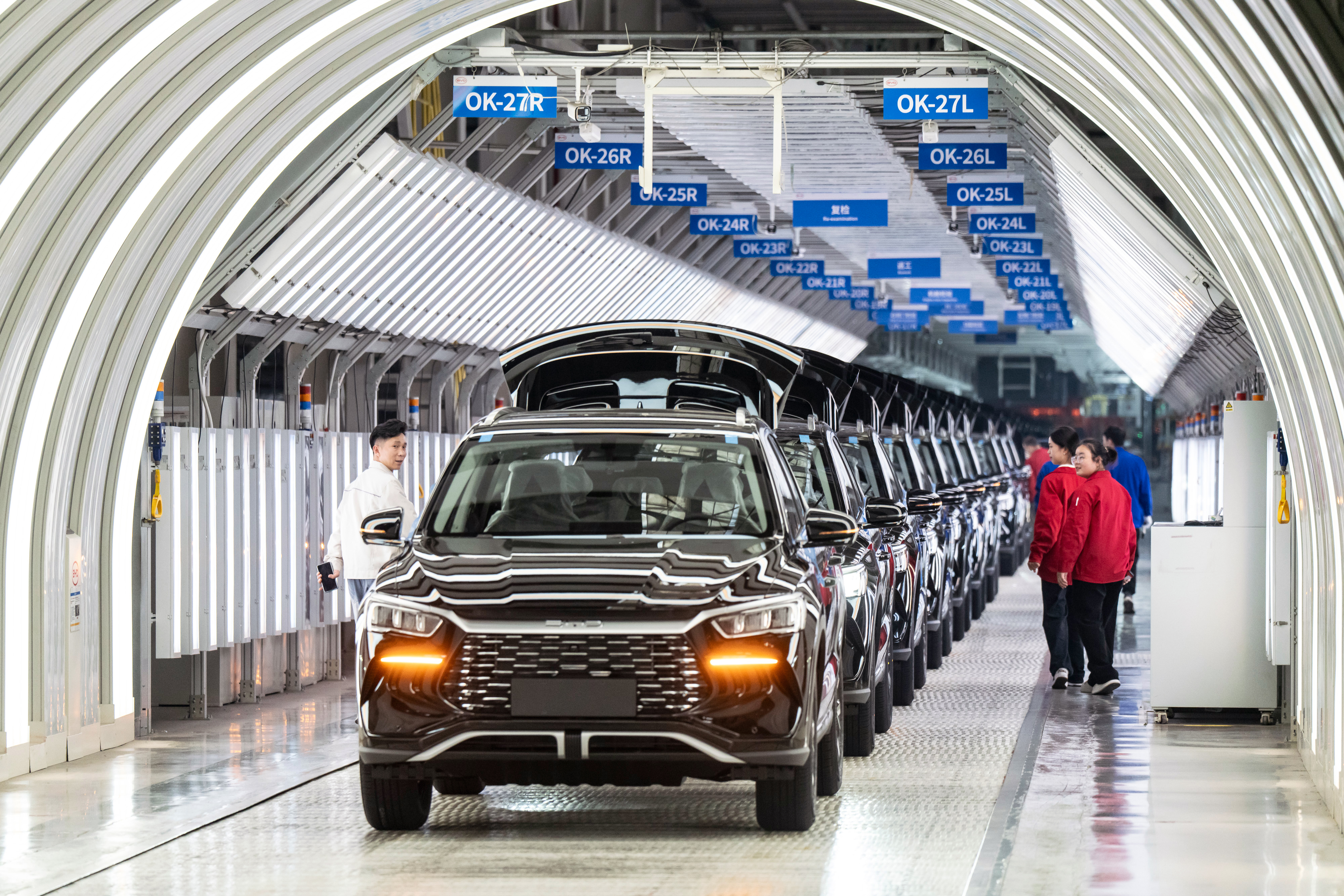
 Electric vehicles on the assembly line at the BYD factory in Zhengzhou, Henan province, China, in November 2025. (Photo: Qilai Shen / Bloomberg)
 One of the more common talking points in the car industry and around various taverns and braais has been the large number of Chinese-made cars that have appeared on our roads in a very short time.
So large is the number that some South African companies have already suffered severe consequences.
WeBuyCars watched its share price drop by 14% in one day after flagging a weaker outlook, simply because more people were buying new Chinese cars rather than second-hand vehicles.
/file/attachments/orphans/ED_487326_999443.jpg "WeBuyCars in Richmond Park, Cape Town. (Photo: Gallo Images / Misha Jordaan)")
These new cars cost the same, or less, than a second-hand car from a more established brand.
Zeda Limited, the owner of Avis Budget in South Africa, reported it had to change its operating policies because it was getting less revenue from selling the cars in its fleet.
This may be just the beginning.
Reuters reported on Tuesday that China has dramatically increased the number of petrol and diesel cars it is selling, particularly to emerging markets.
They say that in 2020, China exported around a million of these cars.
This year, it expects to export 6.5 million.
This is the result of deliberate Chinese government policy.
It created subsidies and policies to increase the number of fossil-fuel and electric vehicles it was making.
The result has been huge parking lots in China where people can buy cars for 60% below their original price. So bad is the price war in electric vehicles that the government has had to order capacity to be closed, while several companies are unlikely to survive.
/file/attachments/orphans/GettyImages-2228976516_320227.jpg "Vehicles parked at a port in Guangzhou, China, in August 2025. (Photo: Bloomberg)")
This was clearly because targets not related to consumer demand had been set. Cars were made not to be sold to customers, but to meet targets.
Now, of course, the companies that make them will get much more for the petrol/diesel cars by selling them in Poland or Uruguay or South Africa.
It would seem to be impossible for our industry to compete with this, despite what many people involved in making cars here might say.
DTIC Minister Parks Tau said in October that our auto industry contributed 5.2% of our GDP. It’s responsible for 22.6% of our total manufacturing output.
Half a million jobs are created directly, and around one million indirect jobs rely on this sector.
No plan to deal with Chinese imports
While Tau has previously focused on the importance of moving this industry towards electric and hybrid models, there does not appear to be a plan to deal with the Chinese imports of petrol/diesel models.
It is not hard to understand why. How can you compete with that kind of manufacturing capacity?
In the past, the classic response has been to enforce tariffs. This would push the price and hopefully level the playing field.
The general secretary of the union with the most members in this field, Numsa’s Irvin Jim, has already called for bold action.
He says Chinese companies importing cars here should be forced to also invest in local production. Essentially, they would be forced to employ South Africans to make their cars here.
While that is a rational response, it may well be unworkable in practice.
Solar panels
There is also a cautionary tale from another sector that has been affected by Chinese manufacturing capacity.
The Economist has recently reported on how Chinese manufacturing capacity for solar panels has become so big, and their products so cheap, that the green revolution is probably unstoppable.
By their estimates, “China can produce almost a terawatt of renewable-energy capacity in a year. That is enough to supply as much energy as more than 300 big nuclear-power plants.”
They also point out that this production is only getting cheaper.
The government’s response to this has been to impose localisation requirements on the solar panels used by our Independent Power Producers that supply Eskom.
Unfortunately, the single remaining South African producer of solar panels has now been forced to go to court to prove that these requirements have been ignored.
Instead of buying locally produced panels, these companies have sourced what they need in China. Presumably, the main reason for that was price.
A global problem
Of course, we are not the only country facing this kind of issue.
Almost all other emerging markets face the same problem.
This is also arguably the main motivation for the Trump Administration’s strategy on China. US President Donald Trump imposed higher tariffs on that country than anyone else, presumably because he wants to protect his own manufacturing capacity.
While this has many perverse effects (Apple’s supply chain is intrinsically linked with China – the US has no capacity to produce smartphones), it might well be an indication of how Trump understands what he sees as a looming threat to the US.
So, if this is the case, what options does our government have?
In his speech to the auto industry in October, Tau pointed to one option which is related to the move to hybrid and electric vehicles.
He said that “Our country and region hosts some of the world’s largest deposits of platinum, manganese, nickel, cobalt and rare earth minerals. This is a once-in-a-generation opportunity to move beyond exporting raw materials and instead beneficiate locally, producing battery-grade inputs and building a competitive battery manufacturing value chain here in Africa.”
/file/attachments/orphans/ED_567239_619429.jpg "South African Minister of Trade and Industry Parks Tau. (Photo: Gallo Images/OJ Koloti)")
This would require a huge amount of investment, but could be a robust response.
It may also be that other, more difficult, options will be needed.
While global discussions about tariffs are dominated by Trump, and despite an obvious reluctance to impose new tariffs on Chinese vehicles, the government may have no choice.
The politics of this are difficult. While imposing tariffs might protect jobs, it will also make cars and solar panels much more expensive for ordinary South Africans.
This would involve difficult trade-offs and probably spark a series of other debates.
Without some change by China, or a strong response from the government, it would seem likely that more jobs will be lost.
Considering the lack of good options, this looks almost inevitable. DM