



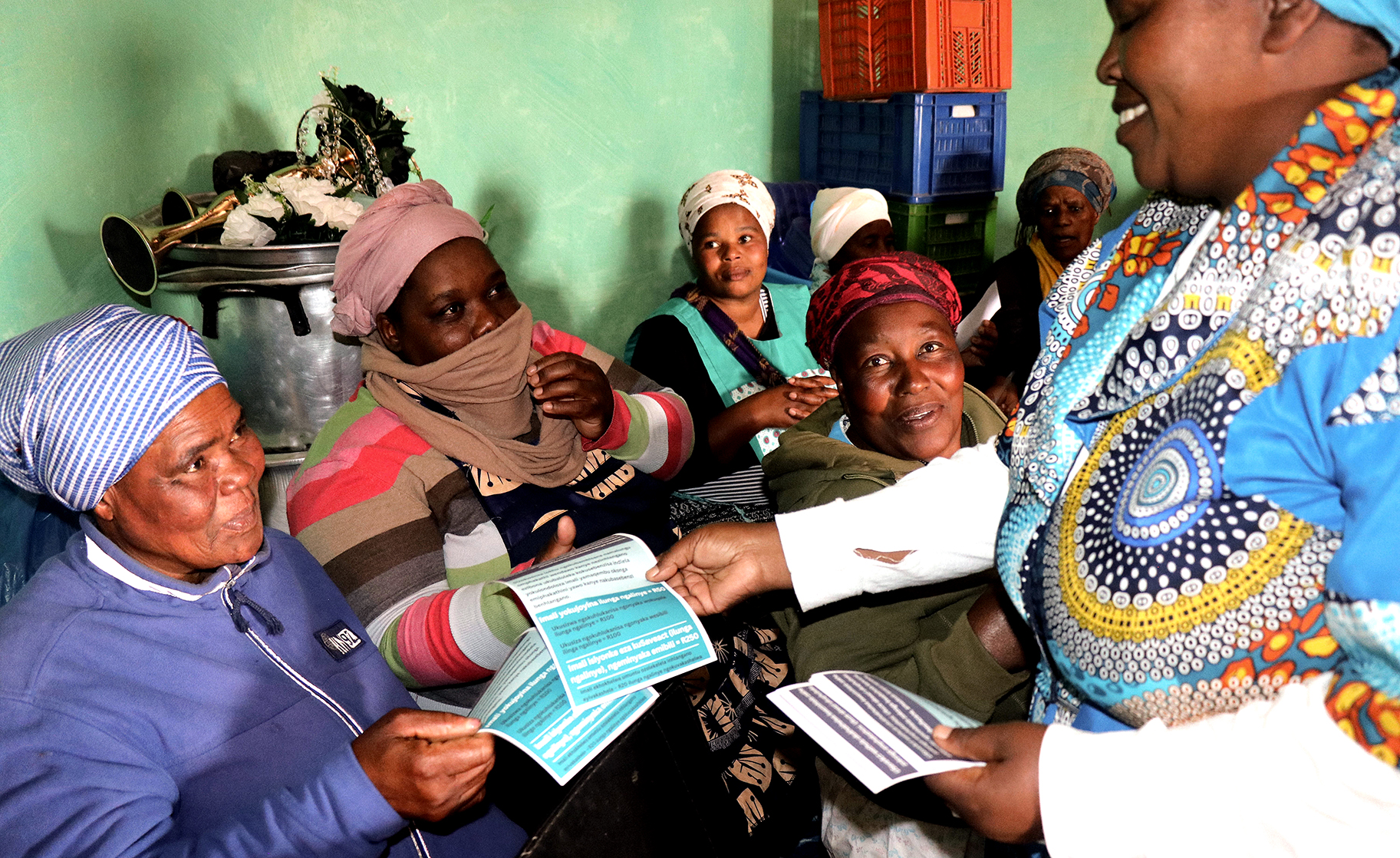
 SaveAct reaches 115,000 individuals, but it has set a goal of reaching two million vulnerable individuals, women, and youth by 2035. (Photo: SaveAct archives)
 “The house always wins”. And while we know “the house” refers to “casinos”, “bookies” and “betting shops” — who you essentially give your money to — it’s ironic when you consider how many South African households are damaged by this silent epidemic. Homes aren’t winning.
Gambling is fast becoming a common headline in the growing list of South Africa’s current crises. Statistics from the National Gambling Board of South Africa show a sharp increase in gross gambling revenue — at the end of 2023/2024 it increased 25.7% to R59,3-billion. One reason for this jump is the rise in online betting — according to the latest research by Experian and Vault22, up to 50% of grant money to younger groups is being spent on gambling (particularly online). There are also growing reports that students are using their National Student Financial Aid Scheme (NSFAS) allowances on gambling and betting.
/file/attachments/2985/gamblingmetrics_508350_ad7b021e254d006cf2c170f52787b502.jpg)
Read more: Students wager NSFAS allowances and their futures at online betting sites
On the opposite end of the spectrum, saving is facing increasing pressure. Rising inflation and the high cost of living have seen the Household Saving Rate decrease to -1.20% (the global average is 10%). South Africa has had a negative savings rate since 2022, meaning households, on average, spend more than they earn.
The CPI doesn’t track savings, but it does track gambling and betting activities. And while these activities account for what might look like a small amount (1.6% of total household spending), it’s not insignificant when you consider that it’s the 12th highest expenditure. Even more worrying is that within the CPI’s branch of Recreation, Sport, and Culture, gambling accounts for over half of this.
/file/attachments/2985/gamblingstats_359428_62cd97bcc253bc19f9b3a73a0dbf30b0.jpg)
Gambling doesn’t exist in a vacuum, and vulnerable groups are particularly susceptible to addictive gambling behaviour. And it doesn’t help that we have gambling influencers, sports heroes and celebrities touting, across multiple platforms, that betting and gambling are a harmless ticket to the good life. For those of you who were around in the early Nineties, this messaging might remind you of the popular cigarette brand offering us a “passport to international pleasure”. Knowing what we know now about cigarettes, we look back in horror and are glad tobacco advertising was banned.
What if we heard more messages about the virtues of saving instead? Take Phyllis Ngubane, from Table Mountain, KwaZulu-Natal. Ngubane joined a SaveAct savings group in 2012, and because of the financial growth and inspiration she found through her group, she became a field officer in 2014. To this day, Ngubane is a strong advocate for SaveAct and cannot overstate the impact that savings groups have had on her life:
“SaveAct picks you up from nothing, dusts you off, and then allows you to sit with the king and queen,” she said.
/file/attachments/2985/IMG_4655_417292_843160cba5707a9fff65b485ed1708a9.jpg "Phyllis Ngubane joined a SaveAct savings group in 2012, and became a field officer in 2014. (Photo: Ganeshan Govender)")
For 20 years, the Pietermaritzburg-based NPO SaveAct and its partner organisations have spread a methodology to promote savings groups and financial literacy across the country — particularly in rural areas. SaveAct founder and Director Anton Krone explains: “In the early 2000s, so many people, particularly women, were dying of HIV, and it was a traumatic and extraordinary time in South Africa’s history. Poverty was an immediate problem that needed to be solved urgently, and I had a deep sense that there weren’t any models being applied to the core issues. I was also observing global trends in savings movements that I knew intuitively could be applied to the South African context.”
The impact of savings groups has been immense. Last year, South African women, vulnerable individuals, and rural communities collectively saved more than half a billion rand — and did so without taking chances or incurring risk. Currently, SaveAct reaches 115,000 individuals, but it has set a goal of reaching two million vulnerable individuals, women and youth by 2035 — it needs advocates, donors and funders to achieve this.
The operations manager from Siyakhula Sonke Trust (an NPO and SaveAct partner based in Hillcrest, KZN), Tuki Maseatile, says that amid the plethora of gambling, betting and particularly sports betting outdoor advertising, there is a growing community of committed savers. In 10 years, the savings groups in his area have shared out a whopping R60-million. Currently, Siyakhula Sonke Trust oversees 126 active savings groups and wants to expand, but as with most non-profits, it has scaling challenges around capacity and funding.
The statistics around the efficacy and impact of savings groups collected by SaveAct and its partners are impressive, but it’s the thousands of human stories that hit home. At the recent partner (Biowatch, Choice Trust, Jabulani Rural Health Foundation, Kruger to Canyons, Siyakhula Sonke Trust and the Ubunye Foundation) celebration to mark SaveAct’s 20th anniversary, Ngubane and Grace Mchunu from Mafakhatini KZN, shared what saving and savings groups mean to them.
/file/attachments/2985/IMG_4660_956836_cce6c5ae73b09db4f1a0fb55e1506d85.jpg "The SaveAct programme's financial education and enterprise development training helped Grace Mchunu to become a more confident entrepreneur. (Photo: Ganeshan Govender)")
Through her own savings, Ngubane describes how she bought a store — not a tuckshop, as she’s quick to specify — as well as a big house, and not a small house, as she is again quick to clarify. After observing her success, Ngubane’s son joined a savings group, and at the time of his death a few years ago, he was the proud owner of four taxis.
Mchunu joined a SaveAct savings group in 2016, after waiting a year to make sure it wasn’t a scam. She found so much success through her savings group that she joined another one to expand her savings potential. She explained that although she was already a businesswoman, the financial education and enterprise development training helped her become more confident. Mchunu now owns a successful events business and has partnered with other women to grow her other business enterprises.
Both Ngubane and Mchunu embody the power of steady and consistent saving. However, the story is bigger than that. Savings groups foster dignity, hope and a sense of community. In a society where our social fabric is eroding, and where gambling and quick money are seen as antidotes, PhD candidate Nqe Dlamini, who is researching savings groups, says savings groups are so much more than money. He says these groups are much more about community and belonging.
“Of course, the money is important, but it’s about having enough and then sharing something so much bigger,” he said.
Over the years of working in their communities, both Ngubane and Mchunu have witnessed real change and impact — particularly in restoring hope and dignity. This is the overarching reason they have become such advocates for spreading the methodology and why they continue to promote and train savings groups. Dedicated SaveAct Programme Manager Nolufefe Nonjeke-Dlwanja sums up the impact: “When the methodology lands, misery walks away.”
Of course, as with most crises gambling is complex, involving social, economic, legal, political and technological dimensions. However, the country’s response to the alarming growth in gambling seems to be at odds with the inevitability of the trajectory we’re on. If we zoom out and look at what we know about gambling and its long history, it’s not a stretch to connect the dots to see the emerging chaos in the crystal ball.
Core issue
Aspiration is a core issue. As one of the most unequal countries in the world, it’s no wonder South Africans are drawn to catchy slogans like the National Lotteries’ famous “tata ma chance, tata ma millions” (take a chance, take millions). When we’re told that with just a small amount we could win big, it’s no wonder we throw away good sense and “take a chance”.
There’s a widely quoted saying that gambling is less about greed and more about hope. Youth unemployment is just over 46% (15-34 age group), and people in poverty view gambling as a shortcut to financial relief, or as a game. If the term “gamebling” hasn’t been coined yet, it should be. The rise of mobile gambling and betting apps that use push notifications, personalised promotions and easy links to our banking is significant. And, because so many people are only betting small amounts of money, they see this as harmless fun. And for some, it might be, but what if that money were saved instead?
Research shows that more often than not, betting and gambling exacerbate debt, food insecurity, mental health issues and GBV. On the other hand, saving is an antidote to all of these things. Yet, in a culture of aspiration, it’s hard to ignore the numerous celebrities, sports stars, and influencers telling us to “be in the game” and “win big”.
We need a cultural mind shift because, as the data shows, “the house always wins”. What if our leaders, celebrities, sports stars and influencers were out there telling us that “if you invest small, you could save big — guaranteed”? DM
Please contact the Responsible Gambling Helpline at 0800 006 008 or WhatsApp 076 675 0710 for support.