




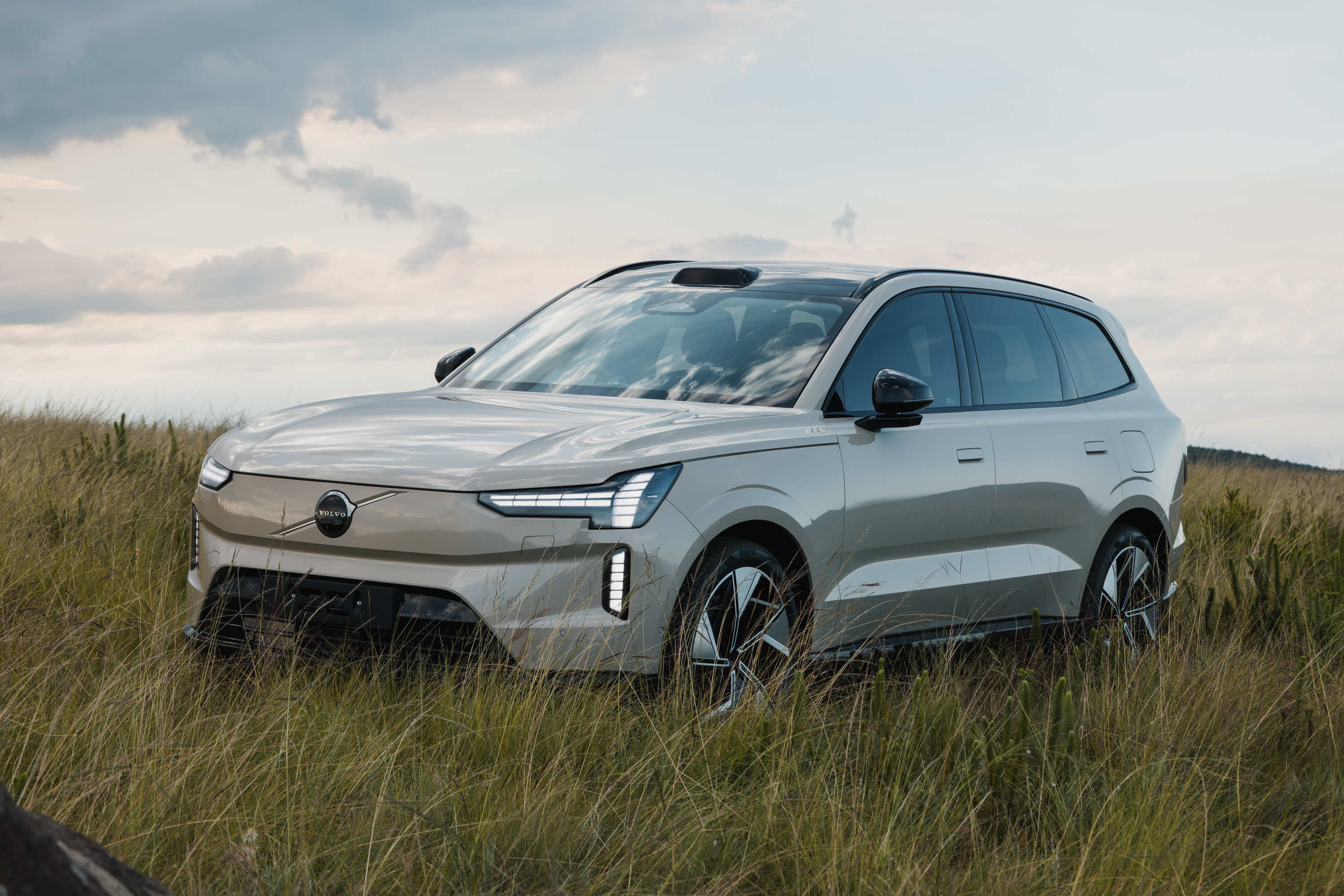
 According to Volvo South Africa, 60% of diesel owners say they’re likely to consider a hybrid in the next 3-5 years. (Image: Volvo South Africa)
 Imagine your day starting with an electric hum. Your car is already charged for the day, and at the office you can plug it in again. By evening no one wants to cook, so you head out for takeaways. Cruising past a restaurant, you ask your electric vehicle’s (EV’s) Gemini system if it serves anything vegan. The answer arrives in a Scarlett Johansson-esque voice before the robot turns green.
It sounds like a well-lit car commercial, but South African e-mobility specialists say this future is already pulling into view.
When it comes to EVs, the debate in Africa is anchored around bankability rather than possibility, and whether EV models can scale in economies where private ownership is still a luxury.
The ‘iPhone moment’ for African mobility
Greg Cress, principal director at Accenture South Africa and leading the company’s automotive and e-mobility practice, said the auto sector was facing the same disruption telecoms saw when the iPhone arrived in 2007. He was speaking at the The Southern Africa Telecommunication Networks and Applications Conference on 2 December 2025.
“The iPhone moment in telecoms is now happening to automotive,” he said. “We’re going through an inflection point around the world that is unstoppable, and South Africa will not be an exception to this rule. It’s just a matter of time.”
Read more: This electric vehicle myth refuses to die, because it’s so hard to pick apart
According to the Africa E-Mobility Alliance, at least 30,000 EVs are operating on the continent, and the growth rate of electric buses has surged 44% year on year.
But the transition is uneven: East Africa is surging on two-wheelers and low-cost financing, while South Africa, anchored in four-wheeler manufacturing, carries heavier structural expectations.
What investors want
Venture investors see opportunity in Africa’s EV wave, but they are also wary. Lewam Kefela, the principal at investment company Partech, warns that EV companies can easily drown in costs.
“Infrastructure costs a lot of money to build. Inventory costs a lot of money to get,” Kefela said. Speaking at the private equity and venture capital conference, SuperReturn Africa, she said investors wanted models that could survive the capital burden long before debt financing entered the picture.

James Obarowski, the CEO of Uganda-based startup Zembo, which sells and leases electric motorcycles to commercial riders, points to EV startups in Kenya that tried to focus on software alone, but “died at the altar of needing infrastructure”.
Read more: From luxury to budget: Top 10 most anticipated electric vehicles for 2025 revealed
Investors wanted to see what returns would look like once debt kicked in. With EV infrastructure very heavy on early stage capital, this discipline would decide who survived, Kafela added.
East Africa’s winning formula
Africa E-Mobility Alliance data shows that electric two-wheelers dominate early deployments thanks to strong product-market fit and a financing model that separates battery ownership from the bike. Obarowski sees this as the third chapter in the region’s evolution. After cheap imports and then early local designs, a clearer, more specialised ecosystem is emerging.
This model illustrates that asset separation limits risk, lowers upfront costs and improves adoption. Battery as a Service structures allow riders to pay only for energy, not the asset.
South Africa’s EV market, however, sits at the opposite end of the cost spectrum. GreenCape’s Electric Vehicle Market Intelligence Report 2025 shows that electric passenger vehicles are viewed as luxury purchases, with many models priced at R800,000 or higher.
Fleets drive the SA market
South Africa’s commercial sector is driving adoption due to operational costs.
Paul Plummer, the COO of Everlectric, a company that leases electric vehicles and charging infrastructure to businesses, says the continent loves efficiencies and cost savings.
Read more: Golden Arrow swaps diesel for volts as SA’s biggest EV depot goes live
Their vehicles run at roughly 40 cents per kilometre compared with R2.50 for diesel. “They are more expensive to buy, the technology is expensive. We’re seeing [that] if you do more than a certain break point, between 2,500 to 3,000 kilometres a month, it makes economic sense,” Plummer said.
Consumers, meanwhile, face a different problem. Range anxiety is being replaced by charger anxiety, Cress notes.
Volvo SA Managing Director Grant Locke lived this on a 1,300km trip between Johannesburg and uMhlanga, navigating a broken charger but still completing the journey.
“If you think you can’t do a long-distance trip with an EV in South Africa, you can,” he said.
Read more: Why South Africa’s EV ambitions are still stuck in low gear
Policy and the price of standing still
South Africa’s dilemma is more demanding than most. It must protect a significant manufacturing base heavily tied to exports.
According to the Department of Trade, Industry and Competition’s 2023 Electric Vehicles White Paper, 46% of locally produced vehicles were shipped to the EU and UK during 2022 — the same markets that have made commitments to ban the sale of fossil-fuelled Internal Combustion vehicles by 2035.
Read more: The fuel levy increase vs VAT hike explained
Yet incentives are complicated, as the government earns significant revenue from fuel levies and taxes on vehicles. Tshetlhe Litheko, the chief policy officer at The Automotive Business Council, said the government collected about R80,000 in taxes on each car on average. This makes sweeping subsidies difficult.
The government has moved on supply-side support. The 2024 Taxation Law Amendment Act introduces a 150% tax deduction for investments in facilities that produce electric or hydrogen vehicles, effective March 2026.
Direct consumer subsidies remain off the table, but the supply side is being primed to protect jobs and grow local capacity.
Software on wheels
Cars are increasingly starting to behave and function like smart devices. Cress points to heart health-tracking seatbelt sensors in BMWs as an example of how automotive tech is merging with telecoms and software.
Read more: BMW producing plug-in electric cars locally flags need for SA to adapt to the EV transition
Chinese Original Equipment Manufacturers are flooding the market with high-quality, affordable electric vehicles. This lowers the barrier to entry for consumers but makes it nearly impossible for African startups to compete on vehicle manufacturing alone.
Southern Africa’s mineral reserves (lithium, cobalt, manganese and copper) position the region to compete in the global battery value chain. Our government intends to work with the private sector to “develop a value proposition for the production of battery cells in South Africa” and introduce “a temporary battery duty rebate” to support cost competitiveness while local capacity is built, according to the Department of Trade, Industry and Competition’s White Paper.
The idea of asking your car to find a vegan dinner spot after a day of workplace charging may feel like a scene from the future. But, Locke said: “The products have to be there, the charging infrastructure has to be there, and you have to take a leap in advance of what the future holds [because] that rate of change of EV adoption will move much faster than you think.” DM