



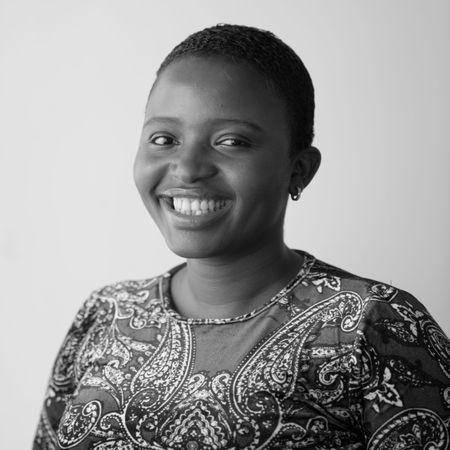
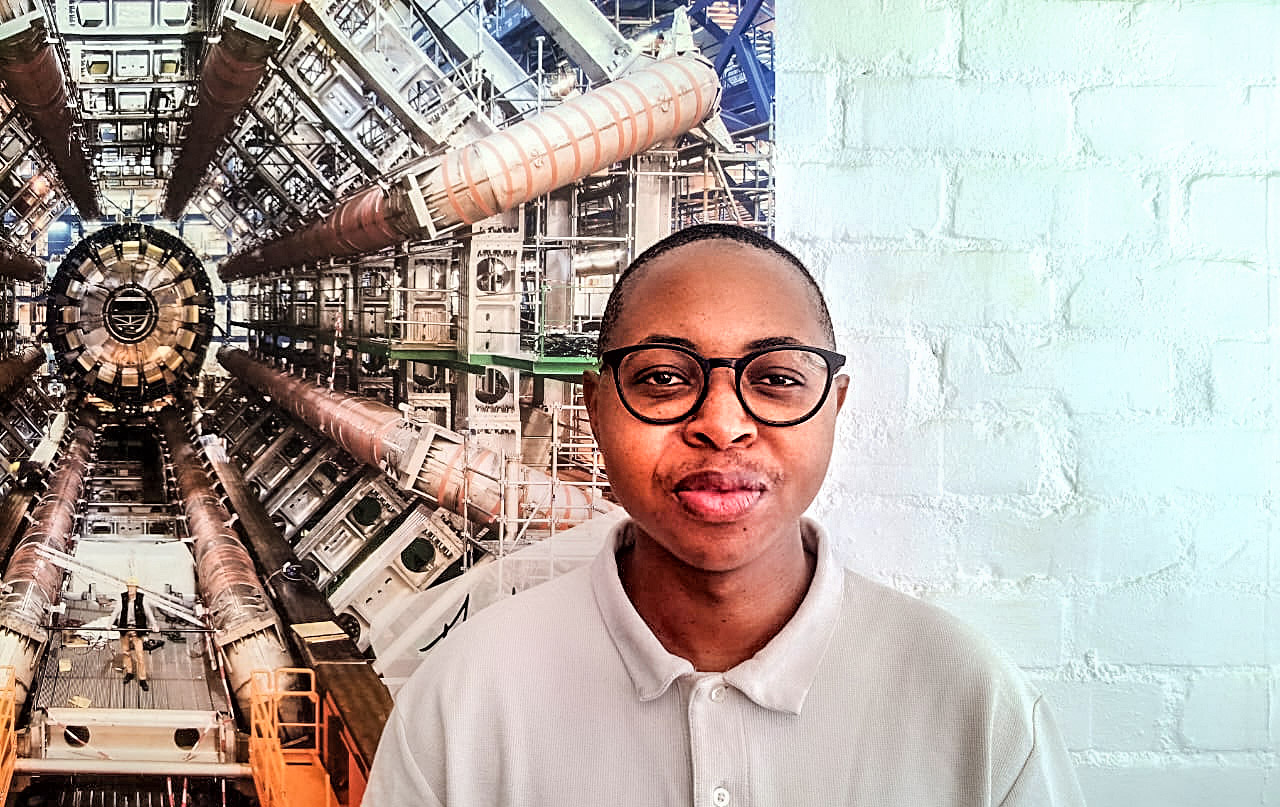
 Thobani Sangweni, 23, a young physicist. He was selected as one of only two South African students chosen in 2024 to participate in the prestigious European Organization for Nuclear Research Summer Student Programme. (Photo: Supplied / Thobani Sangweni)
 From the quiet village of Ntendeka in Ulundi, KwaZulu-Natal, to the cutting-edge laboratories of the European Organization for Nuclear Research (CERN) in Geneva, Nkosinathi Thobani Sangweni’s journey reads like a story of possibility made real.
At just 23 he has already carved a path that bridges worlds between the rural classrooms where he once tutored his peers and the global stage of particle physics where he now contributes to unlocking the universe’s deepest mysteries.
Sangweni graduated from the University of Cape Town with a first-class BSc in physics and astrophysics in 2022, and attained his honours in physics in 2023. He is currently completing an MSc in physics at the university.
One of his career highlights is being selected for the CERN programme, where he joined scientists from across the world from June to August 2024. While there he built a computer program using artificial intelligence (AI) to help scientists sort out different kinds of particles called muons.
Sangweni was primarily raised by his grandparents as his parents sought work in urban areas. He says his grandfather was innovative, and he would watch him do things like engineering water from the communal tap and creating a system so they could have water in his own home and not have to carry heavy buckets from the tap to his home.
He also credits his career choice to his teacher who was passionate about physical science in high school.
“Because we didn’t have much access to information back then, when I wanted to do some extra reading that was not part of the curriculum, I would ask him to provide me with science magazines, and learn about what is happening in the science world and what are the new discoveries,” Sangweni adds.
He had also been inspired by growing up in Ulundi and being able to see the Milky Way and stars at night. He began to wonder what the difference was between a shooting star and an actual star, and this was part of the reason he chose astrophysics when he got to UCT.
Sangweni’s MSc research is within the ATLAS Experiment at CERN, a general-purpose particle detector at the Large Hadron Collider (LHC) which studies high-energy particle collisions to investigate the fundamental building blocks of matter and the forces that govern them. The experiment contributes towards understanding rare Standard Model processes observed in ATLAS.
/file/attachments/orphans/1000146610_594457.jpg "Thobani Sangweni (23) at this year's Phenomenal Physics event hosted by the University of Cape Town, presenting the Cartesian diver experiment that day. (Photo: Supplied / Thobani Sangweni)")
For his honours research, Sangweni explored how new physics can deepen understanding of the universe’s fundamental structure.
His next goal is a DPhil in particle physics at Oxford University, a three- to four-year programme.
At Oxford he hopes to continue on his path of “finding new physics by exploring the lower energies that we can observe and extrapolate what new physics come at higher energies that we can’t see with our current technology”.
Tutoring
Sangweni says his tutoring in high school came from the idea that information is meant to be shared and he naturally wanted to share his passion for science and realised he had a natural inclination towards tutoring and teaching.
“I would share what I learnt and they would share what they learnt, so that’s what influenced my passion for education. I realised that how you share information changes how it is received and can spark curiosity.”
He thinks that, owing to the casual nature of these sessions, the other pupils realised science and maths could be fun, which can be missed in formal learning structures.
Sangweni has been top of his class at UCT, which he credits to the fact that he loves doing it. Having the right supervisor, collaborators and circle of friends had also helped him achieve first honours.
“I am lucky that work for school doesn’t feel like a chore, I want to do it, I want to know how much I can push, how far can I take my research.”
Beyond research, Sangweni serves as a physics tutor and lab demonstrator for first- and second-year undergraduate students. He volunteered with the Golden Future Project that tutored pupils from Khayelitsha, and was also a scribe for the Disability Services in the Office for Inclusivity and Change at UCT.
/file/attachments/orphans/1000146611_689248.jpg "Thobani Sangweni (23) at this year's Phenomenal Physics event hosted by the University of Cape Town. They invite Grade 11 pupils from high schools all over Cape Town and demonstrate cool experiments for them. Here he was presenting the Cartesian diver experiment that day. (Photo: Supplied / Thobani Sangweni)")
Asked where he sees himself in the next 10 years, he says he doesn’t have a set answer yet, but knows that his community and ones like it are part of his story of inspiring the next scientists from there.
“In the next 10 years, honestly that’s a question I still ask myself. It keeps changing... first, I see myself as someone who would be actively trying to make quality education much more accessible than it is today – regardless of your demographic or background or whatever, especially in communities such as the one I grew up in. I see myself as someone who is into uplifting others in the sense of inspiring the next generation of scientists to pursue their dreams... I’m hoping to be someone working on the very frontiers of high-energy physics. I want to go into a niche direction of astroparticle physics,” Sangweni explains
He says he always tells the youngsters he tutors that endless curiosity about the world one lives in is one of the key elements of being a scientist. “What inspired my curiosity was when I was living with my grandparents. While I was taking care of my grandmother she would open National Geographic on TV. So that was when my curiosity was piqued and I would watch to understand the world around me.”
Sangweni’s lifetime goal, though, is to remain curious:
“I want to be someone who is still very curious about not just the little things in the universe but also the very big things out there, and sort of merge that... [that] would be a lifetime goal for me.” DM