




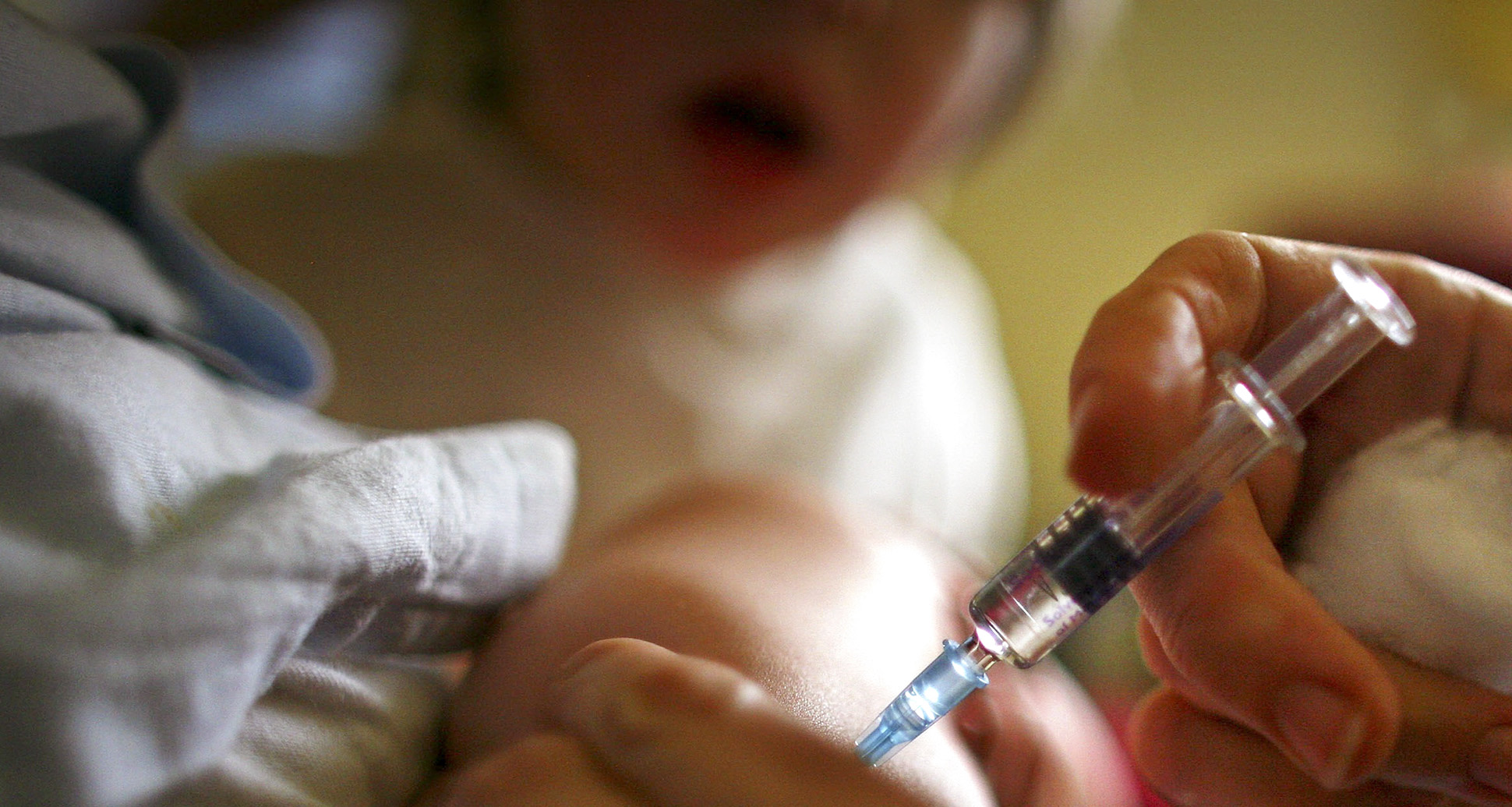
 Middle-income countries have an increasing number of children who are unvaccinated against preventable diseases. (Photo: Jeff J Mitchell / Getty Images)
 The Western Cape Department of Health and Wellness recently flagged a concerning trend in the province: a decline in infant immunisation rates. Even a small drop in vaccine coverage could undo years of progress, officials warned, making it important to tackle the problem head-on.
Professor Hassan Mahomed from the Western Cape Department of Health and Wellness told Daily Maverick that immunisation coverage for children under one year dropped to 67.4% in 2024/25, from 67.6% in 2023/24. This remains far below the goal of 95% needed to achieve “herd immunity”.
“This is a significant gap that leaves thousands of infants vulnerable to preventable diseases. The Western Cape Department of Health and Wellness is actively addressing this with immunisations available at our clinics, while our teams have also launched outreaches and are going door to door to encourage our communities to obtain immunisations at our clinics, or at more easily accessible wellness sites or mobiles,” said Mahomed.
South Africa’s immunisation coverage has been declining nationally, according to Mahomed. He said that data showed it had been under pressure since the Covid-19 pandemic, when disruptions to routine health services during lockdowns created gaps. This was compounded by vaccine hesitancy fuelled by misinformation.
Mahomed noted that vaccine hesitancy had become a “significant barrier” both globally and locally, underscoring the need for community engagement and clear communication to rebuild confidence in immunisation.
/file/dailymaverick/wp-content/uploads/2022/02/Shabir-Madhi.jpg "Professor Shabir Madhi says that immunisation coverage for children under one year remains far below the goal of 95% needed to achieve ‘herd immunity’. (Photo: Supplied)")
Shabir Madhi, Dean of the Faculty of Health Sciences and professor of vaccinology at the University of the Witwatersrand, said the Western Cape was one of the more reliable provinces when it came to data collection around vaccination, as much of its information was captured electronically.
“For other provinces, it’s really difficult to unpack what the trends are. What we do know, and this is based on a survey which was conducted in 2019 across all of the provinces, down to the district and sub-district level, is that even then there was quite a bit of heterogeneity in terms of vaccine coverage,” he said.
According to the South Africa Child Gauge 2025, immunisation coverage in the country remains suboptimal, with only 83.3% of infants under one year fully immunised in 2023/24.
Read more: Childhood vaccine coverage in SA declined in 2023, World Health Organization report finds
Read more: SA Child Gauge 2025 spotlights intersection of violence against women and children
Linking to outbreaks
Immunisations given to infants protected against tuberculosis, polio, diphtheria, tetanus, whooping cough, hepatitis B, Haemophilus influenzae type b (Hib) that is responsible for meningitis and pneumonia, rotavirus and measles, said Mahomed.
“The department encourages all parents to check their child’s Road to Health booklet regularly and visit their nearest clinic for scheduled immunisation. No appointment is needed at public facilities, and immunisations are free. If a child has missed an immunisation, the parent or caregiver can visit their nearest clinic to get their children’s immunisations up to date,” he said.
Mahomed confirmed that there was a link between the decline in immunisation and recent outbreaks of measles and diphtheria in the province, as lower vaccine coverage weakened herd immunity and made outbreaks more likely.
“Less than satisfactory immunisation coverage in infants is more directly related to the measles outbreak. Diphtheria has been affecting mainly adults, and this is due to low vaccination rates in older children (at age 6 and age 12),” he said.
There were 282 laboratory-confirmed cases of measles in the Western Cape between 1 January and 8 November 2025, with the majority of cases in the Cape Town metro. No deaths had been reported.
Between 1 January 2024 and 2 November 2025, South Africa recorded 81 confirmed cases of respiratory diphtheria, one probable case and 56 asymptomatic carriers of toxigenic C. diphtheriae identified through contact tracing — a total of 138 individuals affected nationally, said Mahomed.
“The Western Cape accounted for the majority, with 73% of cases (101 out of 137), including 57 respiratory diphtheria cases and 44 carriers,” he said.
Most confirmed cases were young adults over 20 years, while 25 cases were children under 15 years. There were 10 deaths in the Western Cape, including three children under 15 years.
Mahomed noted that diphtheria was preventable through routine vaccination as part of the Expanded Programme on Immunisation, given at six, 10 and 14 weeks, with boosters at 18 months, six years and 12 years.
In November, the Western Cape Department of Health and Wellness — along with all public health facilities across the country — offered free catch-up immunisations, school and preschool outreaches, vitamin A supplementation and health education as part of a National Immunisation Catch-up Drive.
In the City of Cape Town’s Khayelitsha and Eastern Substructure, where targeted vaccination was rolled out, more than 13,000 immunisations had been administered as of 14 November 2025.
“The main focus of the catch-up campaign is to find children who have never been vaccinated or have missed vaccinations at any age, not just infants,” noted Mahomed.
In the longer term, the Western Cape health department was aiming to strengthen its promotion of vaccines using platforms such as social media to improve public confidence in vaccines and combat misinformation, he said.
It was also undertaking public health measures for the early detection of and response to outbreaks, including strengthening the coordination of the response and intensifying disease surveillance, clinical management of cases, community engagement and targeted supplementary vaccination.
Improving confidence in the healthcare system
Another key reason behind under-immunisation in the country is parents’ loss of confidence in the healthcare system because of vaccine outages at facilities, according to Madhi.
“It’s a cost to the parent, to be taking time off work, to be getting transport. It’s an inconvenience… to take children to be vaccinated only to end up at the clinic and be told to come back at a later stage. It diminishes confidence in the public health system, but also obviously undermines the efforts of the immunisation programme,” he said.
“If there’s proper stock management and there’s proper budgeting on the part of the provinces, you shouldn’t be having vaccine outages.”
Madhi noted that the factors behind under-immunisation could differ between communities. As long as South Africa was not meeting the 95% immunisation coverage target, he said, there would continue to be outbreaks of vaccine-preventable diseases.
Among Madhi’s suggestions for improving vaccine coverage were:
- Employing immunisation managers in provinces’ health structures.
- Integrating immunisation services with primary healthcare.
- Ensuring more robust data collection at a facility and sub-district level through a vaccine register.
“There’s issues related to budgets. What we also observe is that in some provinces they end up not having all of the vaccines available for children, and the vaccines that are often unavailable for children are those that cost more. What the provinces seem to be doing is that when they’re facing budgetary constraints, they become selective as to which vaccines they actually procure, so children don’t get all of the vaccines,” said Madhi.
He called for the ring-fencing of funds for vaccine procurement, adding that vaccines could be acquired at a national level and distributed to provinces in order to ensure funds for immunisation were not redirected.
Vaccine coverage in children was just a starting point, rather than the end, said Madhi, noting that there was increased focus on pregnant women in countries’ immunisation responses. He pushed for some vaccines to be targeted at adults in order to reduce admissions to hospital and preventable diseases in older populations.
Daily Maverick reached out to the National Department of Health but had not received a response by the time of publishing. DM