




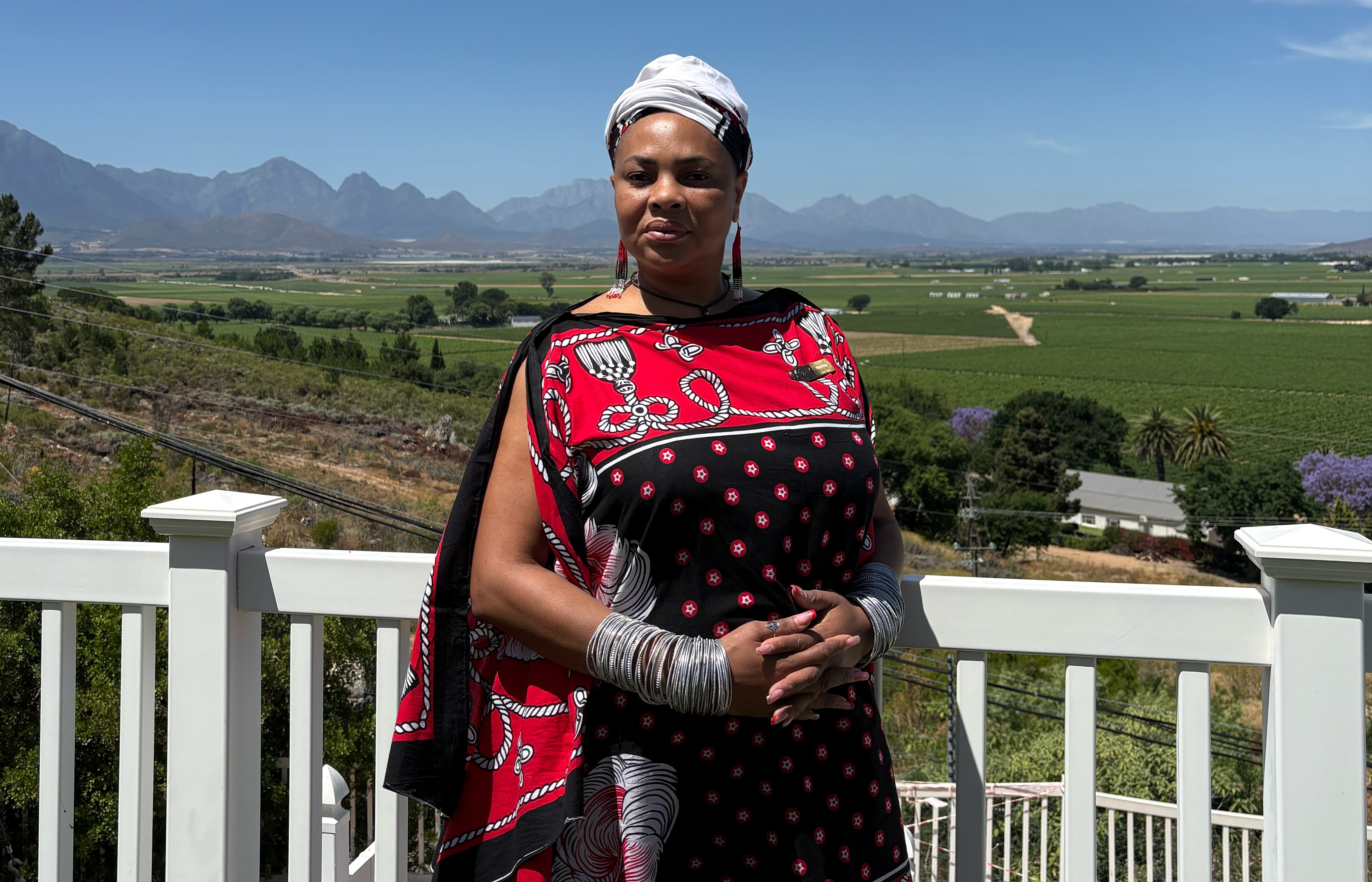
 Gogo Nomsa Sibeko, a traditional healer who wants to collaborate with SA's hunting industry to source sustainable muti. Rawsonville, 18 November 2025. (Photo: Ed Stoddard)
 A grassroots traditional healer organisation is building bridges with South African hunters to legally obtain muti products in a sustainable way, an initiative that throws the largely white, middle-class concerns of animal rights activism into sharp relief.
At the recent annual conference of the Custodians of Professional Hunting and Conservation near Rawsonville in the Western Cape, Gogo Nomsa Sibeko, who heads the Pretoria-based not-for-profit Nature Speaks and Responds, delivered a presentation titled “The role of the hunting value chain in supporting traditional healers”. It was a call for collaboration between the hunting industry and traditional healers.
“The hunting value chain can strengthen sustainable cultural practices... Biodiversity loss and illegal wildlife trade demand responsible alternatives,” Sibeko told the conference. She has been a traditional healer for 20 years and holds a BCom degree in economics from the University of KwaZulu-Natal.
The points she made in her presentation included:
- Materials from legally hunted species that are not endangered reduce the pressure on vulnerable wildlife.
- Hunters often only require meat or trophies and the leftover parts can become valuable for traditional medicine instead of being wasted.
- Legal access for muti parts reduces illegal harvesting.
Daily Maverick interviewed Sibeko on the sidelines of the conference, and her message was clear: traditional healers need parts from wild animals to practise their craft and 21st-century animal rights and welfare activism is alien to her culture.
“We don’t have an anti-hunting standpoint because our people have always hunted. That is why you have medicines that require wild animals – and that requires hunting. So we can never be part of the anti-hunting brigade,” she said.
Sibeko said some of the ingredients sourced in muti markets were suspect, so transparency was essential.
“Having a collaboration with legal hunters will stop us from obtaining the wrong items because if you don’t know what the fat of a lion looks like, you take any fat. We go to muti markets to get what we are looking for.
“I see a better way of doing this by having the hunters [involved]. Instead of discarding what they don’t use, they can share it with us. There are so many of us that a person can make a profit selling some of their items to us, and if they can donate them, even better.”
/file/attachments/2985/Screenshot2025-11-27at204036_953901_fec4e880bce7f46442c3e7cc27226176.png "P18 Hunting Muti
<br>(Photos: Unsplash / Getty Images)")
(Photos: Unsplash / Getty Images)
Traditional healers make use of all animal parts: fat is used to enhance medicine and skin from animals such as kudus is used for the drums played to invoke the spirits. Bones and teeth have a range of applications.
“We also want to turn traditional healers into citizen scientists. We can gather information for the scientists. We go to every river, we go to every mountain, we go to every veld. Who better to gather information for scientists than ourselves?” Sibeko said.
Science, spiritualism and cents
This is an area where science and spiritualism intersect. Sibeko, who is Swazi, said traditional healing was a calling.
“You first get a calling and the family knows about the fact that you’ve had a calling. You get it from birth; you’re born with it. You may not know yourself but your family does,” she said.
“And when the time was right the ancestors communicated with me through dreams and visions, and through other people, that the time had come for me to be initiated.
“I resisted at first because nobody wants to get into the fraternity, because it’s hard to be a traditional healer.”
It’s also a livelihood, and hunting and traditional medicine have what is known in the business world as “synergies”. According to one recent study, which has its critics, South Africa’s hunting industry generates about R45-billion annually.
The traditional medicine trade was estimated in a 2007 study at being worth about R2.9-billion, but this may have been an underestimate and it is clearly significant and growing. However, there does not seem to be any recent number crunching on the value of the trade.
Sibeko’s vision would see more economic value generated from both industries in a transparent way that preserves both biodiversity – vast tracts of previously marginal farmland have been conserved for wildlife in South Africa by the hunting industry – as well as traditional medicine and culture.
In some ways, this evokes the debates about rhino horn, which can be sustainably harvested from live animals, yet its trade has been banned internationally for almost five decades.
In Asia, it is a commodity coveted for a range of reasons, including for use in traditional medicine, and this demand remains entrenched in culture. The result has been rampant poaching to meet that demand.
Wildlife in South Africa is currently being poached for muti, yet traditional African approaches to medicine have more scientific validity than the use of rhino horn for medicinal purposes.
In a society with glaring levels of inequality and a looted and crumbling public health sector, there will always be demand for traditional medicine – a demand that also speaks to deeply rooted cultural and spiritual practices that are at odds with Western animal rights activism.
This demand must be met and Sibeko and her organisation want to meet it with legally and sustainably sourced wild animal products. DM
This story first appeared in our weekly DM168 newspaper, available countrywide for R35.
/file/attachments/2984/DM-28112025-001_195095.jpg)