




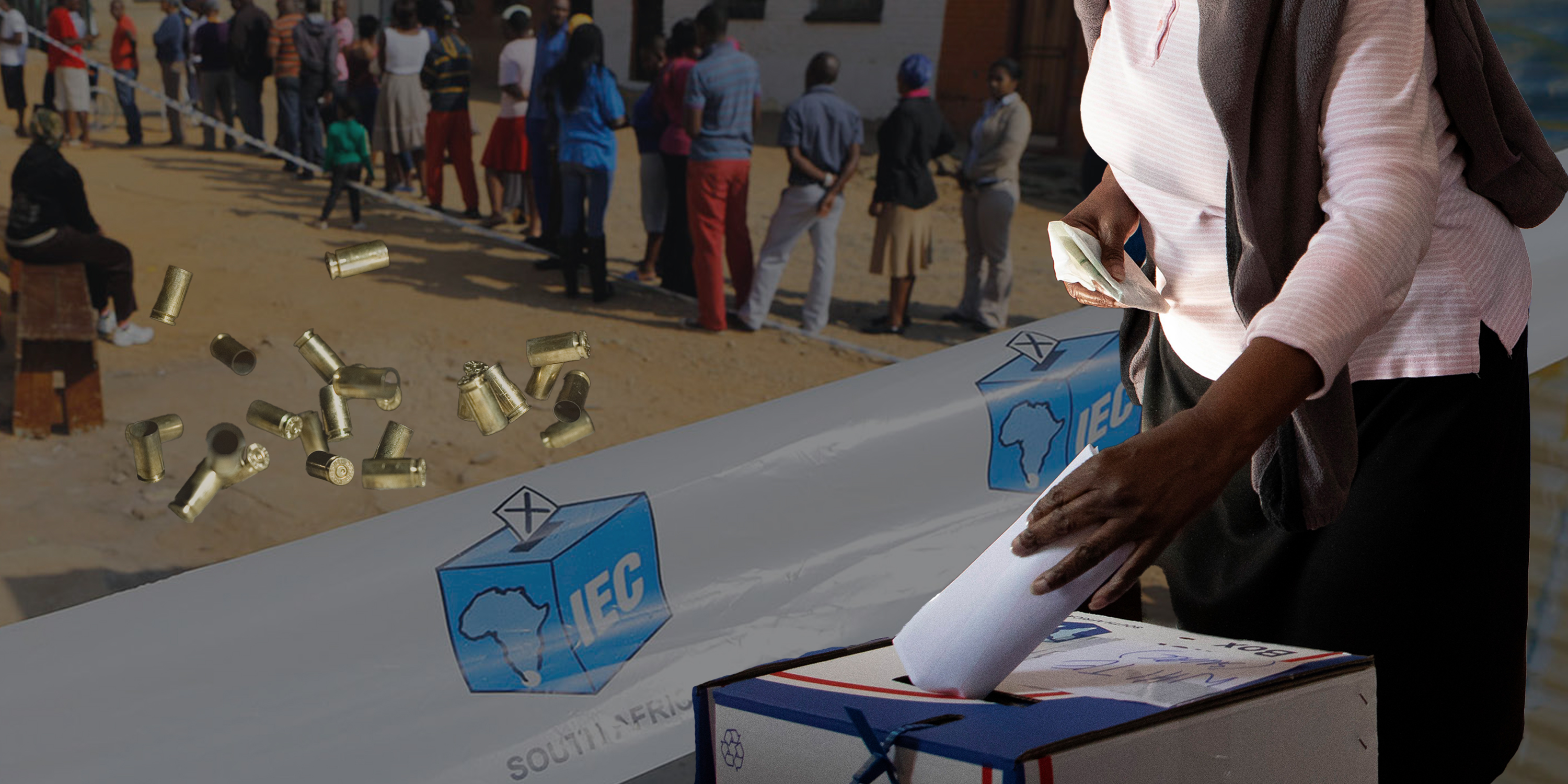
 Illustrative image: South Africans line up outside a polling station in Alexandra. (Photo: Kim Ludbrook / EPA) | Bullets. (Photo: David Stillman / Flickr) | A woman casts her vote during local government elections. (Photo: Kim Ludbrook / EPA)
 Gendered electoral violence is rising across Africa and South Africa — pushing women out of political life even as representation increases.
The 16 Days of Activism Against Violence tends to ignore a potent form of growing violence against women — that against women politicians. This is called gendered electoral violence or violence against women in politics, and is aimed at women who stand as candidates in elections.
For years, feminist and women’s activism has paved the way for women to enter politics through quota systems. Globally, quotas have been successful in increasing the number of women in politics. Currently, South Africa has 45% women in government, a significant milestone. Yet, the success of quotas is undermined by gender violence in many countries in the Global North and South. No matter how many positive measures are taken to get women into politics, if this type of violence is not brought under control, increasing numbers of women will refuse to stand as candidates or will exit politics.
Violence against women in politics should be distinguished from violence against women in general, as well as from gender-based violence.
Research by the political scientist Mona Lena Krook shows that violence against women in politics is a complicated concept, and we need to distinguish between violence in politics in general and violence against women in politics, which can coexist. Violence in politics targets men and women political actors in gendered and non-gendered ways, while violence against women in politics is aimed at women specifically, to keep them out of politics and deter their political participation.
Recent research shows women are threatened, humiliated, abused and even murdered by members of communities and male opponents from inside their own parties (intra-party violence), or other parties (inter-party violence).
Violence against women in politics in Africa
In Africa, the picture is bleak. I am a collaborator on a comparative project on gendered electoral violence with the Nordic Africa Institute in Uppsala, Sweden. We have done fieldwork on gendered electoral violence in Ghana, Kenya and Zimbabwe.
At a time when there is a rapid digital uptake in Africa, women in particular are singled out for hate crimes perpetrated online through gendered threats (to them and their families), harassment, insults and abuse, body-shaming and slut-shaming.
According to the Kofi Annan Foundation, malicious ways in which the digital space is used, mainly during elections, include: doxxing (making candidates’ private information and addresses public), trolling, cyberstalking, instigation to violence, blackmail, hate speech, humiliation, discrimination, defamation, identity theft and hacking, and sexual objectification.
This type of violence is difficult to combat because of the anonymity of many perpetrators. Institutional cultures of male dominance normalise sexist behaviour and the performance of sexism to the extent that these acts are not considered transgressions. This deters women from entering or staying in politics. The abuse of technology increases during election campaigns, where women have to engage with their constituencies and supporters and competition with male candidates can be fierce.
The New Humanitarian reports that women candidates face harassment, intimidation and abuse in person and online. In Kenya, Millie Odhiamabo, an outspoken politician, had her house burnt down, and her bodyguard was run over and killed. Eunice Wambui was attacked while on a voter registration drive. Esther Passaris, running to be Nairobi’s county representative, was held hostage by male students who demanded 150,000 Kenyan shillings. She managed to escape. Another source indicates that a woman candidate was forced to eat faeces.
Violence against women in South Africa
Research by Noluthando Phungula indicates there is limited research on violence against women in politics in South Africa. Her work also shows that while political violence in general is critiqued, investigations using a gender lens are rare.
One dimension of political violence is the assassination of politicians, especially local government councillors. Many of these killings are inter-party killings, because local government positions are viewed as lucrative for self-enrichment and kickbacks from government tenders for service delivery.
KwaZulu-Natal accounted for 56% of political assassinations nationwide (103 killings, some of which were women) between 2015 and 2020. The 2019 South African Local Government Association study of violence during elections found that women experience threats that are extended to their families. Threats are often of a sexual nature.
My research through focus groups with women in local government in the Western Cape revealed that one woman councillor had to move house multiple times because of threats to her and her family. Another woman’s husband was shot and killed when he opened the front door after somebody knocked. It was clear the perpetrators thought she would open the door. Another had a Molotov cocktail thrown at her house.
What makes South Africa different is that political assassinations are more common than in other countries. This is why the Political Killings Task Team that was disbanded (according to the revelations of KZN police commissioner Nhlanhla Mkhwanazi) should concern us.
Next year, in the run-up to the local government election, this type of violence will surely increase. What measures will the government and the Electoral Commission put in place to curb it? Violence against women in politics should not be thought of as a different type of violence — it is violence against women on the continuum of gender-based violence.
Professor Amanda Gouws holds the SARChI Chair in Gender Politics at Stellenbosch University.