



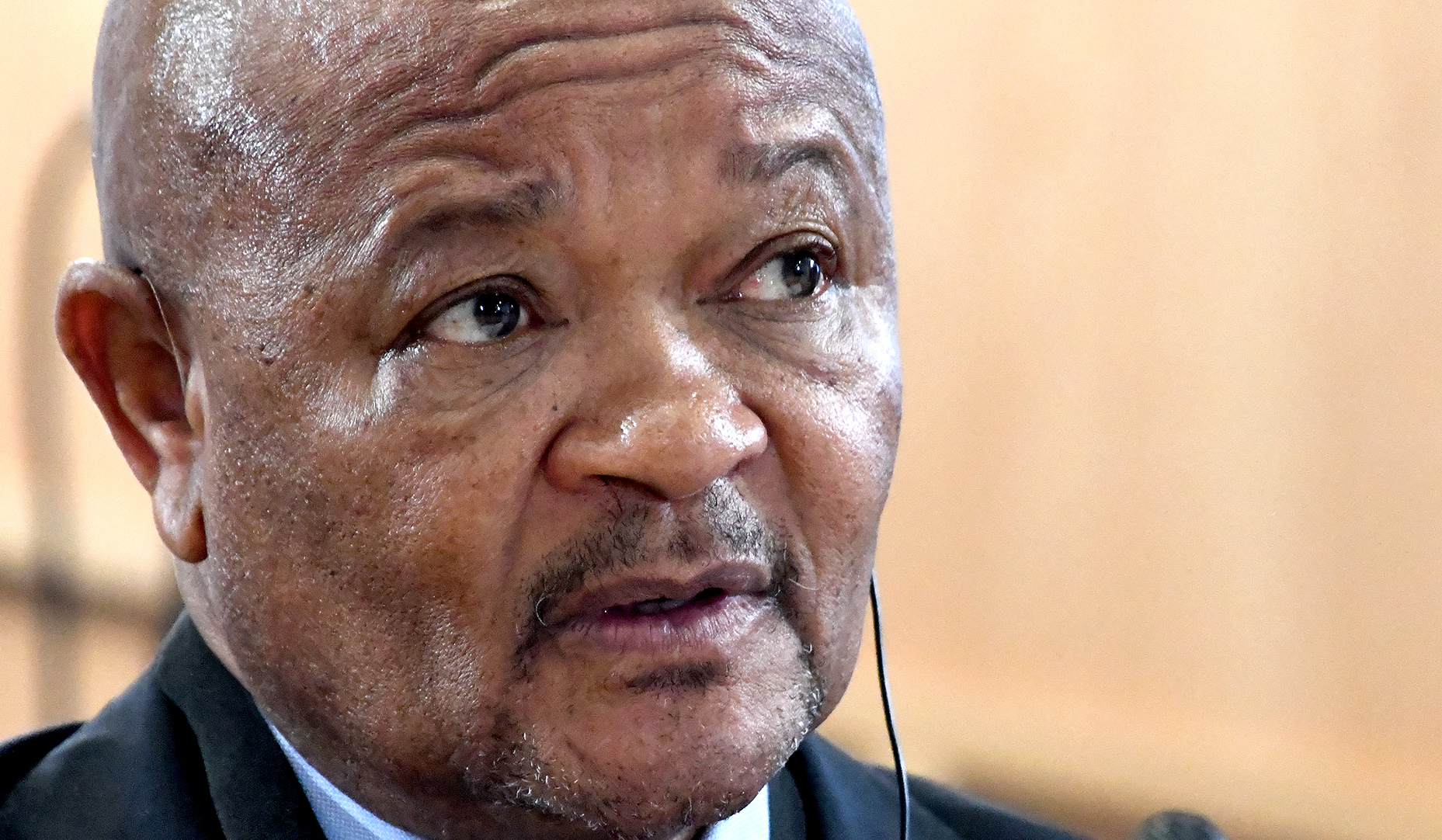
 Police Minister Senzo Mchunu testifies at the Madlanga Commission at the Brigitte Mabandla Judicial College in Pretoria on 2 December. (Photo: Gallo Images / Frennie Shivambu)
 Sidelined police minister Senzo Mchunu, on Tuesday, 2 December, told the Madlanga Commission that as far back as 2019, a work study report had recommended integrating the National Political Killings Task Team (NPKTT) into the Murder and Robbery Unit of the South African Police Service (SAPS).
He noted that the establishment of this unit, along with other specialised units, had been sanctioned by the then national police commissioner, Khehla Sitole, on 26 June 2019. Given that the unit was tasked with handling serial murders, police killings, political murders and farm attacks, Mchunu argued that maintaining a separate, temporary task team was unwarranted and led to unnecessary overlap in operations.
Mchunu, who was appointed as police minister in July 2024, was placed on special leave by President Cyril Ramaphosa in July 2025 because of the accusations he now faces.
Represented at the commission by advocate Tembeka Ngcukaitobi SC, he repeated many of the same reasons for disbanding the NPKTT that he gave when testifying before Parliament’s ad hoc committee looking into the same issues.
Read more: Mchunu uses ‘dangerous man’ crime accused Matlala’s affidavit to defend himself
He is testifying at the Madlanga Commission on the disbandment of the NPKKT in December 2024 and responding to allegations that he had links with tenderpreneur and organised crime accused Vuzimusi “Cat” Matlala and their alleged go-between, Brown Mogotsi.
The Madlanga Commission is hearing evidence of alleged criminality, political interference and corruption within law enforcement, following claims by the KwaZulu-Natal police commissioner, Lieutenant General Nhlanhla Mkhwanazi, that top officials had conspired to obstruct investigations into criminal syndicates.
/file/attachments/orphans/ED_589232_425580.jpg "Police Minister Senzo Mchunu testifies at the Madlanga Commission at Brigitte Mabandla Judicial College in Pretoria on 2 December. (Photo: Frennie Shivambu /Gallo Images)")
The allegations
On 31 December 2024, Mchunu issued a directive shutting down the KwaZulu-Natal-based NPKTT — a move that stunned security experts and outraged political observers.
In July, Mkhwanazi unleashed a barrage of startling allegations against Mchunu and senior police officers.
Mkhwanazi alleged that Mchunu disbanded the NPKTT, set up in 2018, to shield politically connected members of a criminal syndicate from prosecution. He alleged that Mchunu was in cahoots with Matlala, who faces charges in connection with an attempted murder, and Mogotsi, who has claimed that he was a Crime Intelligence operative.
Mchunu has denied any links to Matlala and claimed that Mogotsi is “just a comrade” from whom he never “requested or received” anything.
Matlala testified during his appearance before Parliament’s ad hoc committee at Pretoria’s Kgosi Mampuru Prison that he had a relationship with several police officials, including former police minister Bheki Cele.
/file/attachments/orphans/ED_587858_122538.jpg "Vusimuzi ‘Cat’ Matlala testifies on 26 November before the parliamentary ad hoc committee inquiry at Pretoria’s Kgosi Mampuru Correctional Facility. (Photo: Lefty Shivambu / Gallo Images)
<br>")
Matlala alleged that he paid for flights and accommodation for people linked to Mchunu’s presidential campaign to attend the ANC’s January 8 celebrations in Cape Town at the beginning of this year. He said he spent the money — between R150,000 and R200,000 — to protect himself from prosecution and to safeguard his R360-million tender with the police.
During Mogotsi’s testimony at the commission, evidence leader Matthew Chaskalson SC meticulously laid out how messages between Mchunu and Mogotsi were relayed to Matlala.
/file/dailymaverick/wp-content/uploads/2025/11/6I1A3072b.jpg "Brown Mogotsi testifies at the Madlanga Commission in Pretoria on 18 November 2025. He is accused of acting as a go-between for sidelined Police Minister Senzo Mchunu and alleged crime boss Vusimuzi ‘Cat‘ Matlala. (Photo: Felix Dlangamandla)")
The NPKTT was targeting Matlala when Mchunu ordered its disbandment. Mchunu has repeatedly denied that anyone influenced his decision, although several top-ranking police officers, National Prosecuting Authority officials, and even his two deputy ministers admitted they were surprised by the decision.
At the ad hoc committee in October, Mchunu was pressed on whether President Cyril Ramaphosa had sanctioned the disbandment of the NPKTT. He replied that he briefed the President on the disbandment, and Ramaphosa concurred with the briefing.
NPKTT was an ‘interim structure’
Mchunu stressed that the NPKTT was established in 2018 as a special, interim project.
“Its creation was political and time-bound and did not form part of SAPS’ permanent organisational structure. The national commissioner can establish a task team at any time and use powers bestowed upon him by the SAPS Act.
“The NPKTT was a project. It was always understood to be interim, temporary in nature; it was never at any stage understood to be a permanent kind of set-up,” he said.
Assessments were carried out every six months, and the life span of the NPKTT was extended. However, during the Covid-19 pandemic in 2020, there was no assessment, but in 2021, an extension was approved.
“Beyond 2022, there was no further extension that was sought. As a result, the NPKTT continued to operate without required assessment and renewal for more than two years. During this period beyond 2022, the NPKTT was irregular under the Public Finance Management Act,” said Mchunu.
He has, however, been criticised for disbanding the NPKTT without consulting the interministerial committee that established it.
The commission heard that the national police commissioner, Fannie Masemola, signed a new SAPS structural organogram in 2024, which would have dissolved the NPKTT and absorbed it into the Murder and Robbery Unit.
Masemola, however, told the ad hoc inquiry that Mchunu never expressed to him any “dissatisfaction or unhappiness” about the NPKTT. Masemola said Mchunu’s decision to disband the task team, taken on New Year’s Eve while he was on leave, appeared designed to exclude him. He said the minister’s directive was an encroachment on his powers.
On Tuesday, Mchunu defended his decision and said he did not become involved in operational decisions. He has consistently maintained that disbanding the NPKTT was within his powers.
“I don’t necessarily direct, approve or participate in operational policing decisions or activities like operations that, from time to time, police decide on.
“Any interference would suggest that I played a role in authorising and coordinating operational decisions, including who to arrest and where and when to do raids, technical deployments, who goes where for what reason — such [suggestions] are incorrect.”
Mchunu noted that several allegations were made before the commission relating to communications that were said to have involved him or his instructions.
“I want to place on record that I did not participate in any communication channels nor that I used encrypted platforms for such alleged purposes,” he said.
He is accused of communicating with Mogotsi on Signal, messages that Mogotsi then relayed to Matlala.
It is further alleged that during the arrest of Katiso “KT” Molefe, on 6 December 2024, in connection with the murder of engineer Armand Swart, Molefe told members of the NPKTT that he was “a friend of Mchunu”.
/file/dailymaverick/wp-content/uploads/2025/10/WFD_3595.jpg "Katiso ‘KT’ Molefe leaves the Sandton Police station on 17 October. Molefe is accused of helping to orchestrate a series of contract killings, including the murder of DJ Sumbody. (Photo: Felix Dlangamandla)")
Mchunu denied that he was a friend of Molefe.
He noted that the commission had heard extensive evidence relating to allegations of the criminal infiltration of the SAPS and conduct attributed to certain senior officials, including suspended deputy police commissioner Shadrack Sibiya, who allegedly received bribes from Matlala.
“My knowledge of these matters arose only after they became a subject of evidence,” he told the commission. “Through all my public positions that I have had the privilege to occupy, from MEC, premier and ministerial positions, I have never been accused of corruption, not once. This is the first time that I have been accused of such allegations, particularly on 6 July 2025.”
Mchunu will return to the commission on Thursday and Friday for cross-examination. DM