



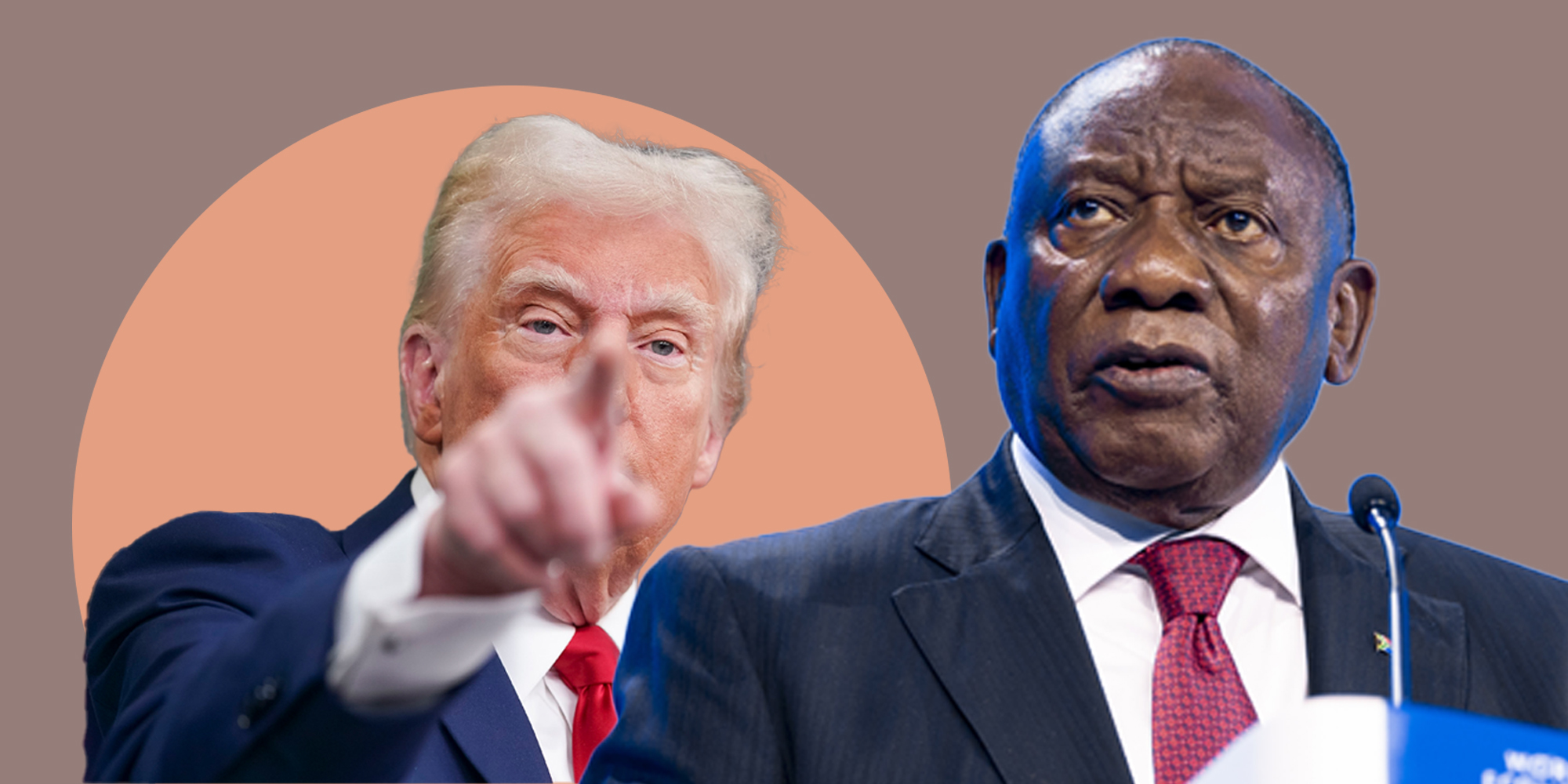
 US President Donald Trump. (Photo: Will Oliver / EPA-EFE) | South African President Cyril Ramaphosa. (Photo: Michael Buholzer / EPA-EFE)
 South Africa is unlikely to try to gatecrash the first G20 meeting under the US G20 presidency this month, though at least one other G20 member thinks it should.
The US sent invitations on Monday to all G20 members except SA to attend the first sherpas’ meeting of the US G20 presidency, which takes place in Washington on 15 and 16 December.
This non-invitation from the US to SA confirmed US President Donald Trump’s announcement last week that he would not invite South Africa to the G20 Leaders’ Summit he will host in Miami in December 2026.
/file/attachments/orphans/GettyImages-2233243940_815882.jpg "US President Donald Trump during an announcement in the Oval Office of the White House in Washington, DC, US, on Friday, Sept. 5, 2025. Trump made official his intention to host next year's Group of 20 summit at his Doral resort in south Florida, with plans to curtail the attendee list and focus talks on the economy. (Photo: Francis Chung / Politico/Bloomberg via Getty Images)")
In his announcement on his social media site, Truth Social, he repeated his false claim that the US had not attended the G20 in South Africa, which has just ended, because of “the horrific human right abuses endured by Afrikaners…”
He added that because SA had refused to hand over the G20 presidency to the acting US ambassador at the Johannesburg summit on 23 November, “South Africa will NOT be receiving an invitation to the 2026 G20, which will be hosted in the Great City of Miami, Florida next year.”
President Cyril Ramaphosa refused to hand over the G20 presidency to the acting ambassador, a relatively junior official. A few days later, officials from the Department of International Relations and Cooperation (Dirco) handed over the G20 presidency to acting US ambassador Marc Dillard at Dirco’s headquarters.
Read more: Ramaphosa dismisses Trump’s threat to bar South Africa from 2026 G20 summit
Commenting on SA’s exclusion from the sherpas’ meeting, Dirco spokesperson Chrispin Phiri said, “As a founding member, our commitment to the G20’s principles and collaborative framework remains steadfast. We are confident that all members recognise that the strength and legitimacy of the forum derive from its established composition and shared adherence to its founding protocols.
“Any unilateral departure from this consensus would not only fragment our collective agenda but would inevitably set a precedent, introducing a new and destabilising variable into the calculus of membership for every nation present.”
/file/attachments/orphans/WFD_7123_260392.jpg "Dirco spokesperson Chrispin Phiri at the G20 summit in Johannesburg. (Photo: Felix Dlangamandla)")
Read more: G20 South Africa goes post-Trump as middle powers signal fresh path
Official sources added that any other G20 members which did not protest at SA’s exclusion could be jeopardising their own membership, as the US was creating a precedent for one G20 member unilaterally expelling another.
However, one SA official said, “But if you don’t have an invitation, you can’t really just rock up.”
A diplomat from another G20 member state said South Africa should arrive at the Washington meeting because, as a G20 member, it had every right to attend. This diplomat said the US refusal to admit SA would probably be an agenda item at the meeting.
An official from another country that participated in the SA G20 presidency said: “G20 has its defined members and the general view is that participating in G20 meetings for the permanent members does not depend on getting an invitation.”
German Chancellor Friedrich Merz said last week he would ask Trump to reconsider his decision not to invite South Africa.
Read more: SA looks beyond US G20 presidency as Trump moves to block participation
However, it seems unlikely that any G20 member state will boycott the sherpas’ meeting – or any other G20 meeting – because SA has been excluded.
The US officially took over the G20 presidency from South Africa on Monday, 1 December. That included taking control of the G20 website. The US immediately deleted SA’s elaborate agenda and record of meetings and decisions, including the 30-page, development-oriented Declaration from the 22-23 November summit in Johannesburg. The site now only has an image of Trump holding up a clenched fist next to a logo saying “G20 Miami 2026” and the slogan “THE BEST IS YET TO COME”.

The US also posted on social media, “Under President Trump’s leadership, we will return the G20 to focusing on its core mission of driving economic growth and prosperity to produce results.
“As we usher in these much-needed reforms, we will prioritize three core themes: unleashing economic prosperity by limiting regulatory burdens; unlocking affordable and secure energy supply chains; and pioneering new technologies and innovations.” DM