




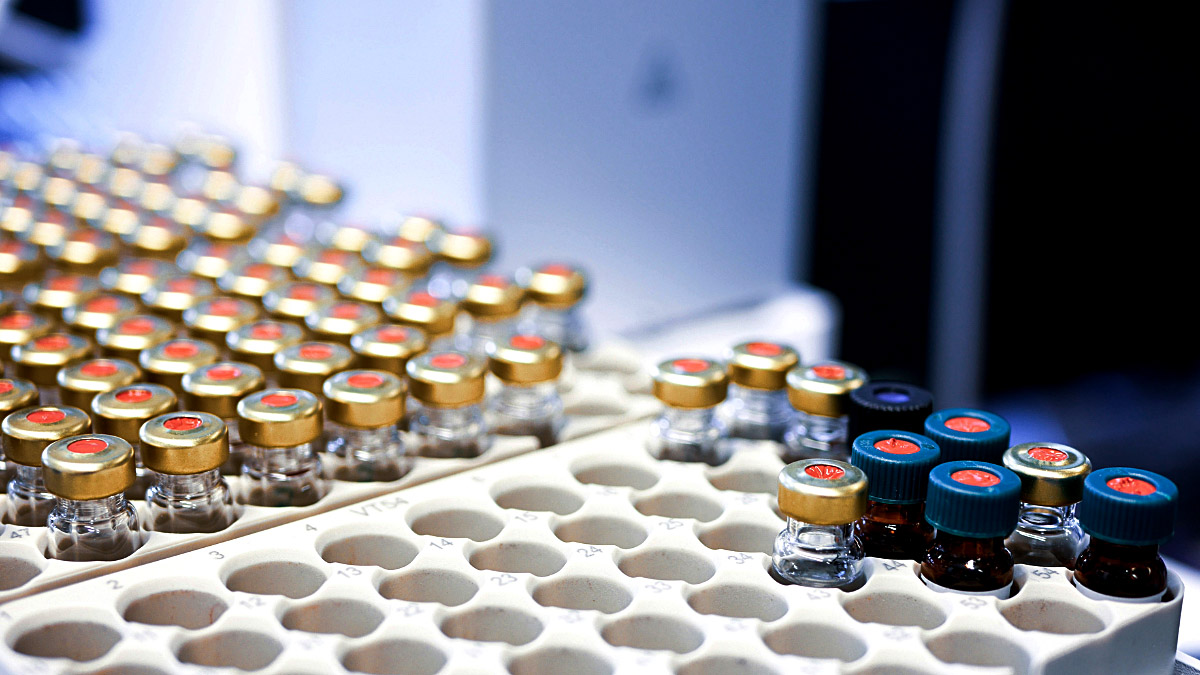
 To end Aids by 2043, the South African government says it could get a group of local pharmaceutical companies to make generic shots of lenacapavir from 2027. However, none of the companies that will be involved has a licence to make the jab. (Photo: Julia Koblitz / Unsplash)
 The South African government is adamant that it could fill that gap in the number of doses it will need – enough for between one and two million people per year – by getting a group of local pharmaceutical companies to make generic shots from 2027.
HIV-negative people can take the almost foolproof jab, lenacapavir (LEN), which was registered in South Africa in October, once every six months to stop themselves from getting HIV. South Africa had just more than 170,000 new HIV infections in 2024, the most for a single country in the world.
In 2026 and 2027, South Africa will receive donated LEN doses paid for by the Global Fund to Fight Aids, Tuberculosis and Malaria, to start and keep 456,360 people on LEN – a total of 974,450 doses – over two years, according to health department data.
Read more: The Lenacapavir Roll out Plan
The first shipment of 115,000 doses for distribution at 360 government health clinics is scheduled to arrive in February, the health department’s deputy director-general for HIV, Nonhlanhla Fikile Ndlovu, told Bhekisisa, although it’s possible that the arrival date could be moved forward.
Although South Africa is getting more than three-quarters of the LEN doses that the Global Fund is donating to nine countries, this still falls far short of the number (enough doses for between one and two million people to each take it at least once a year) that modelling scientists have calculated is needed to make a sufficient dent in new HIV infections to end the epidemic by 2043.
Generics are expected to become available in 2027, that the department will be able to buy for the same price as a daily HIV prevention pill from two Indian manufacturers, but South Africa may still need far more doses than what the companies are able to provide.
The good news is that the government is prepared to buy generics, rather than only relying on donations – the country already buys all its supplies of the daily prevention pill.
Health Minister Aaron Motsoaledi announced at a South African National Aids Council (Sanac) meeting in October that the department will start to buy generic LEN in 2027 and that the department will be “earmarking resources in our medium-term expenditure framework to ensure that once generic versions become available or prices drop, we can scale up access without interruption”.
The government’s local production plan goal is to make sure South Africa has enough LEN, and an interrupted supply of it.
Glaudina Loots, the director for health innovation in the Department of Science, Technology and Innovation, told Bhekisisa: “The goal is to be ready by 2027. It’s a collective that we’re putting together, so that one pharmaceutical company doesn’t have to struggle through this alone.
“We were able to do it with the mRNA vaccine in South Africa because we pulled the process together. We can do exactly the same with LEN.”
Can we do it?
There is, however, a rather big complication.
None of the companies that will be involved – Aspen Pharmacare, Kiara Health, Adcock Ingram and Pharma Q – has a licence from lenacapavir’s inventor, Gilead Sciences, to do so.
Gilead gave six companies such licences, mostly in India, in October 2024. In South Africa’s case, three companies – Aspen Pharmacare, Pharmacare and Cipla Medpro – were evaluated but all failed the test.
And that’s where the hitch lies.
Gilead wants companies to manufacture LEN from start to finish, Sanac head Thembisile Xulu, who is leading the negotiations, told Bhekisisa.
But South African companies aren’t able to do that because they can’t make the ingredient – the active pharmaceutical ingredient (API) – that makes the jab work, but would need to import it and then put the product together locally.
“It’s a complex 28-step process to make the API,” Loots says. “We need a different plan until 2029, so that we have time to get ready to make the API.”
The state departments working together with drug companies are the health department, Department of Trade, Industry and Competition, Department of Science, Technology and Innovation and Treasury.
Expert advice will be provided by the South African Medical Research Council, Unitaid and the Medicines Patent Pool, a United Nations-backed organisation helping countries like South Africa to find ways to access lifesaving medicines.
Xulu concludes: “We are working towards a submission for a voluntary licence that allows South African manufacturers to import the API for Gilead to assess by July (quarter two of 2026).
“Whether we’d be able to make LEN by 2027 is dependent on Gilead.”
How much LEN does South Africa need?
Research shows that a marked drop in HIV infections in a community is seen only if HIV prevention medication reaches a lot of people.
The higher the rate of new infections, known as the incidence rate, the fewer people need to get the medication to prevent one infection, because when there are lots of people who can infect each other, the chances are higher than the people who take the medication could potentially be one of those who would have contracted the virus, had they not taken the medication.
For example, a study shows, in places where the incidence rate is 3% or more, 33 people need to take prevention medication to stop one HIV infection; in areas with much lower rates up to 200 people may have to take HIV prevention drugs to stop one new infection.
Although South Africa’s overall HIV incidence rate is 0.32%, certain groups, such as sex workers, teenage girls and young women, and gay and bisexual men, as well as certain health districts, have incidence rates as high as 4.5%.
For Aids to end as a public health threat, the incidence rate needs to be reduced to 0.1% or below. For 2024, for which there were 172,994 new HIV infections, that number should therefore be as low as 65,000 new infections if we want to end the epidemic.
Lise Jamieson, a modelling scientist at the Health Economics and Epidemiology Research Office at Wits University, has calculated for a study that will be published within the next few weeks, that in South Africa, between 35 and 65 people need to use LEN to stop one HIV infection.
If most people use LEN for a year (each person would take two consecutive doses, and turn up for their second dose in time), we will avert one HIV infection for every 35 people using LEN, and end Aids in 2039 (this comes to a total of 67 million doses we need between now and 2039).
But if most people on LEN use the medicine only once (a single six-month dose) we would need 65 people to use it to stop one new infection, and end Aids only in 2043 (this comes to 31 million doses needed between now and 2043).
South Africa’s Global Fund LEN doses therefore only constitute about 3% (974 450/31-million = 3.14%) of the total number of doses that we would need to end Aids in 2043 (the more conservative scenario that Jamieson calculated).
Because LEN hasn’t yet been used widely in any country, we don’t know if people will stop using it after one dose, or if they will use it for longer.
What do South Africa’s plans to make LEN entail?
Loots says South Africa could potentially be ready to make LEN’s API by 2029 by using the facilities of CPT Pharma, which are being upgraded. Wits University’s advanced drug delivery platform and the API cluster of the Council for Scientific and Industrial Research will provide expert advice.
“In essence,” Loots says, “we will position South Africa as a regional pharmaceutical hub with full sovereign manufacturing capability for LEN.”
Wendy Cupido, the general manager for Gilead Sciences in South Africa, said at the Sanac meeting that the company “would be pleased to consider an additional voluntary licence”, but Xulu says that, even after “extensive engagements, the bottom line is Gilead has not committed to a licence”.
Gilead’s senior director for global affairs, Caroline Almeida, responded to Bhekisisa’s questions on Monday morning: “While end-to-end manufacturing remains our preferred model, we continue to explore opportunities for local formulation in South Africa and have encouraged collaboration with our existing generic partners as a potential first step towards full-cycle production. We are open to partnering with a manufacturer outside South Africa to import the API and complete final formulation locally.” (Read Gilead’s full response).
HIV activists from around the world have called on the South African government to begin taking steps to issue a compulsory licence – when a government allows someone else to produce a patented product or process without the consent of the patent owner – against Gilead.
Ndlovu says the health department plans to start rolling out the first shots by 1 April, at the latest, at the 360 clinics it has identified in six provinces – this covers about 10% of the country’s clinics.
In 2027, when cheaper generics are expected to come to the market, the department will increase the number of clinics stocking LEN to about 30% and to 100% between 2028 and 2029.
South Africa’s next LEN shipment has not been scheduled yet, but Ndlovu says shipments are expected once every six months. DM
This story was produced by the Bhekisisa Centre for Health Journalism. Sign up for the newsletter.
/file/dailymaverick/wp-content/uploads/2025/02/Bhekisisa_logo_hi_res.jpg)