




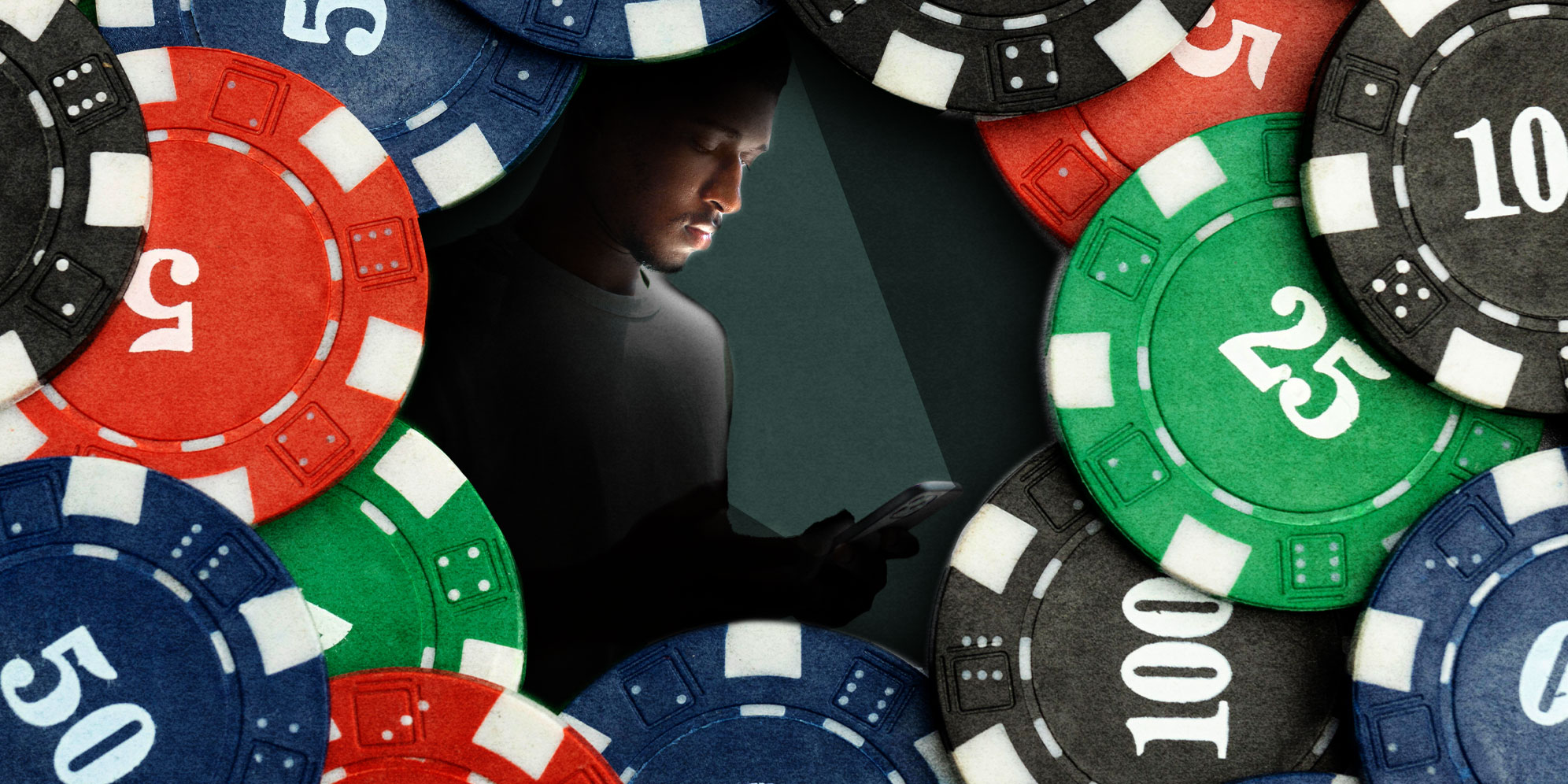
 Illustrative Image: Man holding phone (Photo: Freepik) | Gambling chips (Photo: Freepik)
 South Africa’s gambling sector is exploding with gross gambling revenue surging to R59.3-billion in 2023/24 as online platforms tightened their grip on millions of players.
Behind the numbers are people like *Jaylen, a 24-year-old who spoke to Daily Maverick on the condition of anonymity, recalling how betting apps turned a childhood curiosity into an addiction that cost him thousands, fractured his relationships and led him into drug use just to stay awake long enough to “win it back”.
Jaylen’s story unfolds against a backdrop of rapidly rising gambling participation in South Africa. During a presentation at the Responsible Gambling Summit on 13 November, Yvonne Gwenhure, senior manager for strategy and organisational performance at the National Gambling Board, said recent board data showed that the increase in gambling revenues indicated a staggering 25.7% rise from the previous year.
According to Gwenhure, the sharpest growth was in online gambling and sports betting, while traditional casino visits and lotto participation declined. This mirrors global trends seen during and after Covid-19, with countries such as Australia reporting gambling participation as high as 73% and Kenya recording 42% among young people.
Much like the national patterns, Jaylen’s exposure began casually in his teens. His father played horses, and gambling was, as he put it, “just a bonding thing”. At 16, he would hand adults small amounts to bet on his behalf. But once he turned 18, he gained access to casinos and soon gambling apps, and then everything sped up.
‘Online gambling does not feel real’
What drew him in was the simplicity. No casinos, no long queues, just an app. “It’s very, very accessible,” he said. “You can go on your phone, place the bet and that’s it. You don’t feel like you’re gambling.”
/file/dailymaverick/wp-content/uploads/2024/06/iStock-907044482.jpg "The National Gambling Board's National Socioeconomic Impact Study found that problem gambling affected about 31% of recent gamblers, especially those aged 25 to 34, including a notable proportion of unemployed people. (Photo: iStock)")
This easy access is a critical driver of addiction. Gwenhure warned that underage and vulnerable groups were increasingly exposed, and 29% of adults reported knowing a person below the age of 18 who gambled, despite the practice being illegal.
For Jaylen, convenience became a trap. As he started working and earning his own money, his gambling escalated sharply. “I used to make sure I had at least R50 to be able to do something with it,” he said, adding that he would play at least three times a week.
The highs were intoxicating. One night, he won R20,000, then lost every cent within a few hours.
“It hurt my pocket. I cried for the first time that day because of gambling,” he said.
Tipping point: ‘I used quite a bit of drugs while I was gambling’
Jaylen’s addiction reached new levels when a friend he frequently gambled with proposed a theory: that using cocaine before gambling would sharpen their senses and increase their chances of winning.
“It was a little theory my friend cooked up. He said if we do cocaine before, the likelihood of us winning money was very high because you’re subconsciously more attentive… you’re buzzing,” he explained.
For a while, Jaylen believed it worked. “I’d go with R500 and walk out with a little less than 2,000,” he said. “For a little while, it was a proven thing.”
But it did not take long for the “theory” to unravel. While the drugs kept him alert, they also warped his judgement. As time went on, Jaylen said he took bigger risks, made impulsive decisions and lost more than ever.
“I just started losing it. Instead of walking away when I won, I was taking the money and putting it back into gambling. I was not making the right kind of decisions,” said Jaylen.
The combination of gambling and drugs quickly became destructive, but, tellingly, it was also frighteningly easy to conceal. All of it happened online, through an endless stream of betting apps and draws.
Aspirations of making it big
Jaylen said the belief that gambling could be a livelihood, something he had seen others achieve, fed into the cycle.
He described watching people walk into betting shops with R2,000 and walk out with R20,000. Those stories kept him hooked. “It sounds very profitable. And it’s possible for some people. That’s the problem.”
This is a key concern for gambling researchers. Aggressive advertising, especially on social media, normalised gambling and sold the fantasy of easy wealth.
Gwenhure noted that promotions, loyalty rewards, celebrity endorsements and targeted messages offering free credits all influenced behaviour, particularly among young people and lower-income gamblers.
As Jaylen’s losses mounted, reality set in. His finances collapsed and he began dipping into his rent money to sustain his gambling habit. Soon, he could no longer afford the room he rented and was forced to move back home.
It was only then that he could distance himself from people and habits that fuelled his addiction. He said he began spending time with people who didn’t gamble.
“It kind of made me very self-conscious about what I’m doing. The more I started losing, the more it became a reality that maybe this thing is not it,” Jaylen said.
He stopped using drugs more than a year ago, and his gambling has slowed from several times a week to once a month. But the pull is still there. “I’m not addicted any more,” he insisted, adding, “I used to be.”
Public health crisis in the making
During the responsible gambling summit, Gwenhure said problem gambling was increasingly regarded as a public health issue that required systemic solutions.
The National Gambling Board recommends:
- Stricter regulation of gambling advertising.
- A national online self-exclusion register.
- Updated legislation that addresses the realities of digital gambling.
For all his progress, Jaylen said he worried about others who may be trapped in the same situation he had been, especially those gambling their last income on online platforms.
“I think the idea of online gambling is nice, but the reality is that people don’t know when to stop. These websites are making a lot of money. They put a disclaimer, ‘winners know when to stop,’ but honestly, most people don’t.”
When asked for his advice to people struggling with gambling addiction, Jaylen said:
“Find a way to slow down, even if it means putting less in at a time. Think about your responsibilities. If you’re losing more than you’re gaining, I don’t see the point. Get around people who see gambling for what it is. Birds of a feather flock together.”
Jaylen said he was lucky to have stepped back before the addiction destroyed more than his financial stability, but he wants others to understand how quickly it can happen.
“You start losing a lot of money, and then you start chasing the promise of winning, and once you start chasing it, that’s when you get lost,” he said. DM
*We have used the name Jaylen to protect anonymity.