



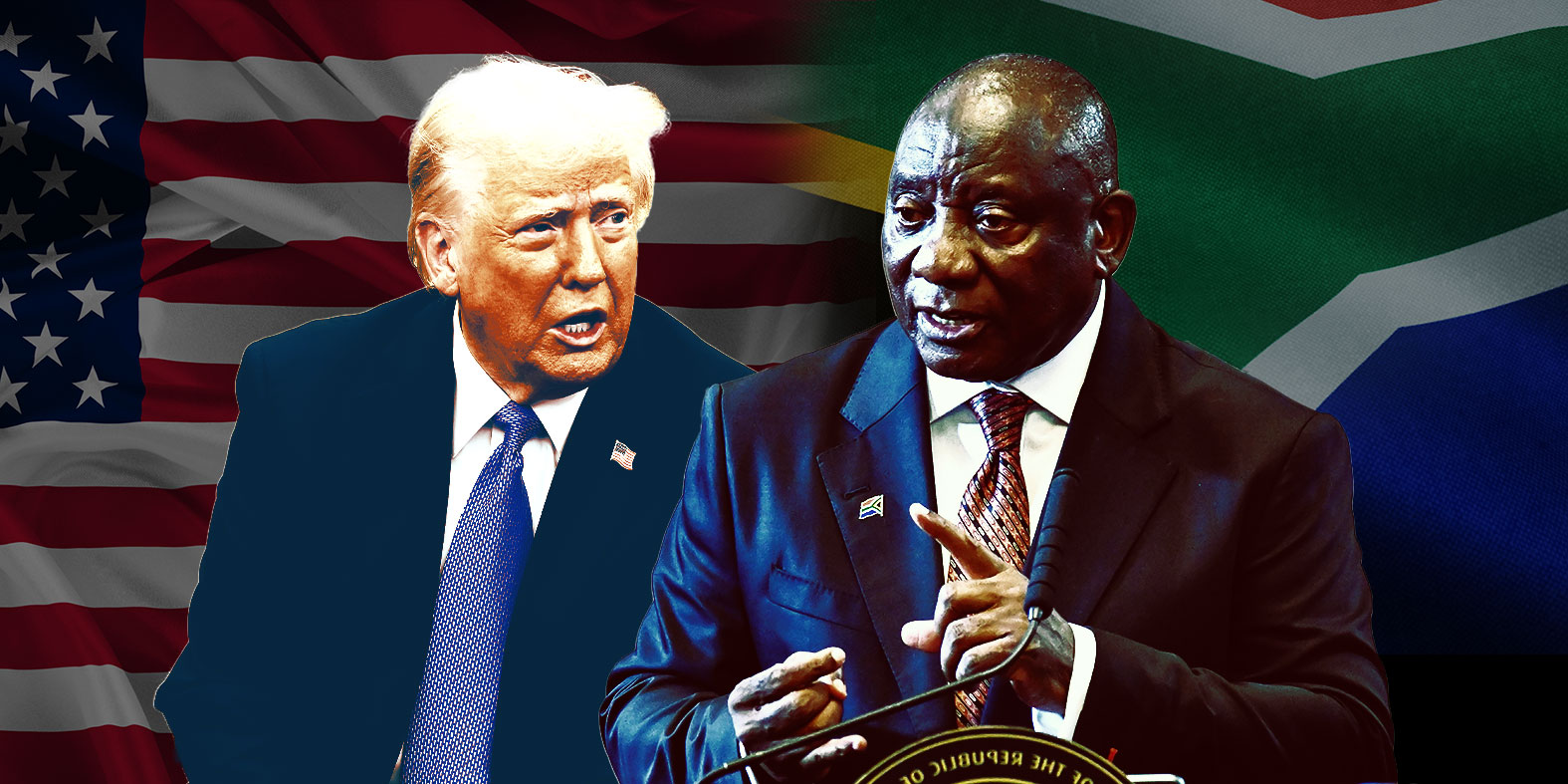
 Caption: Illustrative Image: US President Donald Trump. (Photo: Anna Moneymaker / Getty Images) | SA President Cyril Ramaphosa. (Photo: Gallo Images / Jeffrey Abrahams) | flags (Image: Freepik)
 /file/dailymaverick/wp-content/uploads/2025/10/label-analysis-2.jpg)
On 18 occasions since South Africa, a year ago, took the chair of the G20 group, formed to ensure financial stability and development, US President Donald Trump aimed his barbs.
The mission: clearly to destabilise South Africa under the influence of a powerful group of right-wing political actors in the country and in the US. The target was the G20 meeting, which Trump continued to try to upend until days before, when his administration issued a diplomatic note warning the group against making its standard political declaration.
On Sunday, a nineteenth attack came from White House deputy press secretary Anna Kelly, who told Fox News that President Cyril Ramaphosa’s refusal to facilitate a “smooth transition” of the G20 presidency to the US, coupled with its issuance of a Leaders’ Declaration, amounted to a weaponisation of the G20 to undermine the forum’s founding principles.
Trump wanted that declaration watered down to a chairperson’s summary, which indicates that no consensus was possible.
SA’s values affirmed
In that context, the G20 South Africa, now declared closed by Ramaphosa, had to fend off unprecedented attacks by a superpower to maintain a progressive path in a hostile world. A political declaration was passed and agreed.
How that happened is the story of a changing world: 16 member states and 25 other leaders, many middle powers, defied America’s pique to attend. This was both a mark of solidarity with Africa and with South Africa and, also, of self-interest. Africa’s young population represents a great opportunity, as does the continent’s store of critical minerals.
The neoconservative groups were so successful in influencing Trump that the country had to spend the better part of the year disabling the narrative of a “genocide” against white South African farmers in particular and white Afrikaners in general. It didn’t work.
Only one head of state, Argentina’s President Javier Milei, acted as a Trump proxy and even his boycott was not total. Argentinian Foreign Affairs Minister Pablo Quirno Magrane attended.
One after the other, leaders, in their statements on the opening day (22 November), said presence was solidarity; one after the other recognised the significance of the continental gathering.
Read more: How South Africa used the ‘G20 megaphone’ to put critical issues on the global stage
Deeper than mere attendance is that a different set of values has emerged to those becoming hegemonic under Trump. His anti-woke presidency has unleashed a global rise of conservatism and an unprecedented attack on progressive values, including on gender, LGBTQI rights, diversity and equality.
While differing in shade and grade, the three values chosen by South Africa for the G20 were repeatedly affirmed. This suggests geopolitics is heading in a direction of being post-Trump or what the Financial Times has called “peak Trump”. In that, Ramaphosa has achieved a shift as G20 chairperson with his chosen themes.
Solidarity – when the US has dismantled its world-class solidarity systems with the world by cauterising many shapeshifting public health programmes. Equality – when Trump encourages rule-by-billionaires and has enriched himself to the nth degree. Sustainability – when the oil, gas and fracking lobbies are back in prime position as the transition to renewable forms of energy is on the back burner.
One of the marquee bilateral agreements is between the EU and South Africa, which puts meat on the bones of significant support for a just transition.
Read more: EU announces €750m new investments in SA and an agreement to jointly develop critical minerals
Norway, the UK, the EU and other countries made significant commitments to development which won’t neutralise the American cuts to aid but show a different direction for global solidarity.
Trump’s unilateral drop of a peace plan for Ukraine also reinforced the idea of the importance of multilateralism. The EU bloc was thrown and engaged with how to respond to the peace plan throughout the G20 meeting.
Rise of the middle powers
Trump’s stayaway ended up being a net-positive as the meeting became another staging post for a trend in geopolitics. This is the continued rise of the middle powers, not as a bloc but as an interest and interesting group.
These are countries that are influential, middle- or high-income, support multilateralism and its global rules-based system rather than the unilateralism of Trump and other ascendant hyperconservative powers.
The G20 was a showcase of middle powers, both member states and invited heads of state. These include India (becoming more super- than middle power) and Brazil, to the EU, Australia and Canada; Singapore, Indonesia, Malaysia and Vietnam; Turkey, the UAE, Qatar and Saudi Arabia.
There were many bilateral meetings at the Nasrec meeting centre and around Johannesburg over the G20 weekend as many countries look to diversify trade after the US imposed punishing tariffs.
Inequality (and how to mediate it) and debt relief for developing countries have been threaded into the final Leaders’ Declaration, with important resolutions that have broad support.
High-profile reports by panels led by Professor Joseph Stiglitz (on inequality) and by former finance minister Trevor Manuel (on debt, risk pricing) have been well received and politically well socialised.
The baton will be passed to the US later in the week in a low-key meeting at the Department of International Relations and Cooperation in Pretoria.
The US wanted a big stage handover to its Chargé d’Affaires, Marc D Dillard, but Ramaphosa refused, insisting on equivalence – a final display of how relationships are being reset. DM