



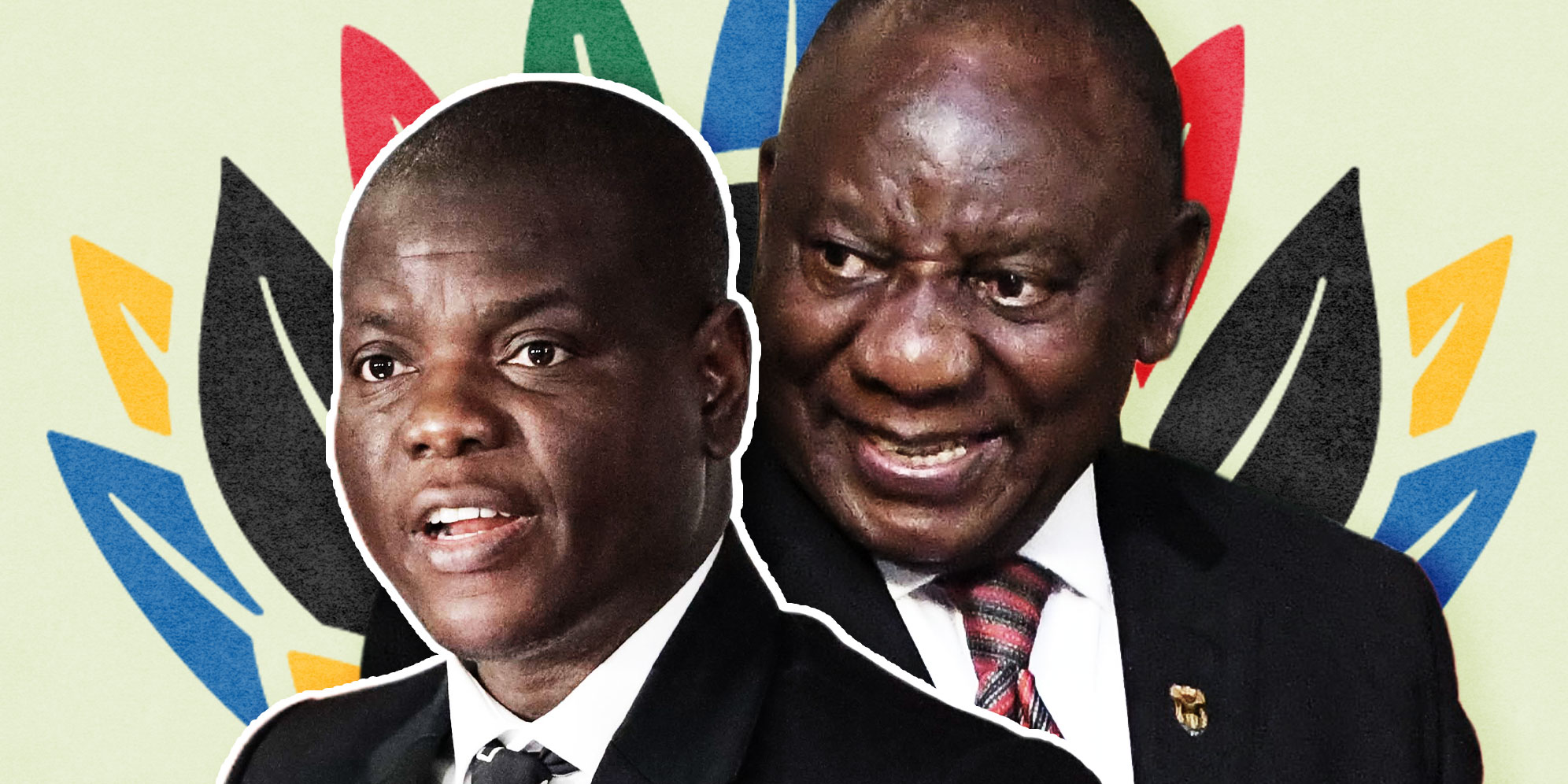
 Illustrative Image: Ronald Lamola. (Photo: Gallo Images / OJ Koloti) | President Cyril Ramaphosa. (Photo: Gallo Images / Frennie Shivambu). | G20 logo. (Image: sourced / G20 website)
For the moment many of the questions put to our senior leaders about the G20 are centred around the country, and the person, who won’t be here.
US President Donald Trump has said no one from his administration will attend, meaning there is no one for our government to formally hand over the G20 Presidency to.
While it seems Trump will host some kind of G20 gathering next year, his attitude to virtually all multilateral institutions suggests he will use his presidency to weaken it.
Certainly, as Trump has made a political statement by refusing to come to our G20, Ramaphosa may feel no need to attend Trump’s G20.
While our government has been diplomatic about Trump’s boycott, International Relations and Cooperation Minister Ronald Lamola has started to up the ante slightly.
On Tuesday, at the Bloomberg Africa Business Summit, he said: “We think the G20 can send a signal that the world can move on without the US.” He also pointed out that “multilateral platforms are the only way we can enable the world to function”.
Essentially, this was a young black man, on a major international stage, standing up to Trump.
Read more: US makes clear it will oppose a G20 Johannesburg Leaders’ Declaration
If the G20 does go ahead and adopt a Chairperson’s Statement that, presumably through very coded language, is seen to criticise the US stance, this weekend could be an important moment.
It would signal that the rest of the world does not agree with Trump.
And those who created that situation, who were able to engineer it, those who are seen to symbolise it, might well come out with enhanced reputations. Particularly to a South African audience.
The first obvious beneficiary of this would be Ramaphosa. He is the host, the person who would have set the tone. Considering the sheer size of the stage, and the fact this is an international event, it would make his domestic critics look quite small.
This means anyone who moved against him would look diminished by comparison. This could well help the ANC. It would be the only party with someone of his international stature.
For them, if Ramaphosa became the personification of the “anti-Trump”, he might well become as important to their polling numbers as he was back in 2019. Back when Phala Phala was merely a farm.
This would also give him more room to move in the coalition.
A strong G20 performance, combined with the recent spate of good news about our economy, could well give him, and his agenda, a sense of momentum.
Certainly it would put parties like the EFF and MK on the back foot.
Inside the ANC it would also make it harder for his opponents. Those who dare to whisper aloud that he will not finish his second term as president would simply look silly.
Lamola’s chance to shine
For Ramaphosa there is another, perhaps more important, opportunity.
Since his election as leader of the ANC in 2017 his own choice of successor has been incredibly unclear. He has made no obvious gesture of support for anyone. This has allowed Deputy President Paul Mashatile (who, presumably, is not Ramaphosa’s chosen person) a virtual open field.
However, Ramaphosa has ensured that one particular person has been put at the centre of things. It was clear just before Ramaphosa was elected in 2018 that Ronald Lamola was important to him.
Then, in the months of 2018 and 2019 when the issue of land ownership owned the political stage, Lamola was put in charge of the issue for the ANC.
In Ramaphosa’s first Cabinet after the 2019 election Lamola was given the prime position of Justice Minister. And then, after last year’s elections, he was made Minister of International Relations and Cooperation.
This allowed him to play a big role in the prosecution of Israel for the crime of genocide at the International Court of Justice.
This might well be a moment for Ramaphosa to give Lamola the space to shine. The timing of this is interesting.
If Lamola were to have a “success” at the G20, and be seen by South Africans to play a role in leading international opposition to Trump, this could be the weekend that would launch his ANC leadership campaign.
This could then turn him into an important campaigner for the party during the local elections next year, and give him a strong platform in December 2027.
All of that said, there is still no evidence that Lamola has any strong constituency in the ANC. At the 2022 Nasrec conference he ran for the position of deputy leader against Mashatile and Oscar Mabuyane. While both at the time had strong provincial constituencies, he still won just 7.24% of the branches.
This would mean something has to change fundamentally for him to really have a strong chance of winning.
Limited impact
It is also true that international events, as important as they may be, can sometimes have no impact on domestic politics.
The famous European example of this is Winston Churchill being seen to play a massive role in leading the UK during World War 2, and then being voted out almost immediately.
Read more: After the Bell: Why do I fret about hosting the G20?
Perhaps the most similar example here was in September 2008, when then president Thabo Mbeki presided over the signing of the Global Political Agreement in Zimbabwe. It saw the creation of a coalition government involving Zanu-PF and the MDC.
Just five days later he was removed as president by the ANC’s NEC.
And of course, the G20 itself may well not go the way Ramaphosa and Lamola want it to go.
There are so many countries involved, with so many different leaders with so many different agendas, that any outcome that reaches general agreement could be seen as a victory.
To get anything close to the consensus that the G20 demands may be impossible. It may be that the most Ramaphosa and Lamola can hope for is to host an international summit with no major disasters. And one in which they are not seen to make any major mistakes.
It would seem likely that the G20 will have some domestic consequences. But its impact is likely to be limited.
Unless… there is a spectacular victory… or a spectacular failure. DM