




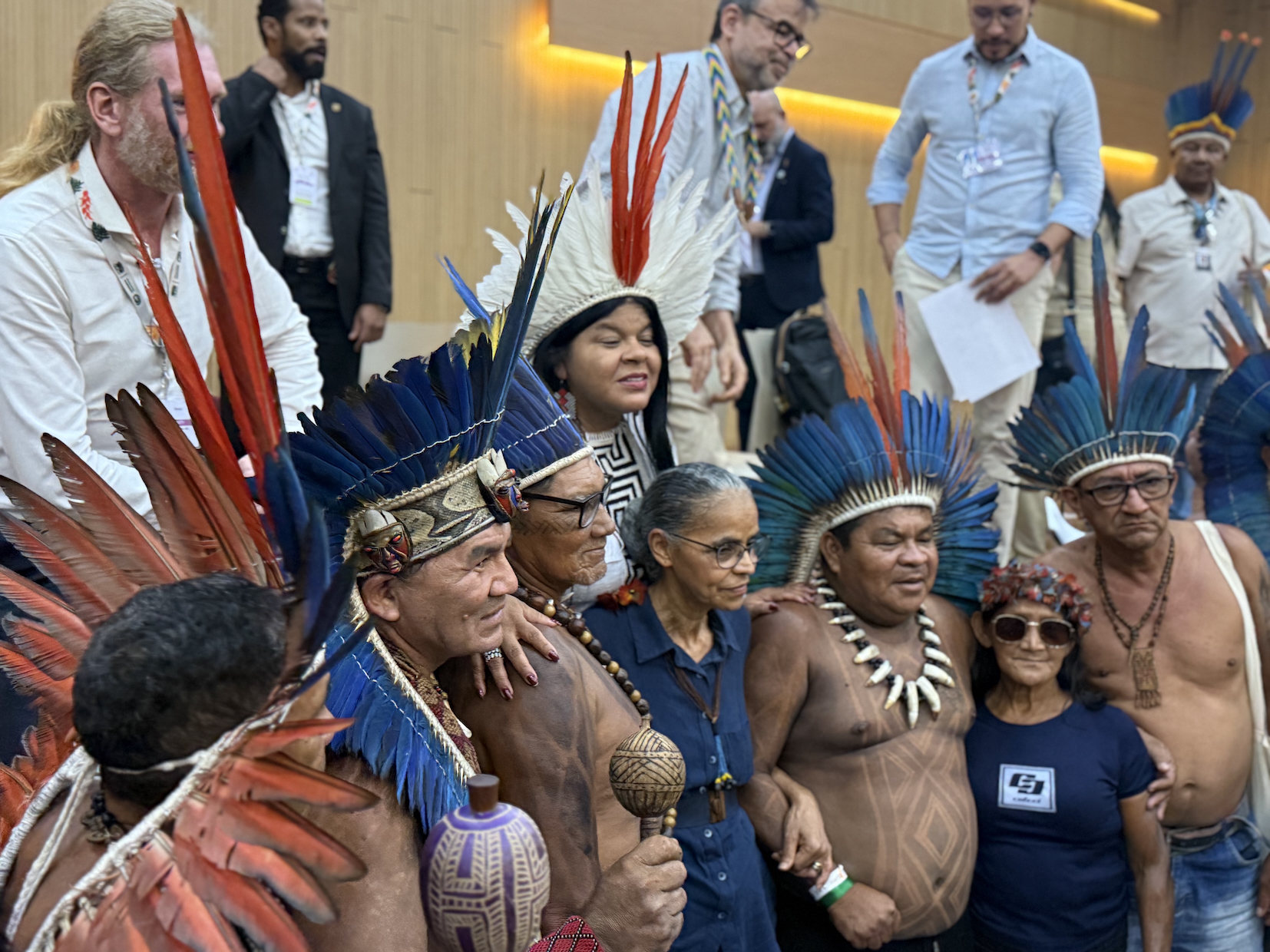
 Minister of Indigenous Peoples Sônia Guajajara and Minister of Environmental Affairs, Marina Silva (centre) pose with Chief Gilson Tupinambá (centre right) and other Indigenous leaders after a meeting in Belém on 14 November 2025. (Photo: Matthew Wilhelm-Solomon)
On Friday, 14 November – at the end of the opening week of the 30th UN Climate Change Conference (COP30) in Belém, Brazil – Indigenous protesters blocked the entrance to the conference’s Blue Zone. The peaceful protesters, from several communities, wearing traditional headwear and clothes, objected to the perceived exclusion of Indigenous leaders from the Blue Zone, against the delays in the legal recognition, or demarcação, of their territories, the privatisation of their waterways, and against the threat of oil drilling near the Amazon River mouth.
The protest revealed the ways COP30 has been marked by both planetary and national divisions.
Security at the conference had already been increased – controversially so – after protesting Indigenous groups breached the security barrier the previous Tuesday. The Blue Zone is the centre of the conference where only accredited delegates and observers can enter. In a vast hangar, after security, one enters a series of brightly lit state and private pavilions – resonant of a corporate trade fair – before an endless passage which branches off into various meeting rooms.
Even in the Blue Zone itself (which is next to an open Green Zone), increased access to which the Indigenous leaders were protesting, the machinations of power are opaque. Amid the seemingly endless pavilions, and the long walk through the hangar, it is hard for the uninitiated to discern the loci of power.
One of those leading the marches was Chief Gilson Tupinambá, representing several communities along the Tapajós River – one of those designated for privatisation under a decree that Brazilian President Luiz Inácio Lula da Silva (or Lula, as he is known) signed in August this year.
“This decree… is death for us,” Tupinambá said. “Because it is from the river, our forest, that we live, and that we get our food. From there our children will see tomorrow. What we are protecting will be destroyed. We have no exit. Those in their air-conditioned rooms do not feel our climate. But we are the thermometer. We feel it in our skin.”
/file/dailymaverick/wp-content/uploads/2025/11/Image-2-1-1.jpg "Tens of thousands march through Belém on Saturday 15 November for the Global Climate March.(Photo: Matthew Wilhelm-Solomon)")
The demand he was articulating was a local claim, but also one that spoke to a wider and global fissure showing its face at the COP – between those with the power to make decisions and those who will be most affected by them. The COP’s success or failure might lie on the extent to which bridges can be made across this.
To diffuse the standoff, Indigenous leaders were offered a stage in an adjacent government building and an audience with COP30 president André Corrêa do Lago, Minister of Indigenous Peoples Sônia Guajajara and Minister of Environmental Affairs Marina Silva, among others.
That such a high-profile delegation was sent to deal with the protests was indicative of some of the progress and paradoxes of Lula’s second government, since beating the right-wing Jair Bolsonaro in 2022.
He appointed Guajajara, the first Indigenous minister in Brazil’s history, and has given weight to marginalised and peripheral communities. He opened COP30 by calling for the phasing out of fossil fuels. And yet the state oil company Petrobras was given permission to drill for oil near the Amazon River mouth, just more than 200km from Belém, in October. Lula and his government have consistently supported the legal recognition of Indigenous territories but have had to deal with a hostile congress seeking to limit Indigenous land rights, and have also been hamstrung by lengthy legal processes.
But on Friday, the delegation sat in silence and listened as Indigenous leaders voiced their complaints. Guajajara then responded to the audience that, of the 1,200 civil society delegates assigned to Brazil, 400 had been given to Indigenous representatives. “It’s the largest Indigenous participation ever,” she said. “We won by getting these places.” Corrêa do Lago promised to take their concerns to heart and to try to secure additional permits to the Blue Zone.
The protest was temporarily diffused, although the tensions remain – the paradox of a COP parachuted into a city and country still dealing with its own legacies of inequality and violence.
/file/dailymaverick/wp-content/uploads/2025/11/13498995.jpg "Indigenous people arrive at the People's Summit at COP30 in Belem, Brazil, 10 November 2025. EPA/FRAGA ALVES")
The city itself is haunted by colonial spirits – the name itself, Belém, Bethlehem – echoes that of another Belém along the Tagus River in Portugal from where the navigators left more than five centuries ago, opening up the Atlantic to the horrors of the slave trade.
The river city, surrounded by islands of forests – with its pervasive decays and derelictions, its markets filled with shrimp and dark bowls of açaí – is a transition zone between the forest and the sea, a passage through which slave ships and the lumber of wrecked forests have passed. And into this place the COP is transplanted, a strange entity spreading across the city, mushrooming into discrete zones. But civil society from around the world has also made the city its own.
On Saturday, 15 November, tens of thousands of people marched through the streets of Belém in a Global Climate March – Indigenous movements, feminist organisations, pro-Palestinian movements, religious institutions and unions, among others. It was an extraordinary display of solidarity, very distant from the formality of the Blue Zone.
The march was organised by the People’s Summit, a parallel event at the Federal University of Pará, taking place along the Guamá River. The atmosphere at the summit was also far cry from the formality of the Blue Zone. On the river alongside the summit, Greenpeace’s Rainbow Warrior was docked, and the event opened with a parade of more than 200 boats. The venue hosted tents from various social movements, a fair and a stage where samba and other music was played. It served as a counterweight by social movements to the COP.
/file/dailymaverick/wp-content/uploads/2025/11/Opening-1.jpg "Brazil’s President Luiz Inácio Lula da Silva speaks at the opening ceremony. (Photo: Alex Ferro / COP30)")
Boats have formed a recurrent symbol at the COP: The Yaku Mama Flotilla, occupied by more than 60 Indigenous land defenders, had travelled from Ecuador towards Belém in the month before the COP.
On Sunday, the People’s Summit delivered its own declaration, presented to the COP30 president, with Guajajara and Marina Silva in attendance.
The declaration opens with the affirmation that capitalist production is the major cause of the growing climate crisis, and that marginalised communities are those most affected. It warns of the risks of privatisation and the financialisation of common goods, and the idea that market forces will provide solutions, and calls for the end of fossil fuel exploration. It argues for the recognition of Indigenous land and proclaims: “We also recognise the presence of enchanted beings and other fundamental beings in the worldview of indigenous and traditional peoples, whose spiritual strength guides paths, protects territories and inspires struggles for life, memory and a world of good living.”
On Monday, 17 November, thousands of Indigenous representatives marched again through the streets of Belém towards a large sculpture of a planet, near the Blue Zone, guided by the refrain, “the answer is us”.
The second and final week of COP30 will be one in which the details of the final statement will be hashed out. In particular, delegates will contest a pathway to phase out fossil fuels, and the expansion of climate financing plans for developing countries – including those for loss and damages and adaptation funds – will be negotiated. Funds will be raised for the new Tropical Forest Forever Facility, launched by Lula at the COP30, which aims to provide financing for forest protection. But there is a deeper issue that the protests of the past week speak to: the carving out of the planet into zones of precarious safety and zones of harm and sacrifice.
The extent to which the spirit of the street, of the forest, of the flotilla and the river – their care and solidarity and sense of justice – can enter into the rooms in which power lies is not merely a case of permits and lanyards, barcodes and bureaucracy; it is the refrain of a world that risks annihilation – after 500 years of atrocity – summoning those in power to listen to a call on which our survival may rest. DM
Matthew Wilhelm-Solomon is a senior lecturer in anthropology at Wits University and an accredited COP30 observer. He writes in his own capacity.