




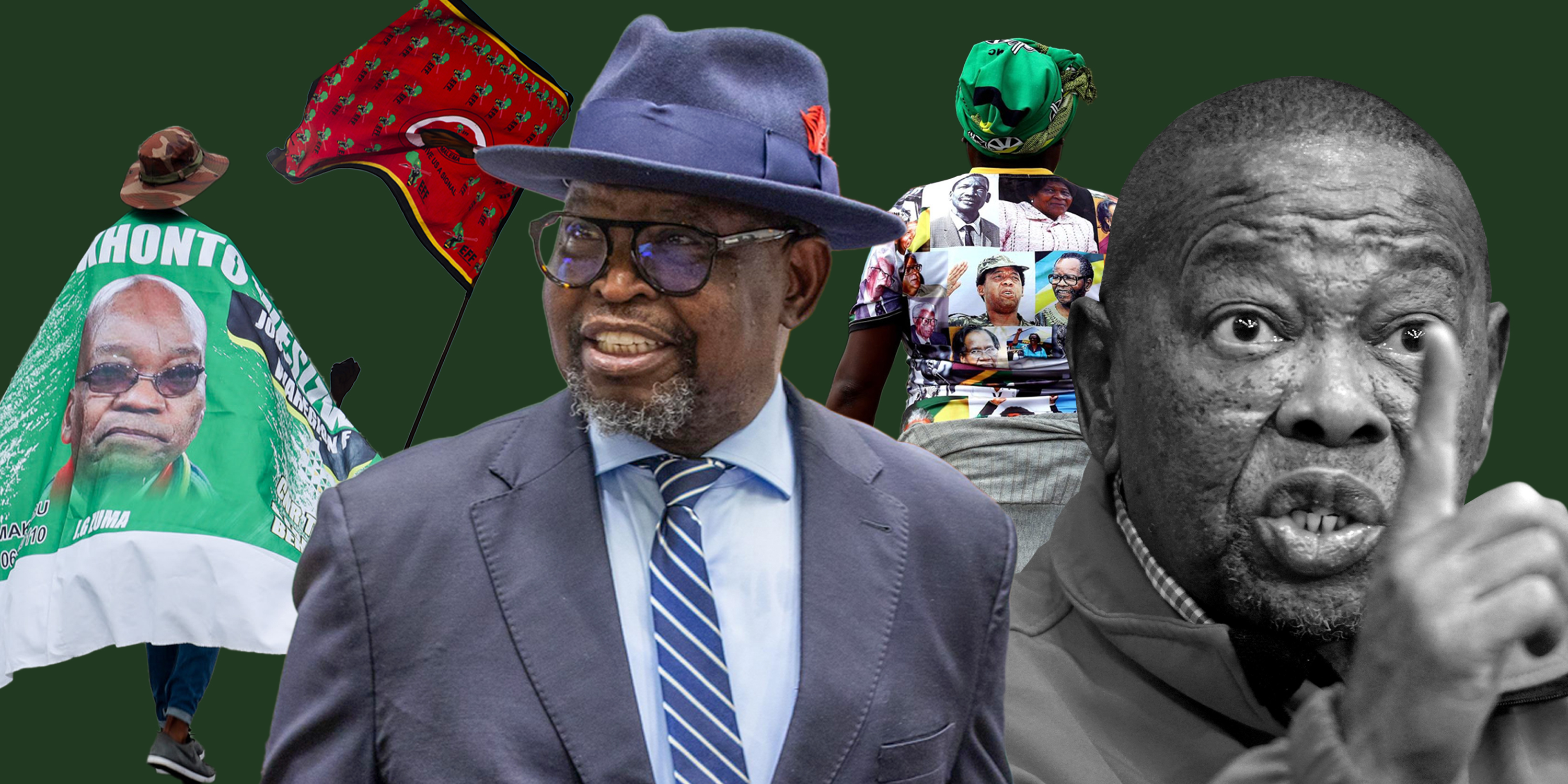
 Illustrative image / Sources (from left: An uMkhonto Wesizwe party member. (Photo: Gallo Images / Fani Mahuntsi) | A supporter flies an Economic Freedom Fighters (EFF) flag. (Photo: Waldo Swiegers / Bloomberg via Getty Images) | Minister of Finance Enoch Godongwana. (Photo: Zwelethemba Kostile / ParliamentRSA) | A woman wears a T-shirt bearing an image of late SACP leader Chris Hani. (Photo: Sandile Ndlovu) | SACP chair Blade Nzimande. (Photo: Gallo Images / City Press / Tebogo Letsie)
  The decision by the National Treasury to lower the inflation target will have consequences for generations to come. And while most of those consequences should be positive (this is obviously contested), it’s a move that would normally be opposed by those on the Left.
In the past, Cosatu would regularly argue, virtually after every interest rate announcement, that the bank was following the wrong policy and that interest rates should be lowered.
Their argument was, and presumably still is, that lower interest rates lead to more borrowing and thus companies expand and employ more people.
It has also appeared many times in the past that some in the ANC wanted to claim more control over the Reserve Bank.
While the argument to “nationalise” the institution is nonsensical (while it is true that anyone can still buy shares in the bank, this does not give those shareholders any power over monetary policy – the bank’s governors are appointed by the President), it masked another agenda – to try to increase political control over an independent institution (which also monitors financial inflows, including who is bringing in foreign currency).
And yet Wednesday’s announcement has, so far, created no political reaction.
Read more: SA shifts inflation target in bold move towards economic stability and growth
Some people have criticised it, but there has been no attempt to turn this into a political issue. And it seems unlikely that it ever will be.
Left wanting
There are very interesting reasons for this.
For example, perhaps the first public criticism of the decision came from EFF leader Julius Malema.
In the moments after Godongwana’s speech, he said that the decision would make it harder for people to borrow (because interest rates will be higher for longer) and he went on to claim that this decision was just “because the Governor of the Reserve Bank just announces… and we want to dance to the tune of the private sector… we want to impress the few…”
Malema’s comments appear unlikely to move the dial in any way.
This is mainly because of the perception that his party is losing power, as it has lost both voter support and senior leaders in the past 18 months.
Also, his comment comes after a public lament that “politicians and other people can just do as they wish, but they never get arrested”.
Considering the rank hypocrisy of that statement, it seems unlikely that his critique of the lower inflation target will gain any ground.
Meanwhile, MK released a comprehensive statement in response to the Medium Term Budget Policy Statement that questioned the lack of focus on job creation and demanded a wealth tax. But it made no mention of the change to the inflation target.
This also comes while the leadership of its Parliamentary caucus is in chaos.
Just days before the speech, John Hlophe had been suspended as Parliamentary leader while Colleen Makhubele was reinstated as chief whip.
This followed a long period of turmoil in the party’s top leadership, after Tony Yengeni both joined the party and became its co-deputy leader on the same day.
One of the most important variables in our politics is the question of whether MK has peaked or if it can still grow. This question may come to dominate the local elections.
So far, there is no public evidence, after all of this turmoil, to suggest it will grow further.
Then there is the party that should be leading the critique of the lower inflation target decision, the SACP.
At 23:43 the night after the speech, it issued what it called an “initial response” to Godongwana. It was just four paragraphs long. None of them mentioned the inflation target. But it did fulminate against “neo-capitalism” and privatisation.
Much later, a comprehensive response came. While the response was critical and important, the news cycle had completely moved on.
As a result the SACP’s voice was completely missing from the media narrative about the budget and about the inflation target decision.
This should not come as a surprise.
This is a party that recently released a statement headed “SACP Rejects Compradorial Policymaking and its Neo-Liberal Paradigm.”
Read more: So, who’s gonna vote for the SACP?
Frankly, it appears they are making a concerted effort to make sure they are ignored.
It is perhaps deeply un-ironic that one of the most important lessons of democracy eludes it. Parties win elections by swaying voters, not by preaching to a tiny converted class.
While the SACP has decided to contest the local elections on its own, and thus against the ANC, it has made no public effort to boost its electoral machinery.
Instead, it appears that the party is still too focused on its perennial debate about its relationship with the ANC.
While it has said formally that it will contest against the ANC, its former leader and current chair, Science and Innovation Minister Blade Nzimande, has released a discussion paper suggesting that it is the wrong decision.
Last week, the SACP in the Eastern Cape lambasted Nzimande for this (the person who released the statement is the leader of the SACP in the Eastern Cape, Xolile Nqatha. He is also an MEC in the Eastern Cape provincial government, presumably through the ANC).
Internally adrift
One of the common features of many of the organisations that claim to be of the Left is that their major weaknesses are all internal.
The SACP, MK and EFF are all suffering from internal conflicts.
While it is true that Saftu appears to be unified in its views, it has been unable to create the mass movement that was Cosatu before the expulsion of Numsa in 2014.
In a country with the world’s highest level of inequality, the parties of the Left should find fertile ground when campaigning.
Instead, they seem to be rudderless.
In some cases, like MK, the real agenda is not the Left, but the politics of ethnic mobilisation.
In the case of the SACP, while it is commendably diverse in many ways, it has simply failed to try to actually grasp the national narrative.
While this may explain the weakness of the Left, it does not explain why there seems to have been virtually no discussion of the inflation target change within the ANC.
While some who might have opposed it might have left the party, it seems almost as if there is no serious discussion about a critical aspect of economic policy.
The upshot of all of this is that the current policy trajectory will continue.
Inflation will be targeted at 3%, the private sector will continue to play a bigger role in our society and the politics of reform will continue.
While the future after the 2029 elections is uncertain as our politics continues to fracture, for the moment, there is very little evidence of any kind of organised leftward swing in our politics. DM