




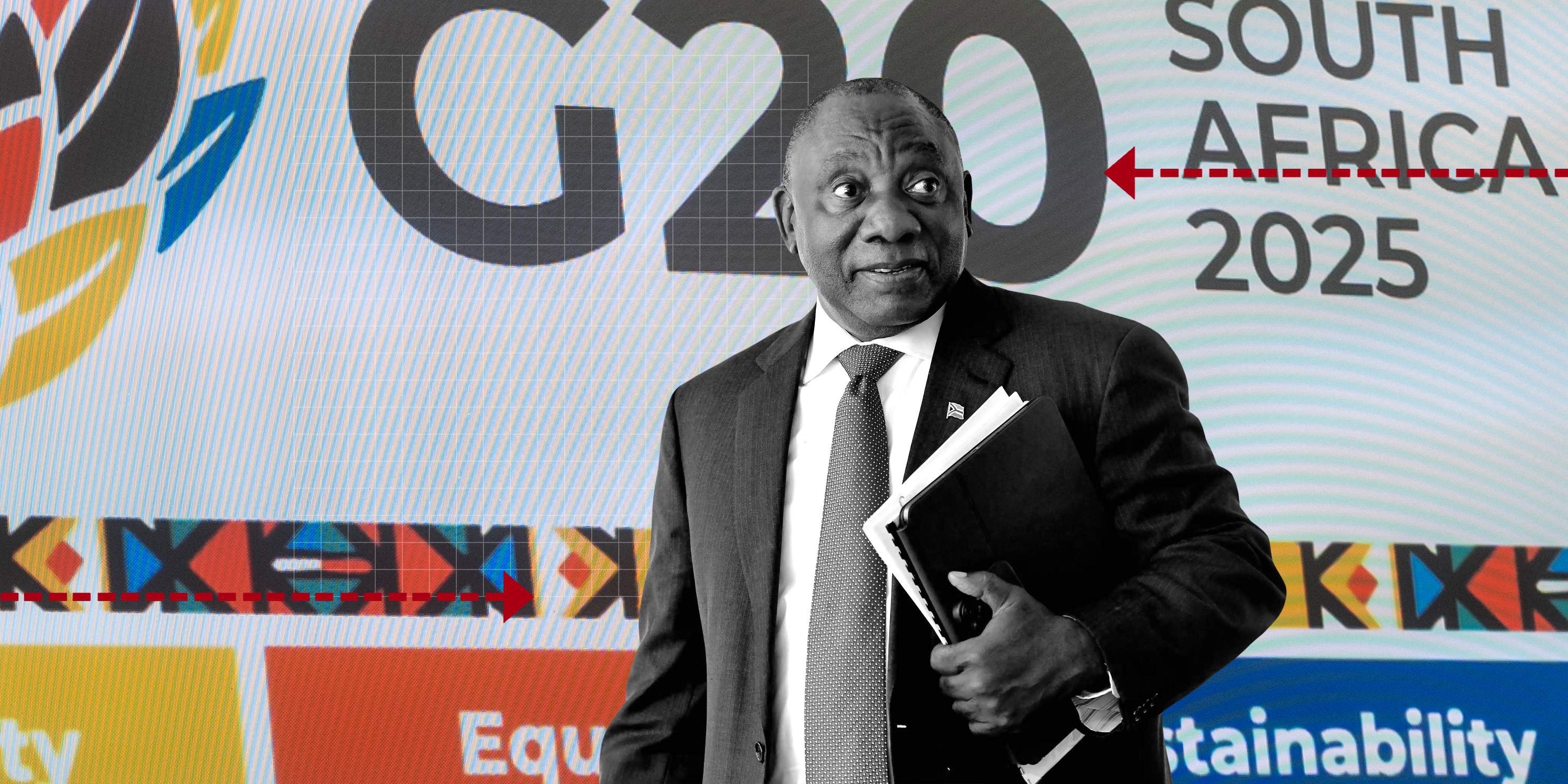
 Illustrative image: South African President Cyril Ramaphosa. (Photos: Brenton Geach / Gallo Images | Flickr / GCIS)
With the G20 Leaders’ Summit taking place in Johannesburg on 22/23 November, on African soil for the first time, South Africa has a unique platform, but also a unique test to turn diplomatic visibility into meaningful economic outcomes.
The global backdrop is sobering. According to the International Monetary Fund (IMF), emerging markets remain the primary engine of growth among G20 economies, yet many face rising debt burdens, fragile investor confidence and volatile capital flows.
Domestically, South Africa’s economy is beset; growth in 2024 ran at only 0.6% year on year. Unemployment remains deeply entrenched, with the official rate at 33.2% in Q2 2025, affecting about 8.4 million people. Youth unemployment (ages 15-34) is at 46.1%, and inequality endures, with the Gini coefficient forecast near 0.63. These realities frame the stakes: growth alone cannot deliver broad-based prosperity without deliberate policy alignment.
/file/dailymaverick/wp-content/uploads/Ed-AfricaDebt-1.jpg "Unemployed graduates from KwaZulu-Natal and Pretoria march to the Union Buildings in Pretoria. (Photo: Gallo Images / Phill Magakoe)")
In this context, the G20 presidency is not ceremonial; it is a lever for change. The challenge is to shift the narrative from one where developing economies are passive recipients of global rules to one where they are active authors of a fairer architecture.
Africa is central to this story. UN projections place the continent at 25% of the global population by 2050 and up to 40% by 2100, with 30% of global mineral reserves and 65% of arable land. These fundamentals create both responsibility and demand for leadership.
Economy
Domestically, the summit will deliver an immediate economic boost. Estimated direct tourism and service revenues are about R1.2-billion as delegates, media and support staff arrive. Hotels and conference facilities around Sandton are investing in upgrades, generating temporary jobs in construction, hospitality, logistics and catering.
/file/dailymaverick/wp-content/uploads/2025/10/GettyImages-2201450037.jpg "The G20 summit will deliver an immediate economic boost, but the question is whether this once-off gain can be turned into a lasting pipeline. (Photo: Dwayne Senior / Bloomberg via Getty Images)")
The bigger question is whether this one-off gain can be converted into a lasting Mice (meetings, incentives, conferences, exhibitions) pipeline and longer tourism stays. Achieving this will require coordinated public-private partnerships, supplier development and marketing anchored on local creative and service industries.
Trade and investment exposure magnify the stakes. Exports of goods and services represented 31.85% of GDP in 2024, with a heavy reliance on a few major partners: China, the EU and the US collectively absorb a large share of exports.
This concentration heightens vulnerability: shifts in G20 trade policy, supply chain incentives or protectionist measures translate directly into export earnings and manufacturing output. The composition of exports, dominated by mining, vehicles and agriculture, further deepens sensitivity to climate and trade policy changes.
For instance, the automotive sector remains a significant employer and export earner, and near-shoring debates in G20 countries could open opportunities if South Africa improves infrastructure, logistics and electricity reliability.
Foreign direct investment remains a critical channel for technology transfer and job creation. South Africa garnered around $661.5-million in FDI inflows in Q1 2025, yet volatility remains high. Coupled with projected gross government debt of about 77.4% of GDP in 2025/26, fiscal space is constrained. Access to concessional finance, strategic linkages between projects and policy credibility will determine whether the G20 presidency becomes a catalytic platform or merely a symbolic banner.
Energy and labour
/file/dailymaverick/wp-content/uploads/2025/11/5421750.jpg "South Africa now has a renewable energy project pipeline of around 117 GW at advanced stages of development. (Photo: EPA / Nic Bothma)")
Energy reliability is a foundational constraint. Load shedding undermines competitiveness and deters investment. Yet South Africa now has a renewable energy project pipeline of around 117 GW at advanced stages of development. This pipeline exceeds earlier targets and signals the potential for a green industrial transition, provided transmission, storage and grid flexibility are addressed.
The G20 platform gives South Africa standing to argue that decarbonisation in the global South should be supported via concessional finance, not penalised by higher borrowing costs. Africa contributes less than 4% of global emissions, but bears a disproportionate climate burden.
Labour markets remain a pressing challenge. With unemployment at 33.2%, youth unemployment at 46.1%, and inequality so entrenched, growth alone will not deliver inclusive prosperity.
The G20 agenda must pair trade and investment strategies with reskilling programmes, apprenticeships and place-sensitive social protection. For coal or energy-intensive regions, a just transition framework must combine income support with retraining for green jobs, alongside local industrial anchors to absorb workers.

Creative economy and continental integration
Beyond factories and energy infrastructure, narrative and cultural influence are essential. Africa’s creative economy – film, music, digital content and culture – already contributes tens of billions to GDP and employs millions.
Platforms such as the African Export Import Bank’s Creative Africa Nexus illustrate how cultural capital underpins soft power, investment and diversification. South Africa’s G20 year should therefore promote “more than minerals”: the creative, tech and digital sectors that shape global perceptions and attract venture capital.
/file/dailymaverick/wp-content/uploads/2024/07/ED_458415.jpg "Attendees during the African Continental Free Trade Area Awareness Workshop in Cape Town on 7 July 2023. (Photo: Gallo Images / Misha Jordaan)")
Continental integration via the African Continental Free Trade Area (AfCFTA) is another key opportunity. Africa’s GDP, roughly $2.8-trillion in 2025, remains smaller than India’s $4.2-trillion or China’s $19.2-trillion, and intra-African trade remains underdeveloped. By aligning G20 priorities with AfCFTA infrastructure corridors, regulatory harmonisation and skills exchange, South Africa can transform this presidency into a stepping stone for continental integration and deeper value chains. Mobilising the African diaspora, knowledge networks, capital and entrepreneurship are equally critical.
Technical assistance
Institutionally, South Africa’s involvement in G20 working groups brings technical assistance on tax administration, digital governance and crisis preparedness. Aligning with global minimum tax rules, ESG standards and anti-money laundering regimes enhances investor predictability. But compliance costs, especially for SMEs, are significant. Domestic policy must ensure phased implementation, advisory support and capacity building to protect local firms while enabling global market access.
Risks are real: protectionist backlash abroad, domestic governance weaknesses, energy unreliability and social resistance to rapid transitions could derail potential gains. Domestic policy priorities must therefore be sharply focused: accelerate energy system and logistics reforms; design industrial policy for green value chains and local content; structure fiscal planning to channel concessional global finance into both social and capital investment; and deploy comprehensive worker transition programmes in regions facing structural job losses.
South Africa’s G20 presidency is more than symbolic. It is a leadership test at the intersection of moral authority and economic necessity.
If we convert summit diplomacy into credible project pipelines, translate visibility into investor confidence and align international finance with domestic reform, we can redefine Africa’s role in global governance. Failure would leave the presidency as another footnote rather than a turning point in the continent’s economic trajectory. The opportunity is extraordinary, but it will only yield enduring results if action is deliberate, sequenced and inclusive. DM
Dr Alex Malapane is the CEO of the Market Intelligence Barometer Research Entity. He writes in his personal capacity.
Prof Shamila Singh is the CEO of Sustainability Consult. Her career spans academia, policy development and strategic advisory roles across southern Africa, including South Africa, Zimbabwe, Swaziland, Lesotho, and the Democratic Republic of Congo.
Sele Yalaghuli is the former Democratic Republic of Congo minister of finance and is currently a Senior Fellow Researcher at the University of Johannesburg.