




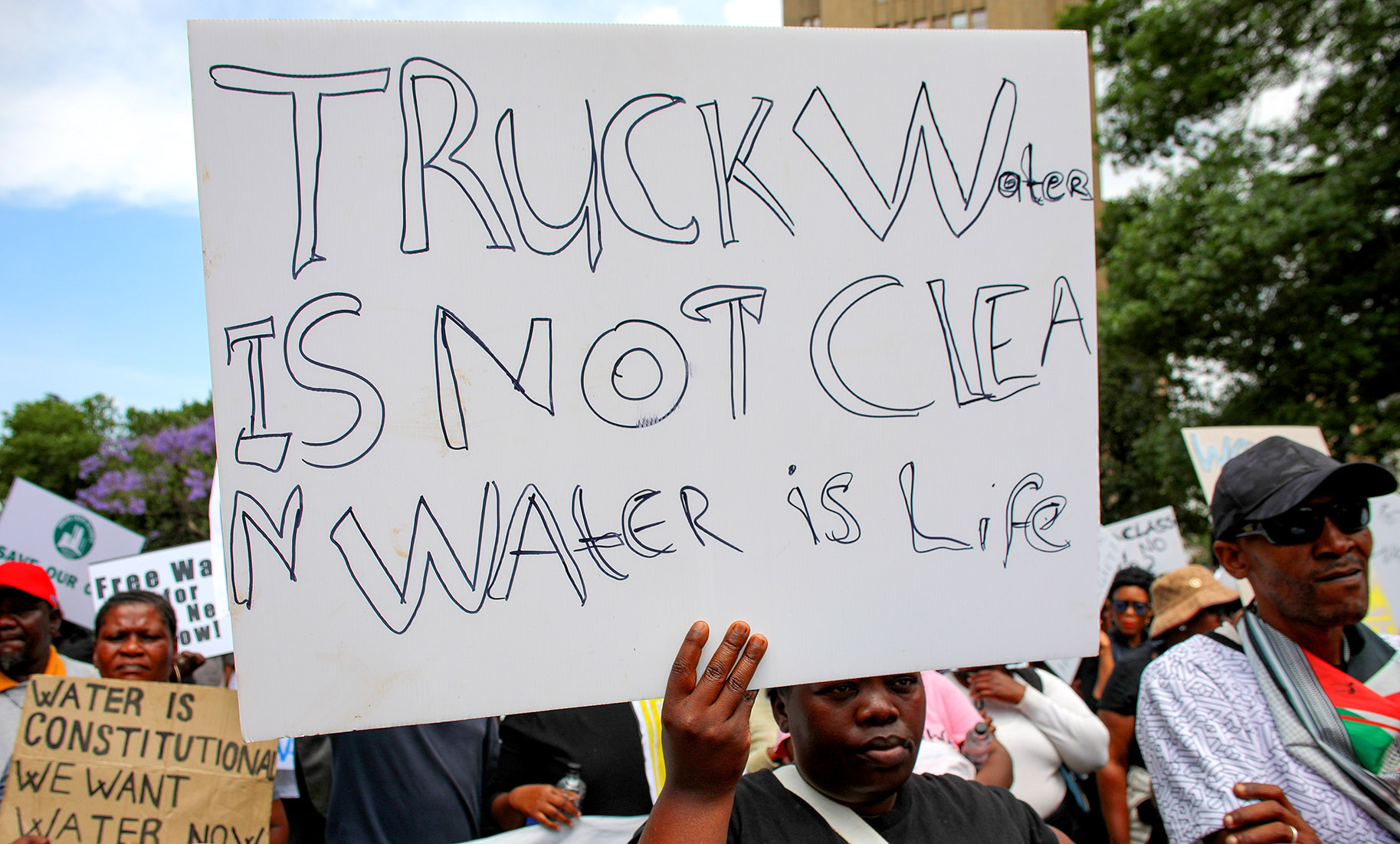
 Johannesburg residents protest against the water crisis outside Johannesburg Council Chambers on 1 November 2025. Thy demanded an urgent action to end what they describe as a ‘human rights and economic emergency’ caused by the worsening water crisis. (Photo: Fani Mahuntsi / Gallo Images)
As Johannesburg rolls out the red carpet for G20 leaders, thousands of its own residents are without water daily. The contrast could not be starker: our government is spending close to R1-billion for a global summit in Sandton while nearby informal settlements and suburban residents alike cannot get a single bucket of clean water.
The executive mayor, Dada Morero, should be leading from the front on this crisis. Instead, he has failed to respond to questions sent to his office nearly a month ago — including two weeks before the 1 November 2025 Joburg Water Protest outside the council chambers. When thousands of residents protest peacefully to demand answers and ring-fenced water funding, silence from the mayor is not just disrespectful — it borders on contempt.
And it is the local government he leads that has seen the debt of Johannesburg Water surge past R1-billion. What was R666-million owed to 203 contractors in September ballooned to R1-billion by the end of October, including R851-million owed specifically to Rand Water.
Behind those numbers are broken contracts, halted services and families who turn on a tap and get nothing. In the Rand West Municipality, water to residents has been shut down due to a R1.4-billion debt owed to Rand Water. People are having to pay the price for the government’s failure.
The G20 theme may be “Solidarity, Equality, Sustainability”, but for Johannesburg residents those words are empty if they do not start with water — Water Solidarity, Water Equality, Water Sustainability.
Read more: Dry taps and empty promises — Joburg’s water crisis and the stench of political failure
In the past week, WaterCAN has been contacted by activists and residents who report critically low water supplies, unfilled community tanks and, in some areas, a complete collapse of water delivery. Contractors responsible for filling tanks and maintaining infrastructure simply have not been paid. When that happens, services stop. When services stop, people suffer.
Pensioners living on the second floor in apartment buildings cannot flush their loos, parents need to buy bottled water to care for their children, while hair salons and restaurants cannot trade.
Meanwhile, our most vulnerable residents living in informal settlements such as Nana’s Farm, Pumla Mqashe and Jacksonville face serious health risks due to the lack of water and poor sanitation.
/file/dailymaverick/wp-content/uploads/2025/06/DSC_0930.jpg "Residents fill buckets with water from Johannesburg Water tanks in Phumla Mqashi informal settlement, Lenasia South. (Photo: Julia Evans)")
This is what financial and infrastructure mismanagement looks like on the ground.
Every single community in Johannesburg is affected by this crisis. Our protest on 1 November showcased this.
No cringeworthy glossy public relations videos, which has bizarrely been the City’s response to the crisis, can quench one’s thirst.
Mayor Morero and his political opponents have surely realised that the water crisis is the number one issue in the city. It will be the defining issue of the City’s mayoral race in 2026, and it will continue to dominate the social and political discourse for years to come.
And yet, as the crisis deepens, the political focus is elsewhere. With less than a week before the G20 Summit, Johannesburg is rushing to clean streets, plant trees, polish security plans and impress visiting dignitaries.
Read more: Pipeline to disaster — how Joburg’s water supply crisis began 25 years ago
Money is always found for lavish projects such as the G20, but our repeated, legitimate and rational request to the City to ring-fence revenue for water and sanitation services is ignored.
When money intended for maintaining pipes, paying contractors, repairing pumps and safeguarding water quality is diverted to plug other budget holes or fund prestige projects, the system collapses first where people have the least power and the weakest legal protection.
We need clear rules that:
- Revenues from water and sanitation stay in the water system.
- Loan funds are traceable from disbursement to final project delivery.
- Contractors are paid on time so that basic services are not disrupted.
- Communities can see — in plain language — where every rand has gone.
WaterCAN is therefore calling for immediate action on the nine demands that were submitted to Mayor Morero, which include: full transparency of the City of Johannesburg’s finances and its management of the sweeping account; urgent payment of outstanding contractor debts; restoration of water services to all affected communities; and a comprehensive, independent investigation into financial mismanagement within the City’s water units.
These are not radical demands. They are the minimum steps required to halt a humanitarian crisis that is already unfolding.
Johannesburg has a choice. It can continue to treat water as a line item to be raided when politically convenient — or it can ring-fence and protect it as the lifeline it really is. Global leaders will come and go. The people of Johannesburg will still be here tomorrow, opening their (empty) taps. DM
Dr Ferrial Adam is the executive director of WaterCAN. The Water Forum is a coalition of civil society activists for water justice in Johannesburg.
To report a leak contact your ward councillor or report the leak to Joburg Water:
Online: jwfaultlogging.jwater.co.za
Call Centre: 011 688 1699 / 086 0562874
SMS: 45201
Email: customerserviceemails@jwater.co.za or fault@jwater.co.za