




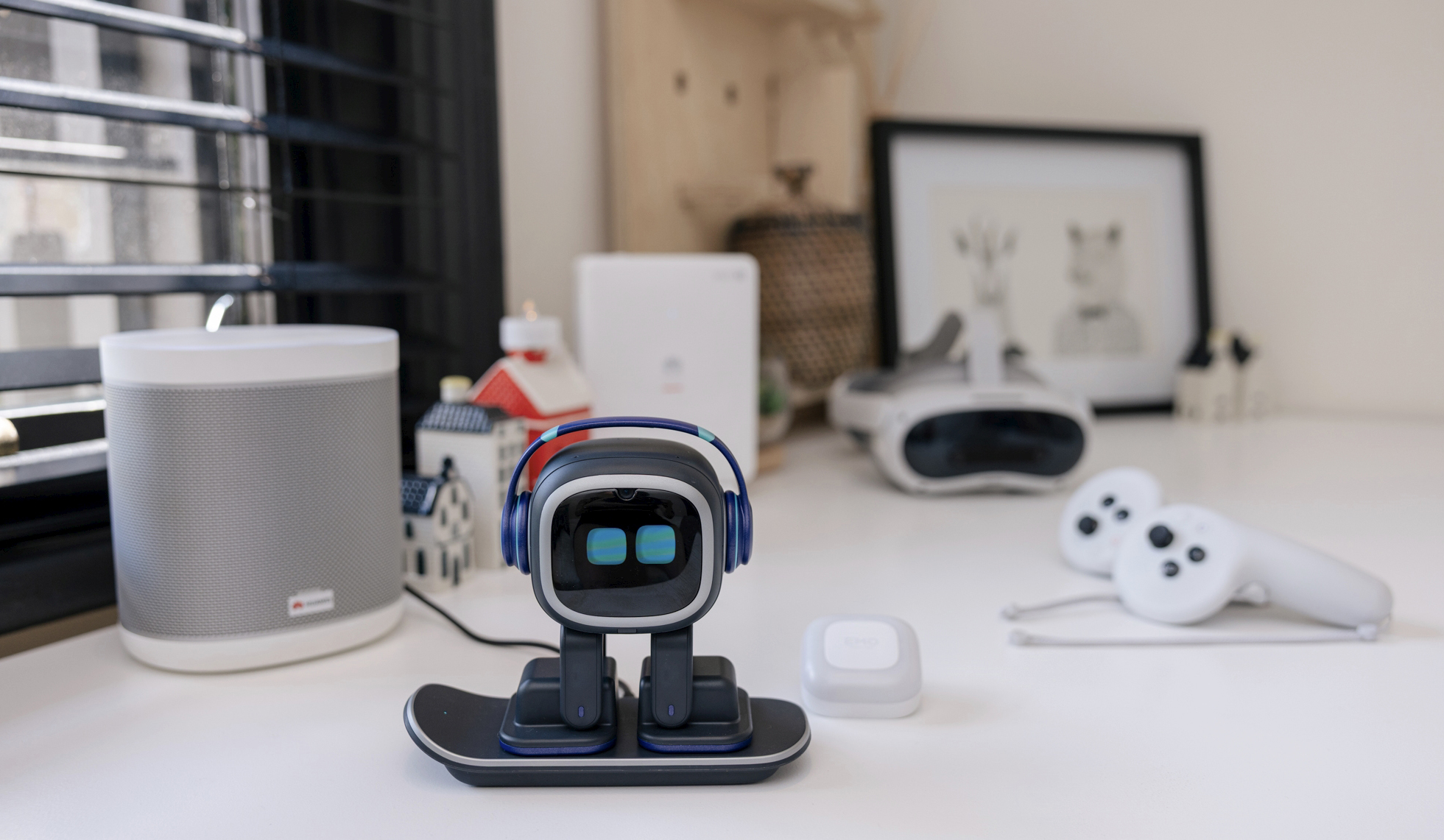
 Huawei puts FTTR at the heart of home and SME connectivity at AfricaCom. (Photo: Supplied)
 According to the Plentify web app, the HotBot connected to our geyser saved me R12 on my electricity bill yesterday. I have it intelligently programmed to provide hot water at 5am and 5pm each day, and it even accounts for load shedding schedules. That’s what technology is supposed to do: make life easier and help save (or make) money.
/file/dailymaverick/wp-content/uploads/2025/11/IMG_20250520_164722_edit_288443277616528.jpg "Plentify partnered with smart meter providers Conlog earlier this year to help South Africans better control their geysers (HotBot) and optimise solar panels (SolarBot). (Photo: Lindsey Schutters)")
For the first time in a while, Africa Tech Festival turned back to consumers and provided the backbone for the smart lifestyle that has been promised for more than a decade.
While the conference halls hummed with AI hyperbole, the real story was happening in the infrastructure announcements that few seemed to notice.
Openserve’s commercial launch of SA’s first Fibre-to-the-Room (FTTR) solution, in partnership with Huawei, might not have the sexy appeal of generative AI, but it’s the spine upon which actual smart home muscle – not the perpetually “five years away” digital assistant fantasy variety – can finally be built.
The connectivity problem nobody wants to talk about
Here’s some home networking real talk: your Wi-Fi is trash. Not because you bought the wrong router, but because the entire architecture of home networking has been built on compromises and half-measures.
Traditional mesh Wi-Fi systems and extenders promise whole-home coverage, but they’re never the true answer. Customers paying for 100Mbps fibre often limp along at 30-50Mbps in their bedrooms, victims of copper’s limitations and Wi-Fi’s inherent degradation over distance and through matter. It’s a growing pain in modern digital living that we’ve collectively decided to accept as normal.
FTTR flips this model entirely. Instead of dragging a fibre connection to your front door and then reverting to Victorian-era tech, it extends flexible translucent fibre along walls into every room. Each room gets a slim access point delivering a 2.5Gbps LAN network, not the gigabit that even Ethernet struggles to maintain.
Openserve rolled out a customer for Daily Maverick to interrogate, and he told us that: “The fibre to the room has made a huge difference for me,” particularly for running a business from home and managing security cameras.
The system can handle more than 100 devices simultaneously without performance degradation, critical in an era where your fridge, doorbell and light switches all demand bandwidth.
As Openserve rightly notes, connectivity is no longer just about having fibre connectivity in the home: “It’s about the quality of experience in every room on every device and at any time.”
Show me the money
But infrastructure alone doesn’t justify the smart home. For all the promise of voice-controlled curtains and AI-powered kettles, South African consumers need technology that solves immediate, tangible problems. Enter the smart geyser controller.
Plentify’s HotBot represents the rare intersection of smart home technology and actual return on investment. While full home automation appeals only to the country’s vanishingly small upper-income segment, a device that slashes electricity bills addresses a common pain point.
The local startup has managed close to 100MWh of water heaters and batteries, collectively saving South African households more than R40-million on their energy bills. It’s not revolutionary, it’s simply making the energy we already produce work smarter.
Jon Kornik, CEO and co-founder of Plentify, has a thesis about why the South African smart home market has lagged behind global trends. When Daily Maverick asked about local innovation challenges, he cut through the usual handwringing about skills shortages.
“I wouldn’t say that this is a skills problem. SA has very talented engineers. I would say it boils down to a limited ecosystem, product market fit, and availability of venture funding.”
A former Google employee, Kornik sees the ecosystem problem as particularly galling. “If you look at how other major smart home markets have evolved, they typically started with smart speakers, the interface to the smart home,” he explained.
“But Google still doesn’t sell its Nest speakers in SA (they are only available through parallel import at inflated prices) and Amazon’s Alexa only arrived in the last couple of years.”
The product-market fit issue is even more fundamental. “Those that have focused on pure automation have struggled to find a large enough market in SA, with products appealing only to our country’s very small upper-income segment,” Kornik says. “By contrast, products like HotBot solve a pervasive pain point for most South Africans – high electricity bills (and in the days of load shedding, cold showers).”
It’s a lesson in pragmatism that many tech companies would do well to absorb: solve actual problems before chasing science fiction fantasies, and one that contributed to an oversubscribed Series A funding round and nearly $15-million in capital raised by Plentify to date.
The wireless holdouts
But not everyone is convinced that optical fibre is the future of home connectivity. Nokia, a major player in consumer networking, has doubled down on wireless mesh solutions, positioning its “beacon solution” as the economically sensible path forward.
When asked about internal fibre deployments like FTTR, Jan Liebenberg, Nokia’s chief technology officer for network infrastructure in southern and eastern Africa, was quite direct: “We don’t manufacture fibre.” Its focus remains squarely on wireless mesh for consumer markets, viewing it as “the most economic solution to actually deploy”.
Nokia reserves fibre-based deployments – what it calls passive LAN – for enterprises or businesses, suggesting a fundamental disagreement about whether consumers will pay for infrastructure that delivers consistent performance over convenient-but-compromised solutions.
/file/dailymaverick/wp-content/uploads/2025/11/IMG_20250813_094530_1-1.jpg "Nokia is the chosen router supplier for Fibertime. Alan Knott-Craig explained that he chose them because of better reliability and data security. (Photo: Lindsey Schutters)")
It’s a bet that history may not look kindly upon, but has served it well in a partnership with Alan Knott-Craig’s Fibertime. As bandwidth demands continue to explode, 4K streaming, remote work, cloud gaming, multiple simultaneous video calls – the physics of wireless will increasingly become a bottleneck.
Read more: Walking the township fibre fault line with Alan Knott-Craig
Fibre doesn’t degrade, doesn’t suffer interference and doesn’t care how many devices are competing for spectrum.
The unglamorous revolution
There’s an irony in Africa Tech Festival 2025 being remembered for infrastructure announcements rather than the latest AI demo. But perhaps that’s fitting.
Real technological progress isn’t about flashy algorithms or virtual assistants that can generate mediocre poetry. True innovation is still about solving the fundamental problems that make other innovations possible.
FTTR provides the backbone. Smart geyser controllers provide the immediate value proposition. Together, they present something actually resembling the smart home future we’ve been promised since the early 2010s. DM