




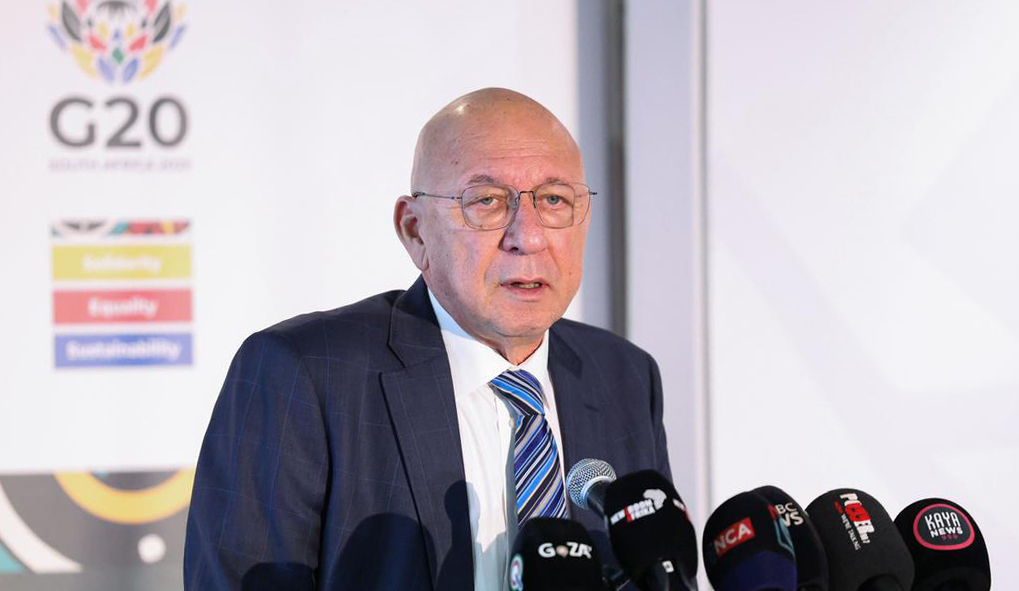
 Former finance minister Trevor Manuel at the second G20 Social Summit at the Birchwood Hotel and OR Tambo Conference Centre, Ekurhuleni, on Tuesday, 18 November. (Photo: Elmond Jiyane/GCIS)
 Against the backdrop of mounting concerns about the rising levels of African debt, a panel of experts on Tuesday presented a report calling for the G20 countries and the International Monetary Fund (IMF) to adopt sweeping measures to refinance debt.
Debt sustainability is one of the key areas that South Africa has prioritised in its G20 presidency, and the report, composed by experts including former finance minister Trevor Manuel, has teeth.
“This proposal would focus on refinancing rather than rescheduling debt obligations,” said the report, released ahead of the G20 Leaders’ Summit in Johannesburg this weekend.
“Sovereign debt has once again emerged as a critical obstacle to development in Africa. Where debt is clearly unsustainable, it must not be allowed to linger and poison the prospects for development.”
The proposals include funding the initiative through the use of special drawing rights at the IMF or the sale of the IMF’s gold, which is currently in record territory, at more than $4,000 an ounce.
Indebted countries should also form a borrowers’ club to present a united front and make their voices heard.
“Its primary mandate would be to strengthen debtors’ voices in negotiations on reforms to the international financial and debt architecture,” said the report.
What this means
Many African countries are burdened with crippling levels of debt that threaten their capacity for economic development and the provision of public services. Addressing this is key to unlocking capital for much-needed investment in productive infrastructure. This initiative moves beyond debt forgiveness, and measures like tapping IMF gold are a masterstroke.
The report also took aim at ratings agencies that assess sovereign credit risk.
“The G20 can help ensure that rating agencies’ methods are sound, their sources are fully disclosed, and their actions are subject to regulatory oversight,” said the report.
It also called for a sharper assessment to separate liquidity and solvency issues.
The time for action has clearly come as Africa is once again sitting on a ticking debt bomb.
“Debt servicing costs have reached unprecedented levels, crowding out vital spending on health, education, climate adaptation, and other development priorities. According to UNCTAD [UN Trade and Development] and the World Bank, public debt in developing countries surpassed $31-trillion in 2024, with debt service costs rising by over 10% in a single year,” said the report.
“Globally, more than 3.4 billion people live in countries which spend more on servicing debt than on education or healthcare.”
According to the World Bank’s latest biannual Africa’s Pulse report, “the risk of sovereign debt distress in Sub-Saharan Africa remains elevated.
“The number of countries in debt distress or at high risk of debt distress has nearly tripled — from eight in 2014 to 23 in 2025 — representing 49 percent of the region.” DM