




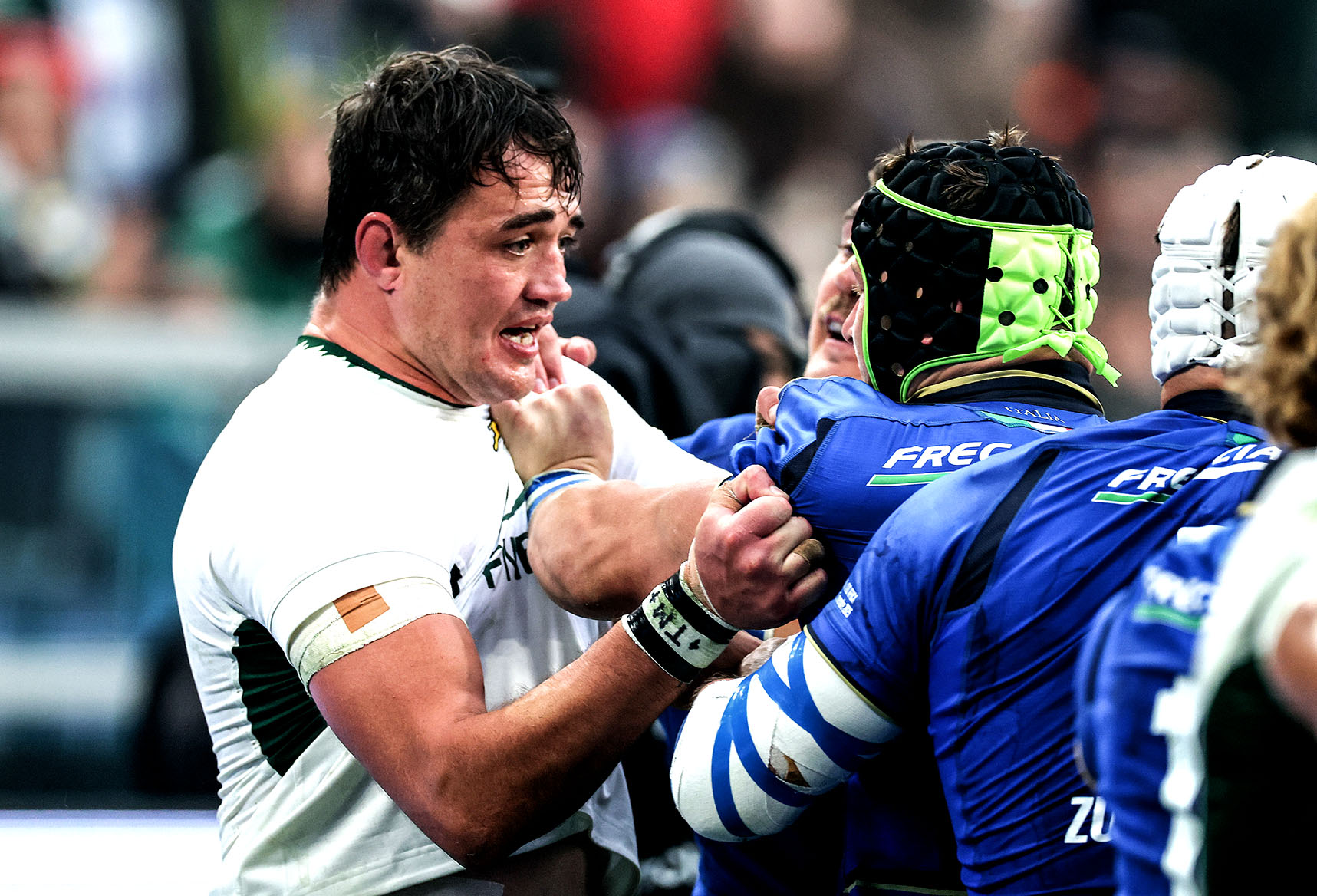
 Bok lock Franco Mostert, left, has an altercation with Ross Vintcent of Italy at Allianz Stadium on 15 November 2025 in Turin, Italy. (Photo: Alessandro Sabattini / Getty Images)
Springbok coach Rassie Erasmus cut a frustrated and confused figure during a post-match media conference following his team’s 32-14 win over Italy in Turin.
For a second week running the Boks were forced to find a way with 14 men on the field. Lock Franco Mostert was red-carded by referee James Doleman for a “dangerous” tackle on Italy flyhalf Paolo Garbisi. The incident took place in the 11th minute and the Boks were forced to play almost a full game, a man down.
Watching the incident again, it’s frankly amazing that the officials reached the conclusion they did.
The two-metre tall Mostert set himself low to make the tackle. He is almost doubled at the waist. An instant before he drives into the tackle, with textbook head-on technique, by squaring shoulders to hit the target before wrapping arms, Bok centre Ethan Hooker hits Garbisi on the hip with a low tackle from the side.
Even so, Mostert, who has a split second to react, drives his shoulder into Garbisi’s chest. The Italian’s head, under the force of almost two simultaneous blows from two men weighing more than 100kg, whips, which makes it look worse.
Play goes on, Garbisi gets up as do the two Boks. Moments later French television match official (TMO) Tual Trainini alerts Doleman to potential foul play.
Initially, the on-field officials think it might meet the yellow-card threshold, which is strange as the initial contact by Mostert is clearly on the chest (see image).
/file/dailymaverick/wp-content/uploads/2025/11/pic.jpeg "Franco Mostert tackles Italy flyhalf Paolo Garbisi, clearly making contact below his head. (Photo: Screen grab)")
But with additional urging from the TMO, they decided Mostert did not wrap his right arm in the tackle and therefore it’s a straight red card.
Mostert’s arm was unable to wrap as Hooker’s body blocked it. And even so, there was no direct head contact.
However, Doleman said: “The TMO has confirmed there is clear head contact.” That is just patently wrong. The initial contact was on the chest and shoulder. And because they deemed Mostert did not “attempt to wrap his arm”, they would “not apply any mitigation”. Straight red. Staggering.
The consistency in these decisions is what is really the most frustrating. Across several Test matches at the weekend there were similar, if not, worse looking incidents that were either just a penalty, or a yellow card.
Bunker?
One of many questions this incident has raised is: What is the point of the foul play review system, known as the bunker, if referees won’t use it?
“I always thought we wanted to get to 20-minute red cards and have a re-check on that. I thought it’s the way to go, but it’s not my place to talk about it,” Erasmus said.
Although the Bok coach tried his best to be diplomatic, he was clearly angry, especially as Siya Kolisi and Marco van Staden had been the victims of an earlier shoulder to the face that looked worse.
Dealing in “whataboutism” is futile after the fact but it does raise the point of consistency.
“I’m not saying the referee made the wrong call, but I definitely saw a lot of other shots in the game where the first tackle he took was right against the head,” Erasmus said, suggesting the referee made the wrong call.
“It’s tough. I’m not saying anybody was wrong, I just thought the balance on calling the headshots wasn’t as equal.” Somebody was wrong.
Doleman did not even consider sending the incident to the bunker because under pressure from the TMO, in front of 40,000 booing and hissing Italian fans, he convinced himself it was a straight red.
One of the reasons the bunker was introduced was to allow referees to refer and defer a decision, and pass it on to another official in a much calmer environment to assess incidents.
The introduction of the bunker was a proactive step by World Rugby, in a genuine effort to combine player welfare with fairness.
So, a decision needs to be made in the interests of keeping the integrity of the game balanced.
/file/dailymaverick/wp-content/uploads/2025/11/2246811554.jpg "Bok coach Rassie Erasmus. (Photo: Alessandro Sabattini / Getty Images)")
A possible solution would be that all potential red cards should be referred to the bunker. That means the official in the bunker will have the added power to award a permanent red card, and not just a 20-minute red.
Even a blatant punch or kick to the head should be referred to the bunker. If it’s that blatant, it will take the official very little time to assess a permanent red card.
In cases such as Mostert’s, which are far more complex and nuanced, he has 10 minutes to make the assessment with three options — a yellow, a 20-minute red, or a permanent red.
In the meantime, the game continues instead of a five-minute on-field debate between four officials in a frothing atmosphere.
The bunker is not infallible. A few weeks ago, the official in the bunker upgraded Ireland lock Tadhg Beirne’s yellow to a red for a dangerous tackle on All Black Beauden Barrett.
A few days later a disciplinary panel rescinded the red card, effectively overruling the bunker decision, mainly due to Barrett’s testimony in support of Beirne.
Still, it’s rare that a bunker review is overturned, and it’s a far more balanced way of reaching a crucial decision.
Confusion
The other aspect that is coming to the fore is that players and coaches are confused.
The Boks have done a massive amount of physical work to ensure players are able to change body height quickly to meet World Rugby’s mandate for lower tackling heights.
Head of athletic performance Andy Edwards has overseen special sessions on lower back and hip flexor mobility to ensure even the biggest men can change height quickly.
The Boks started that physical work in earnest before the 2023 World Cup.
Both red cards in the past two weeks, committed by locks Lood de Jager and Mostert, saw both giants low in the tackle. In fact, the 2.06-metre De Jager had one knee on the ground and was still guilty of a high tackle on the 1.78-metre Thomas Ramos, who was on his knees.
/file/dailymaverick/wp-content/uploads/2025/11/2245862565.jpg "South Africa lock Lood de Jager received a red card from referee Angus Gardner this hit on Thomas Ramos of France at Stade de France on 8 November, 2025 in Paris, France. (Photo: Lionel Hahn / Getty Images)")
/file/dailymaverick/wp-content/uploads/2025/11/2246814810.jpg "Edwill van der Merwe of South Africa is tackled by Monty Loane of Italy at Allianz Stadium. (Photo: Alessandro Sabattini / Getty Images)")
/file/dailymaverick/wp-content/uploads/2025/11/2246824436.jpg "André Esterhuizen of South Africa passes the ball in the tackle in Italy on Saturday. (Photo: Alessandro Sabattini / Getty Images)")
Erasmus lamented the situation, not unreasonably asking what more he, as a coach, could do?
“Losing two five-locks in two games for not going lower than they can is tough to understand,” Erasmus said. “We don’t know how to coach guys any different — we’re really in a fix. For a two-metre tall guy and a 2.06-metre guy to go lower than a guy on his knees, it’s tough.
“We are a very proud team in the way we do level changes to try to avoid head contacts, and we’ve received just so many red cards. Makazole Mapimpi got six weeks, and we are really trying hard because it’s not just those guys who suffer, and the game that suffers.
“I mean we beat Italy with 14 men, it’s an embarrassment for them. But we know they are a good team, even if we were at 15, we were going to start to struggle.
“For the referee, he doesn’t have slow motion and all the things that happen there. He trusts very much on the team, and I think it was two French TMOs or a TMO and the one AR (assistant referee), I’m not 100% sure.
“We did get better, but individuals suffer in big moments and things that they can celebrate, and that makes us tighter as a team and makes us more desperate, but it doesn’t take the hurt away.” DM