



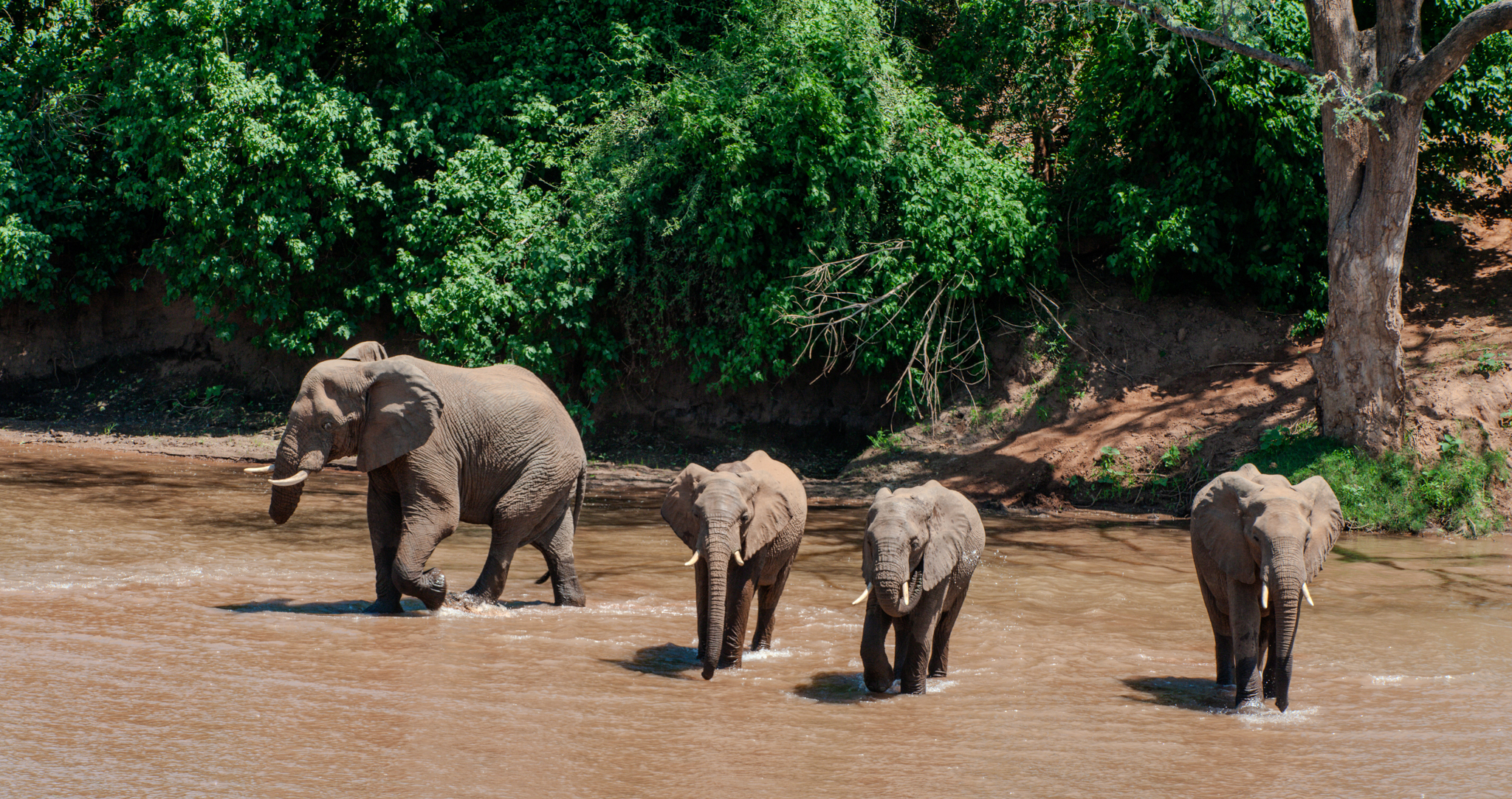
 The combination of rising elephant numbers and declining large trees in SA’s Associated Private Nature Reserves has led to heated debate. (Photo: Don Pinnock)
Elephant populations in South Africa’s Associated Private Nature Reserves (APNR) are placing increasing pressure on large trees, sparking fierce debates among those who live with, study and visit them.
According to new research led by a team from the University of the Witwatersrand and Elephants Alive, elephant numbers in the APNR rose from around 500 in 1993 to as many as 3,000 today, partly because of the region’s unusually high density of artificial waterholes. These water sources keep elephants concentrated in specific areas, increasing tree damage.
/file/dailymaverick/wp-content/uploads/2025/11/Gona-6-image-Gonarezhou-Conservation-Trust.jpg "An elephant bull forages in one of the woodland areas where taller trees have been pushed down or shortened by feeding elephants. (Photo: Gonarezhou Conservation Trust)")
“The combination of rising elephant numbers and declining large trees has induced the development of proposed management plans,” the researchers explain.
They surveyed 170 stakeholders – including conservation managers, property owners, tourism operators and tourists – on how best to balance elephant numbers with the conservation of large trees.
The findings, published in the European Journal of Wildlife Research, highlight deep divisions over strategies such as waterhole closures, tree protection methods, contraception and culling.
Large trees provide more than scenic value. As the researchers note, they recycle nutrients, offer shade, host bird nests and create habitats for countless species. Yet elephants, as keystone megaherbivores, can damage and destroy them when populations are high.
Stakeholder voices
The survey revealed broad agreement that both elephants and large trees are vital for tourism and ecosystem health, but opinions diverged on how to manage the conflict.
Waterhole closures received strong support from conservation managers, particularly younger ones, who saw it as a natural way to disperse elephants. “Waterhole closure could encourage elephants to spread out, reducing pressure on specific areas,” one manager said. However, according to the study, tourism stakeholders were more sceptical, with 59% worried that fewer elephants at waterholes would mean fewer sightings for visitors.
Tree protection methods such as wire-netting or beehives were the most widely supported option, with 77% of participants in favour. Property owners in particular valued these techniques, describing large trees as “irreplaceable and essential for tourism appeal”. But the study notes that many questioned the feasibility of scaling up such methods across entire landscapes.
Contraception divided opinion. According to the researchers, tourists were the most open to contraception, seeing it as a humane option. Long-term stakeholders, especially property owners and managers with more than 10 years’ involvement, were more sceptical, citing cost, logistics and uncertainty about effects on elephant behaviour. One participant asked: “It sounds good in theory, but how practical is it in the wild?”
Culling was the most contentious measure. The study found that support came mainly from older stakeholders and men, many of whom had experienced the culling era in Kruger National Park between 1967 and 1994. Tourists overwhelmingly opposed it, calling it too harsh and damaging to conservation’s image. “Culling is too harsh; we should seek humane methods,” one tourist responded.
/file/dailymaverick/wp-content/uploads/2025/05/Serengeti-12-Edit-3.jpg "Elephant cow and her calf. (Photo: Don Pinnock)")
Generational divides
According to the study, age and experience played a significant role in shaping attitudes. Stakeholders over 50, who lived through the period when Kruger culled more than 14,000 elephants, were more likely to see culling as effective. Younger managers and tourists leaned towards non-lethal methods, reflecting what the researchers describe as “a generational shift toward compassionate conservation principles”.
Gender also influenced perspectives: men were significantly more likely to support culling than women. Meanwhile, residency length mattered too – those with longer ties to the APNR were more sceptical of newer methods such as contraception.
No single solution
The study concludes that no single strategy will satisfy both ecological and social goals. Instead, it recommends adaptive, context-specific management that blends ecological science with stakeholder values. According to the researchers, conservation managers can incorporate “stakeholder-specific preferences into an adaptive management plan, adjusting strategies based on evolving concerns and ecological needs.”
For instance, rotational waterhole closures might reduce tree damage while maintaining tourist sightings. Protecting high-value trees with mesh or beehives could safeguard icons of the landscape, even if every tree cannot be saved. And contraception, while logistically complex, might be applied selectively to slow herd growth without triggering ethical controversy.
Why it matters
The research underscores that conservation is no longer only about ecological thresholds – it is about social acceptability. According to the authors, “By understanding and respecting the values of diverse stakeholder groups, conservation strategies can be more adaptive, resilient and effective.”
In practice, this means engaging landowners, tourists and managers in dialogue, ensuring that management plans carry both scientific credibility and public support.
Ultimately, elephants and trees could both be winners in this story: elephants remain central to Africa’s ecological fabric, while large trees provide the shade, beauty and biodiversity that make protected areas thrive. The real challenge lies in how people choose to manage the balance between them. DM