




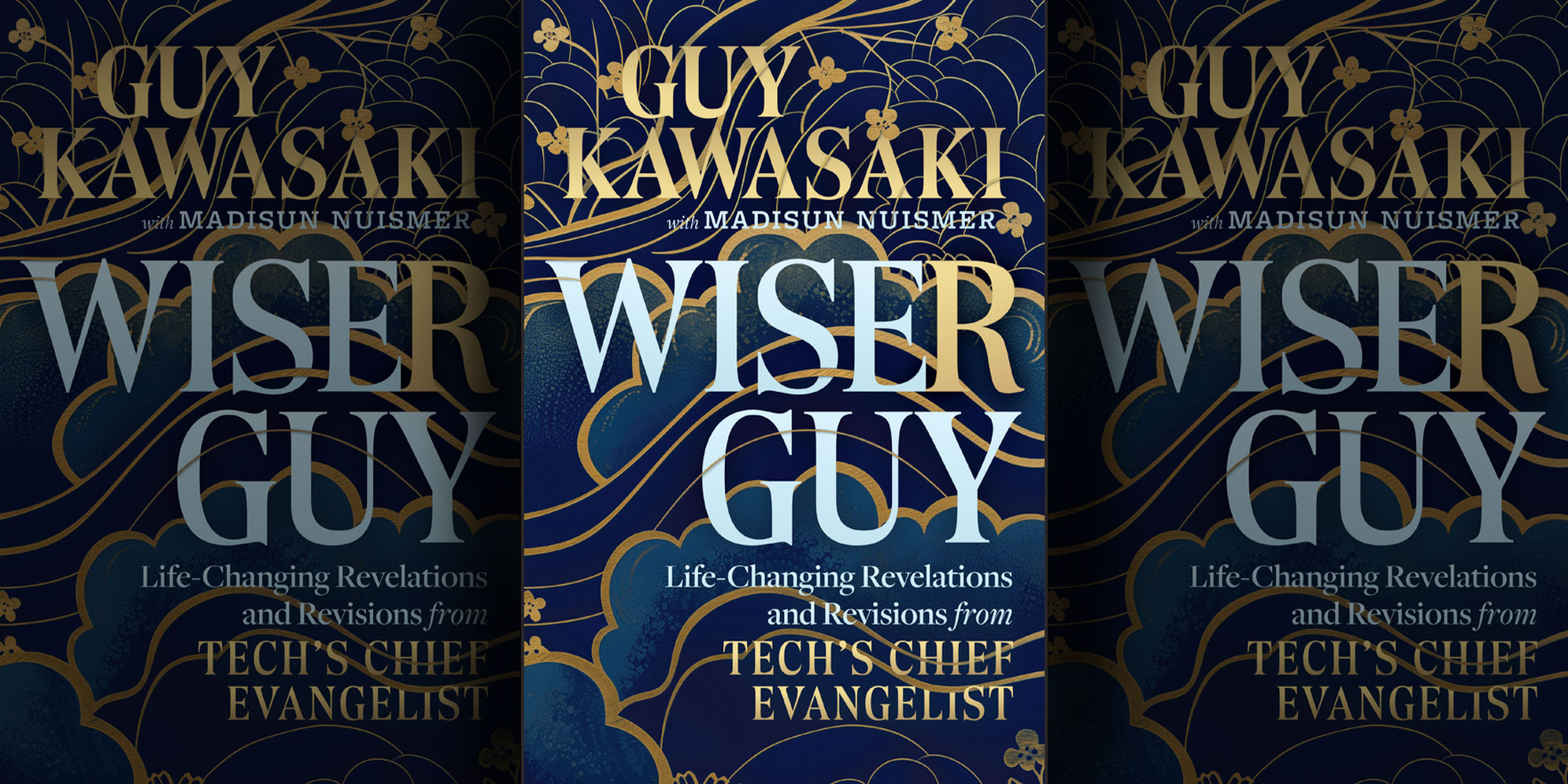
 Wiser Guy is a practical and inspiring guide that combines humour, humility and wisdom. (Image: Supplied)
 Whether you’re launching your career, building a company, navigating uncertainty, or simply striving to grow, Wiser Guy is a practical and inspiring guide that combines humour, humility and wisdom. This new edition is enriched by deep conversations with luminaries such as Jane Goodall, Angela Duckworth and Steve Wozniak. Here is an excerpt.
***
Jane Goodall, secretary
Remarkable people often recount their childhood experiences in order to explain where they ended up. For example, here is Jane Goodall reminiscing about her youth in the 1930s: “I used to roam on the cliffs with my dog, and that’s where I watched the birds and the squirrels, read Dr Doolittle, and I wished I could have a parrot to teach me animal language. And when I was eight, I pretended to all my friends that I could understand. I interpreted the dogs barking and the cats meowing and the birds singing.”
Jane Goodall’s family couldn’t afford to send her to college, so she attended secretarial school to learn how to type, take shorthand, and do bookkeeping. Jane traveled to Nairobi in 1957 because of her fascination with animals and Africa.
She met Louis Leakey, the British anthropologist who documented the origin of human beings in East Africa. It just so happened that Leakey’s secretary was leaving, so Jane could fill that position and remain in Africa.
In 1960, Leakey sent Jane to study chimpanzees living near a lake in Tanganyika. Jane’s fascination with chimpanzees began when she was in her mid‐twenties and lasted for 60 years. She proved that chimpanzees were not simply wild animals but were intelligent and highly social.
By 2023, Goodall had received honorary doctorates from more than 70 universities. She was a member of the National Academy of Sciences and the Royal Society of London. She was named one of Time Magazine’s 100 most influential people in the world in 2018, and in 2021 she received the Templeton Prize, given for achievements in scientific and spiritual curiosity.
Wisdom
Jane Goodall’s narrative is a masterclass in seizing opportunities. As a child she roamed cliffs with her dog and fantasised about communicating with animals and later became a pioneer in primatology. Her life demonstrates that true calling often finds us when we indulge our early interests.
What matters is not the path you start on. It’s about seizing serendipitous good fortune like filling in as Louis Leakey’s secretary and running with it. Just keep your eyes open, and never let go of your curiosity.
‘I have ALS. Why don’t I complete 50 marathons?’
In 2014, Andrea Lytle Peet was diagnosed with ALS, a degenerative nerve disease that destroys cells in the brain and spinal cord. Most people succumb to ALS within two to five years as they lose their ability to eat, breathe, walk and speak.
So far Andrea has survived for 11 years. Following her diagnosis, she had a brave idea: complete a marathon in all 50 states to defy the disease and to raise funds to find its cure. This is what Andrea Lytle Peet went through after learning of her ALS diagnosis: “I remember just after my diagnosis I was sitting in the car crying. I was so depressed, and I looked up and I just realised that I can be depressed, or I can live my life now. Time will pass the same way either way.”
She began her quest running on two legs but ended it in a recumbent trike. She achieved her goal in May 2022 in Prince of Wales Island, Alaska. Striving to complete 50 marathons after a diagnosis of a deadly nerve disease is the embodiment of embracing vulnerability and being inspiring.
Wisdom
To be blunt, sh*t is going to happen. You will face negativity, rejection, and even danger. People will tell you that what you want to do cannot be done, should not be done, and isn’t necessary.
Andrea Lytle Peet’s story is a profound example of resilience and the power of choice. After being diagnosed with ALS, she faced the grim statistics and decided to embrace bravery, defying expectations by completing marathons in all 50 states.
So “go on and be brave” (like the name of the movie about her) like Andrea. Her story teaches us that how we respond when life throws its toughest challenges at us defines our legacy.
From prisoner to painter
Halim Flowers had 22 years to prepare for his art career. In 1988, at the age of 17, he was convicted of aiding and abetting a felony murder. He was sentenced to two terms: forty years and twenty‐to‐life.
Halim grew up in Washington, DC, which was then known as the “murder capital” of the United States, with the highest homicide rate in the country. His father was a crack addict and few of his peers survived the drugs and crime.
In 2019, Halim was released after twenty‐two years and two months of imprisonment because of the passage of a law that enabled convicts to be re‐sentenced if they committed their crime before they were 18 and had served at least 15 years.
While in prison he became a peer counsellor, an activist and the author of 11 books. He enrolled in the Georgetown Prison and Justice Initiative to become a credit‐earning student at Georgetown University. He also served as a mentor in the Young Men Emerging unit inside prison.
Halim has exhibited at the Philips Theological Seminary, Nicole Longnecker Gallery, Moma PS1, and the National Arts Club in NYC. His art is for sale in the DTR Modern gallery in Georgetown, where he is the second black artist to be exhibited. The first was Jean Michel Basquiat — which is mighty fine company to be in.
He has sold more than $3-million of art through DTR Modern alone, and he’s started a nonprofit called Artonomics, an organisation that helps artists master the business of art by bridging creativity and commerce.
Wisdom
Halim Flowers exemplifies the concept of turning hardship into opportunity. What strikes me the most about Halim is his determination not to let external circumstances shape his identity or future.
Given his circumstances, society would have expected him to fall into oblivion, if not death. Instead, he turned his circumstances — even one as difficult as prison — into a catalyst for change, demonstrating that extraordinary people frequently have origins in significant hardships.
Consider Halim’s prison sentence as an unintended incubation period. He used those years to develop a rich inner life through reading, writing and mentoring. His ability to transition from a life of crime to one of art and advocacy exemplifies the power of preparation and opportunity. DM
Wiser Guy is published by Wiley. It is available for purchase at a retail price of R640.