




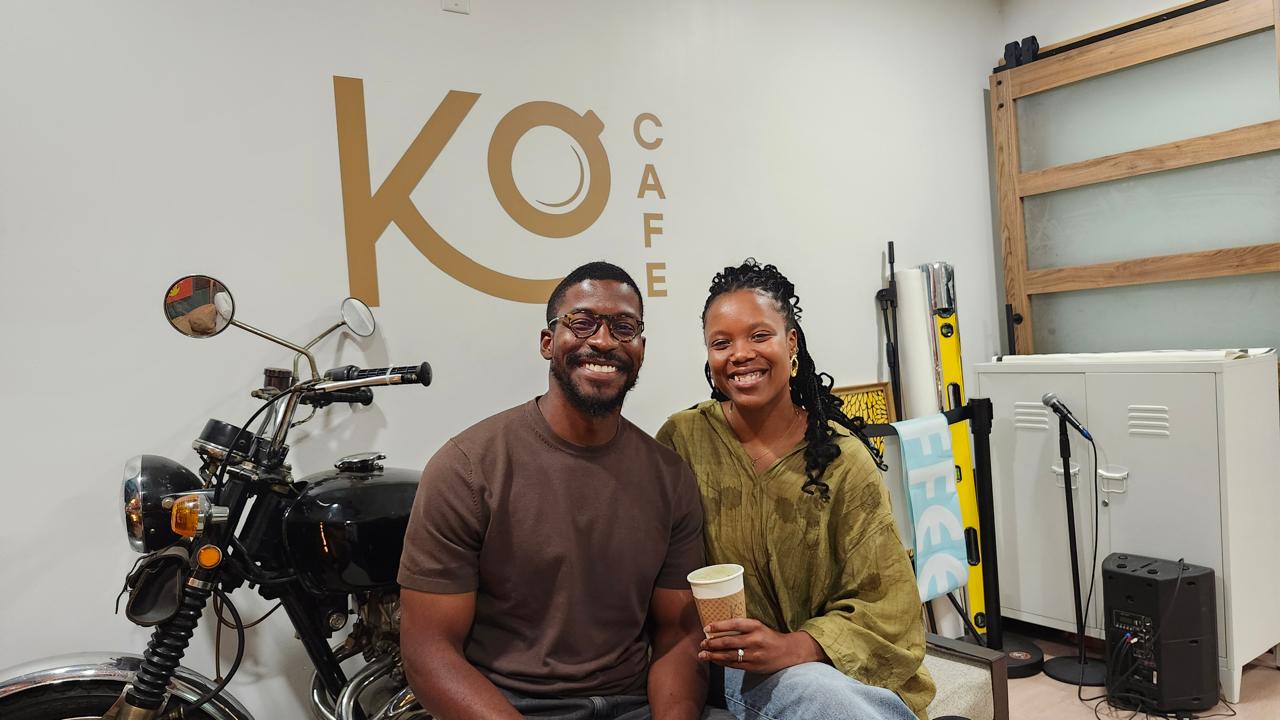
 Isreal and Lulu Adeyanju photographed at Ko Cafe in Jersey City, New Jersey. (Photo: Naomi Campbell)
 The modern coffee shop that your parents grew up loving serves your basic coffee flavours like black and French vanilla, the simple yet perfect grab-and-go order. But the shop serves more than coffee — it is a comforting, coming of age experience that transformed the traditional coffee shop. From new trends and flavour additives like matcha and embracing coffee origins from countries like Ethiopia, the 21st century coffee shop is a third space.
Ko Cafe in Jersey City is among the new wave of coffee shops redefining the coffee buying experience. The café is an interactive social and working hub for individuals seeking community, creativity, diversity, and of course, personalised coffee with a curated menu. It pays homage to the West African roots of the founders, including Ghana and Nigeria.
Pronounced “koh”, the word means, “to build” in Yoruba, a Nigerian native language, and “to go” in Twi, a Ghanaian native language translating to “build, grow, go”. Opened in February 2023, the café is described as a co-working space started by five family members and friends who consider themselves brothers — Isreal Adeyanju, Olubanwo Aruleba, Sam Osei Afriyie, Victor Adeyanju and Daniel Adeyanju.
“Our motto is ‘build, grow, go’,” said Isreal. “The café is an embodiment of that, but it’s also a platform for other ideas to flourish and grow.”
Isreal is the lead founder and CEO of the café. Born in Jamaica to Nigerian parents, his educational studies include a bachelor’s degree in economics and political science and master’s in industrial systems engineering. Using the team’s collective tech background, he was inspired to build a multipurpose space — a coffee shop.
“We know we had a strong team, but we’re all builders and connectors and so the through-line between all of us is this interest in building community and bringing people together, so building a coffee shop was no-brainer to bring all of those things together,” said Isreal.
At a young age, Isreal always focused on building. If he had an idea, he wanted to bring it to life. He believes that everyone is a builder.
“We believe everyone is a builder, everyone should be a builder. You bring joy to yourself when you own something. At the end of the day not everyone wants to be the CEO of a company, not everyone wants to be a senior developer, but people want to own the task that they have,” said Isreal.
He knew that the current spot for Ko Cafe, which was formerly a drop-in dry cleaning service, was the perfect location for the coffee shop. Located in the Junction in the city’s Bergen-Lafayette neighborhood, he wanted to bring the busy intersection to life.
/file/dailymaverick/wp-content/uploads/2025/11/PHOTO-2025-11-11-11-16-51.jpg "Ko Cafe merchandise and artwork on display at the venue in Jersey City, New Jersey. (Photo: Naomi Campbell)")
“I also recognised that there were a lot of folks who were indigenous to Jersey City and new coming to Jersey City, but there weren’t as many places to build community, to grow community, and so I knew I wanted to be a part of helping to build that,” said Isreal.
But the catchy name and developing part of the city is only part of the reason that customers not only choose to enter the space, but become regulars.
The decor in the coffee shop serves as a reminder of that “building” mindset. The creative space is a canvas, explains Isreal. His wife, Lulu Adeyjanju, is credited for the interior design and crafting of the menu. The East London, South African native studied fashion at university and became a fashion designer working in publication for a fashion magazine and designing women’s wear for a retailer. She had a vision to create a seamless design space.
Deep clay colors, concrete walls to represent the artisanal and village aesthetic, art pieces from Lulu and Uzo Njoku, a Nigerian artist, and even the Danfo bus (the yellow bus in Nigeria used as a mode of transport for the locals) create the essence of a cultural café that is proud of its African roots.
“Being a designer, being a creative, having that eye, I was able to use that in designing the space, but also expanding that into social media,” said Lulu who also crafts the menu and promotional items like the mugs, totes, and the branding for the So gbọ coffee blend (medium roast), which means “Do you understand?” in Yoruba.
The founders of Ko Cafe have not only mastered the art of storytelling through the decor in the coffee establishment, but also through the delicious menu. The coffee shop is committed to representing African heritage through traditional dishes. A taste of South Africa is experienced with the inspired Nando sauce for the peri-peri sandwich and the Sudanese samosas, representing the diversity of the African diaspora through cuisine.
“It was important for us to have key ingredients that come from each of the cultures, and so obviously we have the very traditional jollof rice, or the Nigerian meat pies, but we also wanted to include other parts of the continent and so we have South Africa, and we have the Sudanese samosas, we have the peri peri croissant,” said Lulu.
The coffee shop is also committed to creating an inclusive menu to entice everyone’s palate, but with an African twist. From the Caribbean latte (coconut, iced latte blend, whipped cream and sprinkles of cinnamon) to the non-coffee options like the tropical iced tea (a dash of guava mixed with lemonade and iced green tea), the menu is versatile.
“We want to be accessible to everyone, we want to be inclusive, choosing things that are easy to grab and go, but bringing the African flavour into it,” said Lulu.
/file/dailymaverick/wp-content/uploads/2025/11/PHOTO-2025-11-11-11-20-29.jpg "Avocado toast with roasted bell peppers at Ko Cafe. (Photo: Naomi Campbell)")
The indigenous ingredients are also found in the coffee blends. As a coffee connoisseur, Isreal is not just passionate about coffee, but also sustainability and supporting the local economy while also building global connections. He travelled to the Karangu farm in Nairobi, Kenya, in 2022 to learn more about the coffee industry. His relationship with coffee was transformed at that moment.
“I understood the science and the business, why small coffee shops are important, why the supply chain is critical, why the cost of coffee is the way that it is. It was amazing to kind of see what the finished product looks like,” said Isreal.
In just two years, the cozy coffee shop’s Instagram page has grown to 5,000 followers. What started off as an idea has been built into a desire to continue creating space for communities to grow and for bonds to form.
“First and foremost we are believers, we are Christians and we believe that spaces like this are important to be able to share love and be able to be a beacon for people in the community, so I think God laid it on my heart to do this,” said Isreal.
Lulu and the team are intentional about building community with customers. She said it was hard for people to make friends these days, so Kọ wanted to be that community builder, whether through personally connecting customers or creating a safe space for guests to do so themselves.
“Community is everything. I like to say that your relationships are your wealth, and sometimes you’re born into that, sometimes you have to find it,” said Isreal.
I have visited the cozy coffee shop on Grand Street three times since my first visit in August. During my first visit with former barista Raymond Cortez, I learned about the commitment to preserving and representing African culture at the coffee shop.
Jersey City is broken up into different sections, and the Heights where I live is predominantly Hispanic. Having a coffee shop that celebrates African culture, especially after returning from South Africa, gave me a taste of the country I miss so dearly. And let me not get started with the food seasoned to perfection from the small chop menu with the flaky vegetarian samosas to the right dosage of caffeine blended with cold foam to kickstart my day. I have visited the coffee shop solo, and with my cousin, Mercedes Campbell Gomes, and with each visit the essence of community can be seen and felt.
Though the coffee shop is committed to crafting and creating narratives of African heritage and culture by embodying a space to celebrate Africanness, the founders realised the different reactions allowing customers to either reconnect, connect or learn about the diaspora.
“We see three things. We see one person who is of the diaspora, who grew up in the continent and who’s like ‘Wow I feel like home’, that’s the common word that we hear from people. Then you have two, someone from the greater pan-African community who is interested and curious about learning more about their heritage. Then the third, you have someone who is completely far removed but is able to recognise and realise that ‘Oh, wow the continent is more than what I read in the books,’” said Isreal.
/file/dailymaverick/wp-content/uploads/2025/11/PHOTO-2025-11-11-11-17-15.jpg "Cheese Sudanesa samosas. (Photo: Naomi Campbell)")
The coffee shop not only satisfies your caffeine cravings, but also your creative ambitions. The Ko Cafe is a podcast space with fully furnished equipment readily available, free Wi-Fi, entertainment space for live music and poetry, corporate catering, workshop sessions and ultimately a creatives’ and entrepreneurs’ multidimensional space.
“We came in not as food and beverage specialists, we came in as specialists consumers, we are really good at consuming things, food wise and drinks, and we’re like ‘Hey we can use that to build a good business,’ but ultimately what we are leading with is our community, our service, and our support,” said Isreal.
While the team values community, collaboration and ownership is important to developing the mission of Ko.
“One of the next phases in the road map of Ko is to get to a point where a few people can actually invest in and own some of Ko, not just Ko, but the building that Ko owns as well. Community ownership is super important,” said Isreal.
The team has a coffee partner based in Brooklyn that is passionate about sustainability. The goal is to also partner with farmers who are conscious about the environmental and cultural footprint.
“One of our many goals is to be able to directly support a cooperative or a farm that is owned by the people of the community. That is extremely important to us,” said Isreal.
The café is not just a coffee lover’s potentially new favourite coffee shop, or a place that births networking opportunities, but a home waiting to be filled with more guests.
/file/dailymaverick/wp-content/uploads/2025/11/PHOTO-2025-11-11-11-17-05.jpg "Lulu Adeyanju photographed preparing a lox bagel at Ko Cafe. (Photo: Naomi Campbell)")
“We just love for people to come through and stay a while. We also just encourage people to share whatever it is they are working on. We love to partner with people, we love to be thought partners on ideas, like Isreal mentioned earlier, we want to see people win and continue to build and just connect on that and help that come to life,” said Lulu.
Kayla Howard, a resident in Jersey City, was commuting home when she came across the café. She saw the jollof rice advertised and walked into the shop. She left with a green smoothie with a dash of ashwagandha and an appreciation for the cultural coffee shop.
“Not only is the service impeccable, but again it is really about forming a community in an area that is considered very desolate. I think that bringing life over here, especially in the Junction area that’s so rich in history, it’s just a hub for culture and a hub for togetherness,” said Howard.
Ko Cafe puts the “ko” in community, connections, collaborations and, above all, your community awaits you.
“We are a place with amazing events where you can come and meet your tribe and build your tribe, but most importantly we are a safe place and a safe space,” said Isreal. DM