




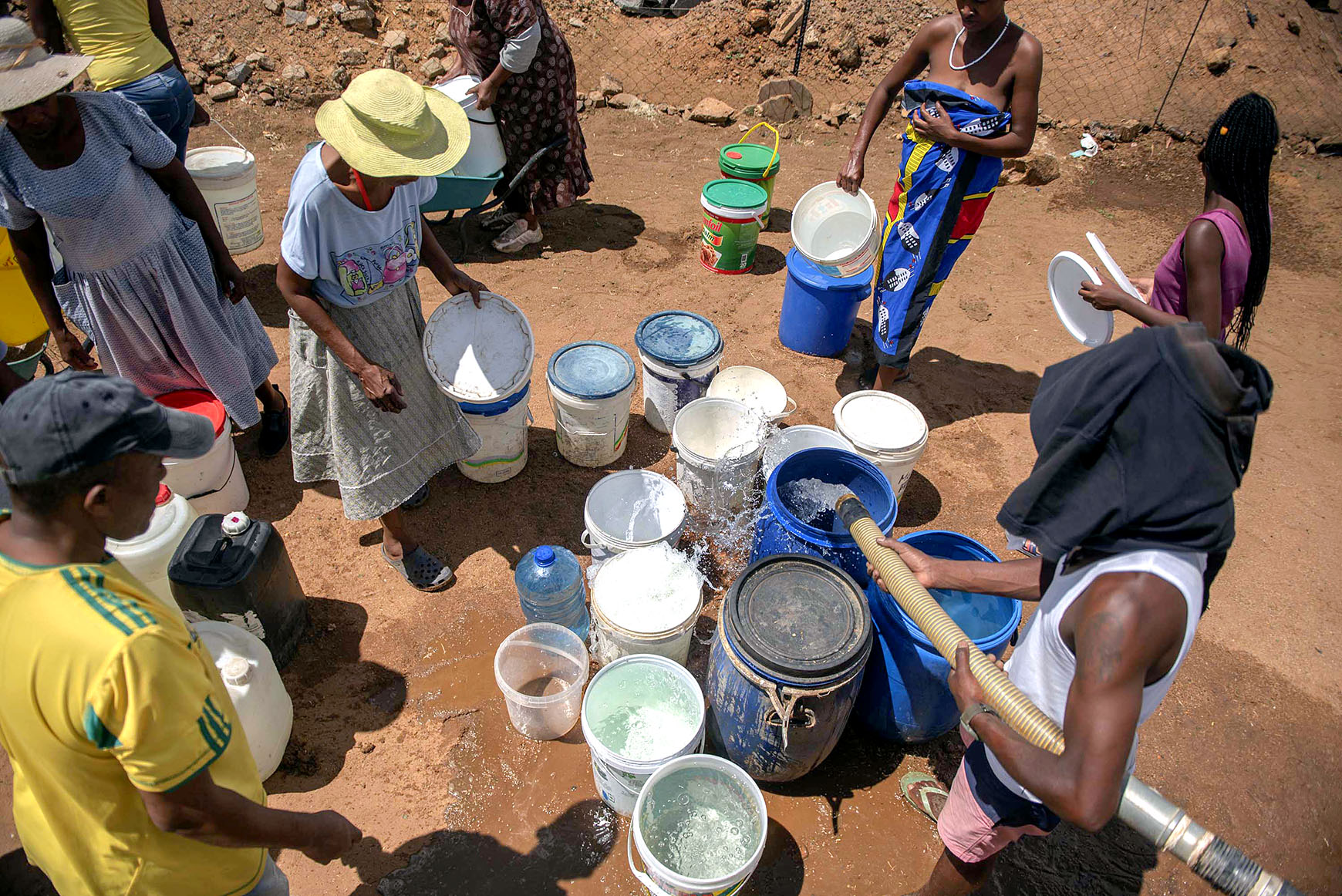
 Residents of Mandela Village, Hammanskraal, collecting water from a communal water tanker. (Photo: Alet Pretorius)
 Over a number of years, the Cradle of Humankind – a Unesco World Heritage Site that’s home to rich archaeological evidence of humanity’s origin story – has seen outflows of sewage and acid mine drainage into its rivers.
Toxic chemicals from industrial processes like coal or metal mining bleed into natural resources, endangering the integrity of the land itself as well as the safety of the humans and non-humans who depend on it.
This ecological emergency has now become a catalyst for creativity that addresses the physical and metaphorical values of our soil and water. Thus, Soil & Water (a project hosted at NIROX Sculpture Park, that brings together more than 40 artists from around the world) is, as the title suggests, about the balance between these two fundamental substances and the wider anxieties at play around the climate crisis.
This entanglement of art, history and the environment evokes crucial questions about our interconnectedness with and responsibility to the earthly materials that sustain the planet’s life. But more than being the foundation of life, water and soil are bearers of history. And what better place to experience this exchange between creativity and the environment than the Cradle of Humankind, where the land holds and reveals traces of our collective past as humans.
/file/dailymaverick/wp-content/uploads/2025/11/Mudflames-made-from-oil-and-ritual-clay-on-canvas-by-Jacob-van-Schalkwyk_Soil-Water.jpg "Mudflames made from oil and ritual clay on canvas by Jacob van Schalkwyk. (Image: Soil & Water)")
/file/dailymaverick/wp-content/uploads/2025/11/Maria-Lantz-collages-jigsaw-puzzles-to-create-a-new-mosaic-like-image-representing-the-sea-which-separates-and-holds-us-together_Soil-Water.jpg "Maria Lantz collages jigsaw puzzles to create a new, mosaic-like image representing the sea, which separates and holds us together. (Image: Soil & Water)")
Among its participants are several South African artists and artistic collectives whose pieces embody Soil & Water’s central themes.
Alet Pretorius, for instance, brings to Soil & Water a photographic representation of the fragile intersection between human survival and the environment, particularly in relation to our dependence on water.
One of Pretorius’s photos documents residents of Mandela Village in Hammanskraal as they collect water from a communal tanker. The overhead shot focuses on a dozen or so buckets being filled – its composition centralising, in a literal sense, the need for water. On the outskirts of the frame, even more buckets are scattered among residents waiting their turn to replenish their stock of this vital resource.
The image captures not only the reality of water scarcity in South African communities, but also how this reality is inseparable from ecology and politics.
Multidisciplinary artist Seretse Moletsane, on the other hand, expresses the land’s therapeutic potential through his work, bringing to the fore a contemplation on ancestral heritage, spirituality and belonging.
/file/dailymaverick/wp-content/uploads/2025/11/Seretse-Moletsane-uses-earth-based-materials-to-reflect-on-heritage-and-spirituality_Soil-Water.jpg "Seretse Moletsane uses earth-based materials to reflect on heritage and spirituality. (Image: Soil & Water)")
/file/dailymaverick/wp-content/uploads/2025/11/Listen-to-Me-is-a-sound-sculpture-by-Christophe-Fellay-enlarging-the-groove-of-a-vinyl-record-and-etching-it-into-the-earth_Soil-Water.jpeg "Listen to Me is a sound sculpture by Christophe Fellay, enlarging the groove of a vinyl record and etching it into the earth. (Photo: Soil & Water)")
/file/dailymaverick/wp-content/uploads/2025/11/Caroline-Le-Mehaute-exhibits-a-portrait-of-different-soils-taken-from-three-various-locations-in-the-Cradle-of-Humankind_Soil-Water.jpg "Caroline Le Méhauté exhibits a portrait of different soils taken from three locations in the Cradle of Humankind. (Image: Soil & Water)")
Moletsane, whose own first name means “mud”, transforms soil and cow dung into an artistic medium. The earthy tones stretch out to create a meditative landscape – flecks of plant fibres a reminder of the material’s organic source, while sharp blue paint strikes through the scene.
The work is an invitation to consider how cultural practices might shape our relationship to place and land.
Soil & Water also brings together artists from beyond South Africa. The diversity among the contributors serves to channel a range of perspectives into a multidimensional conversation, forging connections between different systems of knowledge, science and artistic expression.
Part of the exhibition is Spanish artist Paula Anta’s Plasticised Trees. Wrapped and heat-bonded to the bark of barren trees, brightly-coloured plastic becomes a second skin for this gathering of slender forms. Blue, yellow and red in colour, the plastic references European waste-sorting colour codes as well as the omnipresence of corporate branding in South Africa.
Anta’s reworking of plastic waste into a visual art piece reveals a dichotomous nature within the material: its pervasive, destructive presence in our ecosystems existing in contrast to its unexpected ability to play a role in a process of restoration.
The artists participating in Soil & Water are, however, not only examining the physicality of land itself.
/file/dailymaverick/wp-content/uploads/2025/11/Paula-Antas-Plasticised-Trees-turns-plastic-waste-into-a-visual-art-piece_Soil-Water.jpg "Paula Anta's Plasticised Trees turns plastic waste into a visual art piece. (Photo: Soil & Water)")
Argentinian artist Diego Masero takes as his point of departure the concept of home, resulting in an installation that South Africans can immediately recognise: a shack made of corrugated iron.
Built on a wooden platform suspended over a lake in the Cradle of Humankind, Home confronts our country’s continual housing crisis that sees millions of people living in informal settlements built from scrap materials. It’s a structure that is inherently vulnerable to the natural elements, yet in its golden colour and aquatic location, Masero references the famous Golden Pavilion of Kyoto, Japan – an embodiment of luxury and enlightenment.
Home is at once both eye-catching and poignant, capturing an interplay between instability and resilience, which offers a social commentary on inequity, dignity and innovation in South Africa.
As the above artists demonstrate, the making of art is rarely a coincidence. Each creative decision is made with purpose, shaping messages that speak to and even challenge contemporary society. Soil & Water’s curation is a realisation of that intentionality.
More than an art exhibition, the Soil & Water project aims to be a series of artist residencies and public programmes such as dialogues, performances and community engagement initiatives.
/file/dailymaverick/wp-content/uploads/2025/11/Home-by-Diego-Masero-is-a-social-commentary-on-inequity-dignity-and-innovation-in-South-Africa_Soil-Water.jpg "Home by Diego Masero is a social commentary on inequity, dignity and innovation in South Africa. (Photo: Soil & Water)")
One such initiative is the Waterstories programme, a three-year community engagement project.
Waterstories brings students from the University of Pretoria’s School of Arts and the Department of Plant and Soil Sciences to the Kromdraai Impact Hub for a cross-disciplinary research and creative education workshop. The programme endeavours to create artistic realisations of water’s role as an essential resource and as a symbolic element.
In an environmental crisis where the pollution of natural and life-giving resources is not always visible to the naked eye, art becomes a way of making tangible these obscured hazards – calling us to bear witness to and seek justice for the human-made threats to our earthly home. DM
Soil & Water exhibition takes place from 1 November 2025 to April 2026 at NIROX Sculpture Park in the Cradle of Humankind. This curatorial project is a collaborative development between Professor Johan Thom from the University of Pretoria’s Department of Visual Art, Professor Basak Senova from the University of Applied Art Vienna, and the NIROX Foundation in South Africa.